
Virtual temples go viral in South Korea, Vietnam: What sets the games apart?
From bowing before Buddha statues to collecting rewards and leveling up, virtual temple games are taking social media by storm in South Korea and Vietnam, blending Buddhist traditions with digital entertainment and a touch of humor.
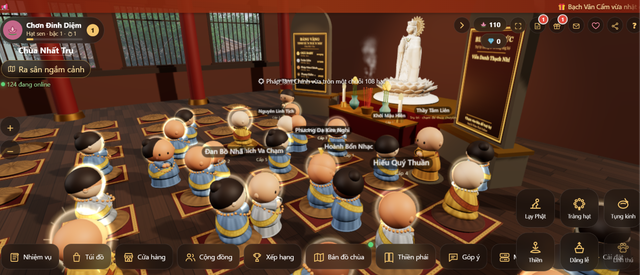
The game draws large numbers of users to experience visiting a temple in a virtual environment. Photo: Screenshot
South Korea's AI-powered virtual temple Sansa reportedly attracted more than 600,000 visits within three days, while Vietnam's browser-based 3D game Niem Phat Online (Online Buddhist Chanting) has also sparked curiosity and laughter among social media users.
From exploring temple grounds to performing Buddhist rituals, both platforms bring familiar religious practices into the digital world, each with its own interactive features.
Vietnam's virtual temple: Pray, play, and level up
Niem Phat Online allows users to create avatars, explore temple grounds, and enter worship halls, where they can bow before Buddha statues, chant scriptures, count prayer beads, or meditate.
Players can also light incense and candles, offer flowers, ring temple bells, and release floating lanterns carrying their wishes.
Unlike a conventional virtual temple tour, the game incorporates role-playing features, including daily and weekly quests, character levels, collectible items, and leaderboards.
Players can earn lotus flowers by completing quests, checking in, and participating in various activities, while a merit-point system tracks their progress.
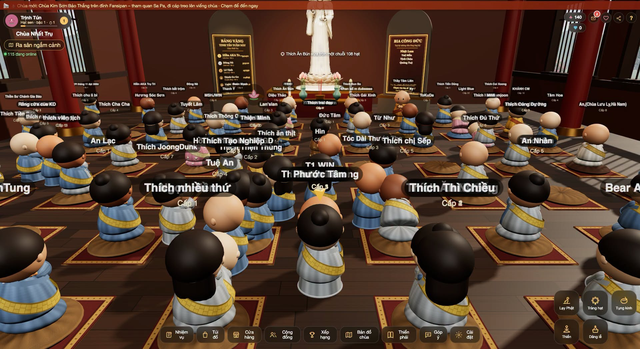
According to an in-game disclaimer, merit points are used to track players' activities and do not reflect their actual spiritual merit or religious practice in real life. Photo: Social media
The game also features a map of temples across northern, central, and southern Vietnam, complete with 3D models and information about each location.
The unusual blend of Buddhist traditions and gaming mechanics has sparked a wave of humorous reactions online.
"There's nowhere left to sit and meditate, and when I went outside to collect golden lotus flowers, another player snatched them first," one user joked.
"If I reach VIP level 13, do I get to become the abbot?" another quipped.
Others joined in, joking that losing Wi-Fi would mean starting their merit accumulation all over again, while one suggested adding a combat feature between temples.
The growing interest in virtual temple games reflects how familiar cultural and religious practices are being reimagined as interactive digital experiences.
Beyond their novelty, the games have gained attention through players' humorous reactions, turning virtual Buddhist activities into an unexpected source of online entertainment.
South Korea's virtual temple: A peaceful escape with a playful twist
In South Korea, an AI-powered virtual Buddhist temple called Sansa has attracted more than 600,000 visits since its launch, with over 100,000 people accessing the platform daily.
The website was created by Park, a 26-year-old job seeker, using vibe coding, an AI-assisted software development approach.
Park said the idea came to him during his job search, when he wanted to visit a Buddhist temple to find peace of mind but lacked the time and energy to do so.
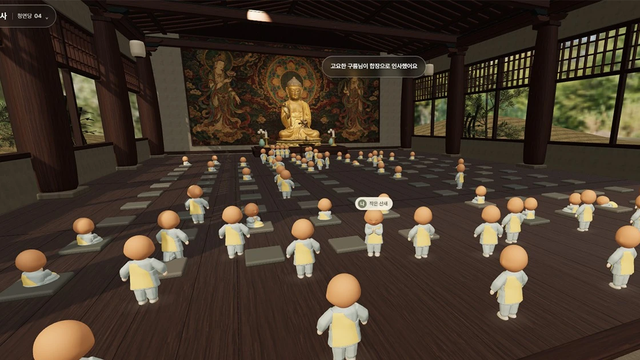
Online temple games are attracting attention on social media. Photo: Sansa
Unlike many online platforms, Sansa requires no lengthy registration process.
Instead, users are automatically assigned a chubby novice monk avatar dressed in traditional robes, along with a randomly generated Korean name that is both poetic and humorous, such as "Emotion Tree."
Once inside, users can stroll around the temple grounds, greet fellow visitors with their palms pressed together, bow on prayer cushions, count prayer beads, and listen to Buddhist chants.
The platform also allows users to perform the traditional ritual of 108 prostrations and offer prayers from home.
Adding a playful touch, the virtual temple even has a queueing system, requiring visitors to wait their turn before entering the main worship hall.
While the popularity of virtual temples may appear to be just another quirky social media trend, it also points to young people's growing interest in accessible spaces for spiritual reflection amid their busy lives.

Ngoc Nguyen - Mai Nguyet - Binh Minh / Tuoi Tre News
Link nội dung: https://news.tuoitre.vn/virtual-temples-go-viral-in-south-korea-vietnam-what-sets-the-games-apart-103261102090614184.htm