
Visit by Vietnam’s top leader to Thailand aimed at deepening strategic partnership
Vietnamese Party General Secretary and State President To Lam arrived in Thailand on Wednesday for an official visit expected to strengthen the Vietnam–Thailand Comprehensive Strategic Partnership through deeper cooperation in digital economy, supply chains, green transition, and regional security.
At noon on Wednesday, the Vietnamese leader arrived at Udon Thani International Airport, beginning his official visit to Thailand through Friday.
This is the first visit by Party General Secretary and State President To Lam to Thailand in his role as Vietnam’s Party and state leader.
The trip is expected to further translate the Vietnam–Thailand Comprehensive Strategic Partnership into concrete outcomes.
Thailand was not chosen by chance as Vietnamese Party General Secretary and State President To Lam’s first ASEAN destination.
Combined with his trips to Singapore for the Shangri-La Dialogue and to the Philippines, the visit forms part of a broader regional diplomatic tour with strategic depth.
International relations experts in Vietnam and abroad viewed the visit as a clear signal of Hanoi's commitment to bilateral ties with Bangkok and to ASEAN’s central role.
Professor Thitinan Pongsudhirak of the Institute of Security and International Studies at Chulalongkorn University in Thailand said the visit was aimed at building trust through tangible results.
“In the context of an unfavorable global geostrategic environment, both Thailand and Vietnam stand to gain more by standing closer together in a clearer manner, thereby demonstrating the combined weight and potential of the two countries. This will also help strengthen ASEAN unity and centrality,” he said.
Thitinan also emphasized that the new level of bilateral relations rests on a solid foundation, as Vietnam and Thailand are the two largest economies in mainland Southeast Asia and key Mekong countries.
Dr. Tran Thanh Huyen from the Faculty of Social Sciences and Humanities at Ton Duc Thang University in Ho Chi Minh City said the top Vietnamese leader's choice of Thailand as the first ASEAN destination out of the three countries reflects an emphasis on coordination with key regional members to reinforce the bloc’s unity and central role.
According to Huyen, the visit is an important step in implementing the Comprehensive Strategic Partnership framework, reflecting not only diplomatic symbolism but also growing political trust between the two important ASEAN nations.
“In the context of intensifying strategic competition among major powers, ASEAN continues to be a strategic priority in Vietnam’s foreign policy,” she said.
Both experts expressed expectations that the visit would produce more substantive, strategic, and sustainable outcomes centered on three key pillars.
The first pillar is the digital economy and supply chains.
Huyen noted that Vietnam and Thailand are highly complementary partners.
As ASEAN pushes forward the ASEAN Digital Economy Framework Agreement, the region’s digital economy is projected to reach around US$1 trillion by 2030.
Vietnam and Thailand could become leading forces in shaping the region’s digital economic space.
Thitinan also said there remains strong potential for cooperation in supply chain integration, digital connectivity, and logistics linkages.
The second pillar is non-traditional security and the Mekong–Lancang cooperation framework.
Amid global instability, Huyen said bilateral cooperation should expand toward building strategic resilience against non-traditional challenges such as climate change, energy crises, cybersecurity threats, and transnational crime.
Thitinan added that within the Mekong–Lancang Cooperation framework, Vietnam, located downstream, is among the countries most heavily affected and therefore has a clear interest in having a stronger voice regarding upstream dam construction and water resource use.
“The Mekong is precisely the space where Vietnam and Thailand can achieve more together,” he stressed.
The third pillar is digital and green transformation.
Huyen said both countries are pursuing green development and digital economy strategies, creating opportunities for cooperation in renewable energy, smart cities, AI governance, and e-commerce.
“If ASEAN wants to strengthen long-term resilience, it cannot rely solely on traditional economic growth but must invest in technological capacity, digital governance, and sustainable development. Vietnam and Thailand can absolutely play leading roles in this process,” she said.
From partners to strategic companions
The Vietnam–Thailand Comprehensive Strategic Partnership marks a major step forward in bilateral relations.
The two countries share many geographical and economic similarities as key ASEAN members and nations connected by the Mekong River basin.
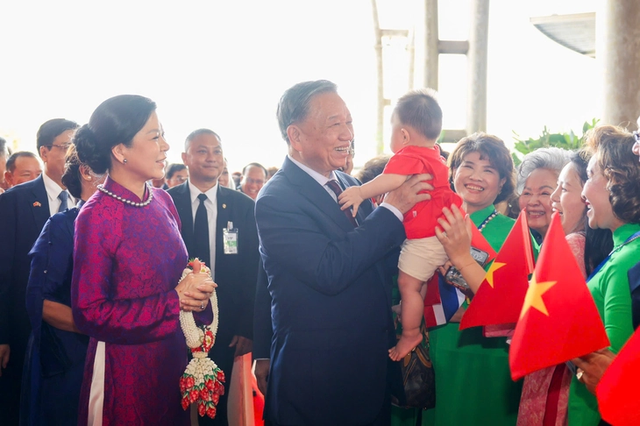
Vietnamese Party General Secretary and State President To Lam and his spouse meet overseas Vietnamese in Udon Thani, Thailand, May 27, 2026. Photo: Nguyen Khanh / Tuoi Tre
Thitinan concluded that the Thailand–Vietnam partnership still has considerable room for growth.
The two countries can leverage this relationship within ASEAN to rebalance the U.S.–China rivalry.
While there are competitive elements between Thailand and Vietnam, opportunities for cooperation and connectivity in supply chain integration, digital connectivity, and logistics linkages remain far greater, he said.
On Wednesday afternoon, Party General Secretary and State President To Lam, his spouse, and the Vietnamese high-level delegation arrived in Bangkok.
Thailand held a formal welcome ceremony for the Vietnamese leader and his spouse, marked by a 21-gun salute at Don Mueang International Airport, demonstrating the host country’s respect for the visit.
Earlier the same day in Udon Thani Province, home to a large Vietnamese community in Thailand, Party General Secretary and State President To, his spouse, and the Vietnamese delegation offered incense in tribute to late President Ho Chi Minh at a memorial site dedicated to him.
They later visited Ho Chi Minh’s House, which preserves memories of the late Vietnamese leader’s revolutionary activities in Thailand from 1928 to 1929.
In the guestbook at the memorial site, Party General Secretary and State President Lam wrote that the site is not only a sacred historical and cultural destination for the Vietnamese community in Thailand, but also a vivid symbol of the close bond between the two peoples over many decades.
He expressed appreciation for the community’s efforts in preserving and restoring the site and encouraged overseas Vietnamese to continue promoting patriotism, contributing to their homeland, and serving as a bridge for friendship and cooperation between the two countries.
Later, To Lam, his spouse, and the delegation met with staff from the Vietnamese Embassy and Consulate General in Thailand, along with nearly 600 overseas Vietnamese living, studying, and working in Thailand and representatives of the Vietnamese community from Laos.
At the meeting, the top Vietnamese leader said he always feels emotional when visiting Thailand because it was there, under the name Thau Chin, that President Ho Chi Minh spread patriotism, nurtured revolutionary ideals, and laid the groundwork for Vietnam’s national liberation movement.
He said the visit would focus on discussions with Thai leaders on future directions for cooperation, emphasizing that the Vietnamese community in Thailand remains an important bridge contributing to the friendship and the Comprehensive Strategic Partnership between the two countries.
He affirmed that recommendations from overseas Vietnamese would be compiled and forwarded to relevant agencies for consideration and appropriate solutions.
Thanh Ha - Ngoc Duc - Duy Linh / Tuoi Tre News
Link nội dung: https://news.tuoitre.vn/visit-by-vietnams-top-leader-to-thailand-aimed-at-deepening-strategic-partnership-103260528162009773.htm