
What makes Da Nang’s Han Market must-visit destination for foreign tourists
Han Market, one of the most popular tourist attractions in Da Nang City, draws thousands of international visitors every day with its unique blend of traditional market culture, tourist-friendly services and distinctive shopping experiences.
Among the many markets in Da Nang, Han Market stands out for its distinctive business model.
Although it operates as a traditional market, its primary customers are tourists, making it a unique shopping and cultural destination in the central Vietnamese city.
“We saw many posts in online travel communities recommending Han Market as the first place to visit in Da Nang,” said a South Korean tourist who was waiting for her ao dai (traditional Vietnamese long gown) to be tailored at the market on Thursday afternoon..
“Besides offering relatively affordable goods, the market feels like a showcase of local products.”
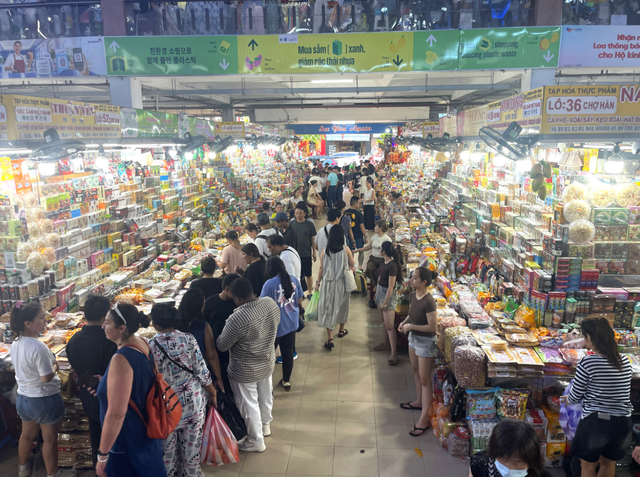
Han Market in Da Nang City is crowded with international visitors every day. Photo: Photo: Ba Dung / Tuoi Tre
A market where visitors feel safe
Situated between Bach Dang and Tran Phu Streets, two of Da Nang’s most prestigious and bustling thoroughfares, Han Market enjoys a prime location.
It is also conveniently located just around two kilometers from Da Nang International Airport.
Its appeal is further enhanced by its proximity to popular tourist sites, including Dragon Bridge and Da Nang Cathedral.
Han Market welcomes long streams of visitors every day without causing significant inconvenience to local residents.
Nguyen Trung Thanh, head of Han Market’s management board, said the market follows an unusual operating model.
It retains the character of a traditional marketplace while embracing a modern approach, using familiar trading practices and authentic shopping experiences to attract tourists.
Although relatively modest in scale, with some 800 stalls, Han Market has long received special attention and supervision from the Da Nang People’s Committee and relevant municipal departments.
Every stall owner is expected to help preserve the city’s image and reputation.
Ensuring that visitors have a positive experience is a top priority, and vendors are expected to avoid any behaviour that could disappoint tourists.
Shopping destinations often face problems such as overcharging, pickpocketing and unfriendly interactions between vendors and customers.
However, at Han Market, such incidents are kept to a minimum, according to Thanh.
“This is not only a shopping market, but also a tourist attraction,” he said.
“Security is therefore tightened through close coordination among the relevant authorities.
“We are delighted that security-related incidents have been kept to an absolute minimum over the years.
“Visitors are assured that if they accidentally lose or leave behind their belongings at the market, efforts will be made to return them.”
Han Market also takes a different approach to product returns.
While purchases at traditional markets are generally difficult to return, or can only be exchanged within a few days, the market encourages vendors to offer greater flexibility.
Prices are not artificially inflated, while customers who are dissatisfied with their purchases can request a refund.
Thanh cited the example of a South Korean customer who purchased an ao dai but, after returning home, decided 15 days later that she was unhappy with it.
The shop owner still agreed to refund her money, accepting the financial loss in order to satisfy the customer and protect Da Nang’s reputation as a welcoming destination.
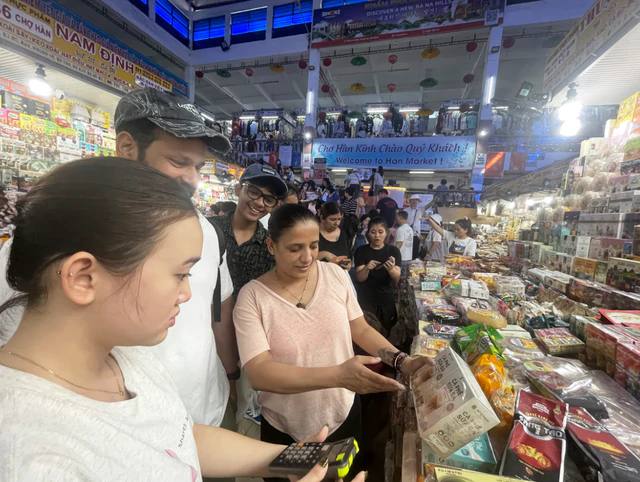
Indian tourists shop at Han Market, November 5, 2026. Photo: Ba Dung / Tuoi Tre
Express ao dai tailoring: ready in just 30 minutes
Although Han Market is a traditional marketplace, it has become an established destination on Da Nang’s tourism itineraries and in promotional materials produced by the city’s tourism authority and international travel companies.
According to statistics, the market welcomes over 7,000 to 8,000 visitors a day during peak periods.
In the past, Han Market was considered a must-visit destination primarily among South Korean tourists.
In recent years, however, its visitor base has expanded significantly, including travellers from India, China, Taiwan and Malaysia, among other markets.
One of the market’s most popular products is undoubtedly the ao dai.
Its distinctive express-tailoring service has become a particular attraction for international visitors.
Rather than having a single tailor handle an entire garment, which can take several hours, the market’s closely positioned tailors operate through an assembly-line system, with different workers responsible for specific stages of production.
Once customers select a design and provide their measurements, they are free to explore the market and shop for other items.
Just 30 minutes later, they can return to collect their newly tailored ao dai.
The service offers tourists a convenient way to experience Vietnamese traditional clothing without having to spend hours waiting.
A group of Indian tourists shopping with friends at Han Market on Thursday afternoon said they were particularly impressed by the experience.
To them, the market felt like a supermarket while retaining the vibrant colors, atmosphere and distinctive character of a traditional local marketplace.
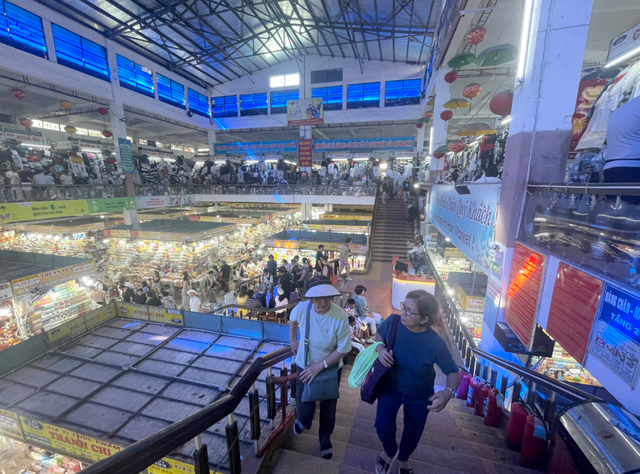
Crowds of international tourists visit Han Market. Photo: Ba Dung / Tuoi Tre
Building long-standing culture of hospitality
Han Market’s management board regularly provides vendors with training in foreign languages, particularly Korean and English, as well as professional skills for welcoming and serving international tourists, Thanh said.
The management approach also links vendors’ business interests directly to their responsibilities, making it particularly effective.
Requirements concerning public security, customer service and pricing are clearly stipulated in the agreements signed by stallholders.
Depending on the severity of a violation, vendors can be suspended from doing business for between three and 30 days.
In the most serious cases, their stall rental contracts may be terminated.
“Vendors are not simply vendors selling goods. They are also ambassadors who contribute to introducing the image and identity of Da Nang to visitors.”
Tieu Bac - Thai Ba Dung / Tuoi Tre News
Link nội dung: https://news.tuoitre.vn/what-makes-da-nangs-han-market-must-visit-destination-for-foreign-tourists-103261106164448695.htm