
When Vietnamese children go online every day, are parents truly present?
There was a time when many Vietnamese parents believed online safety was someone else’s problem, trusting that their well-behaved children were immune. Yet the moment such confidence takes hold is also when the protective line shielding children from fake news, harmful content and toxic information online becomes dangerously thin.
Last school year, teachers and parents whispered anxiously about a photo taken by a seventh grader.
The image, awkwardly posed, was meant only for a private group of close friends. Somehow, it leaked beyond that circle.
Conversations flared, shares multiplied, and before long adults were alerted.
Family members and teachers intervened quickly, preventing wider circulation.
More importantly, they sat down with the child–talking, advising, explaining the risks of the digital world and how to protect oneself online.
Fortunately, the incident did not spiral into lasting harm, but many similar cases will not end so neatly.
For years, public concern around online safety has focused on harmful comments, inflammatory posts or the spread of bad information.
Yet the dangers lurking in cyberspace have taken on darker, more disturbing forms.
Many Vietnamese have not forgotten the alarm raised in 2024 by the case of a sixth-grade girl in Da Nang City.
She was lured by predators who manipulated her photos into explicit images, then threatened to release them unless she complied.
The child was sent obscene links, ordered to read pornographic stories aloud, and later coerced into video calls that were secretly recorded to fabricate sexual content.
Terrified, she eventually told her parents, who reported the crime to authorities.
Do parents truly follow their children’s digital footprints?
Australia made global headlines by becoming the first nation to ban children under 16 from using social media, a law set to take effect at the end of 2025.
The move sparked a domino effect worldwide, forcing governments, educators and parents alike to reconsider the impact of digital spaces on children’s development.
In Vietnam, many parents seem to have handed their children a vast virtual world without adequate safeguards.
There is no denying the practical benefits of social media.
However, not everyone has the skills to use it wisely.
Each day, educators watch with unease as students drift into unhealthy online habits–chasing toxic trends, consuming violent content, or parroting vulgar language.
No age group can confidently claim immunity from online manipulation.
Middle-school students navigating rapid psychological and emotional changes are particularly vulnerable.
Their ability to distinguish right from wrong, truth from fabrication, is still forming.
It is hardly surprising they rush to follow trends, share violent clips, or cheer on questionable online phenomena.
In classrooms, teachers try to counterbalance this.
When positive images or stories are presented, students often respond with blank, puzzled stares.
Lessons increasingly include discussions about the darker side of the virtual world: deceit behind suspicious links, manipulation hidden in edited images, and the harm inflicted by malicious comments.
Yet educators’ efforts are like drops in the ocean if parents remain disengaged from their children’s online lives.
Social media is a double-edged sword.
It can fracture real-life relationships, waste precious time, deepen loneliness and leave lingering psychological scars.
Parents need to know which influencers their children admire, which trends they chase, which websites they visit, how they speak online, and whether the content they share aligns with social norms.
The world is watching Australia’s bold experiment, while some nations are beginning to speak up.
Therefore, Vietnam cannot afford to stand on the sidelines.
Waiting for tech companies or legal frameworks alone will not create a safe digital environment.
Building digital armor for children is urgent.
It is parents who must protect their children from the swirling vortex of harmful content.
Also, parents themselves must be digitally literate.
Before handing a child a smartphone, they should understand age restrictions, platform rules and community standards.
They need to equip both themselves and their children with the skills to become responsible digital citizens.
Children must be taught basic online safety rules: never share personal information, never click suspicious links, never befriend strangers, never spread explicit images, and never engage in hateful commentary.
Time spent being friends with children online is not wasted.
Following their digital footprints with goodwill builds trust and understanding.
When children feel respected and heard, parents can guide them–knowing who they interact with, how they communicate, and when intervention is needed to remove unsafe influences.
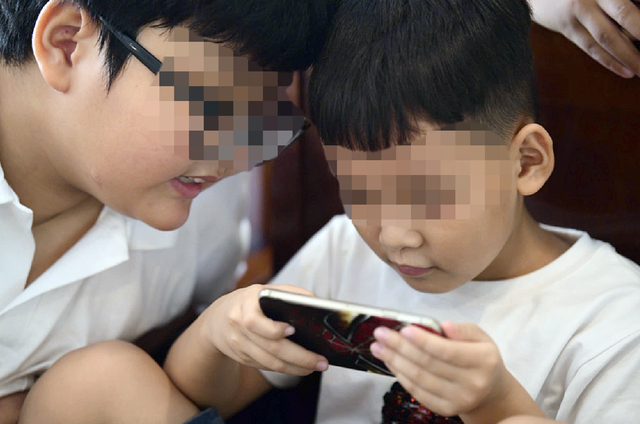
Children should not be left alone with internet-enabled devices without parental management. Photo: Q. Dinh / Tuoi Tre
Dangers remain real and complex
Closed groups sharing explicit material, forums fueled by hatred or reckless behavior, violent videos circulating freely, and extortion schemes involving sensitive images all continue to surface daily.
Evil creeps closer through countless harmful links, waiting to trap children in fear and obsession.
Worse still, it reaches out with calculated intent–tempting, staging and exploiting innocence for money or hollow online fame.
Tieu Bac - Thanh Nguyen / Tuoi Tre News
Link nội dung: https://news.tuoitre.vn/when-vietnamese-children-go-online-every-day-are-parents-truly-present-103260128154626853.htm