
Why does SE Asia fight for homegrown ASEAN Cup, in face of FIFA-ruled alternative?
Why is Southeast Asia still obsessed with its 'homegrown' football tournament, the ASEAN Cup, now in its 30th edition, while remaining skeptical of a global giant's intervention like the FIFA ASEAN Cup?
Established in 1996 by the ASEAN Football Federation (AFF) as a biennial regional flagship, the tournament, officially recognized by FIFA as an 'A' international event, has evolved through several eras, starting as the Tiger Cup before becoming the long-standing AFF Cup and today's ASEAN Hyundai Cup.
Over thirty years and multiple rebranding cycles, it has stood as the definitive battleground for Southeast Asian football bragging rights.
Now reaching its 2026 edition, this 30-year legacy finds itself at a historical crossroads as FIFA prepares to introduce its own rival format.
Yet, that three-decade legacy is facing a seismic shift. The FIFA Council has officially approved the brand-new 'FIFA ASEAN Cup,' marking a historic milestone as an official FIFA-sanctioned tournament for the region.
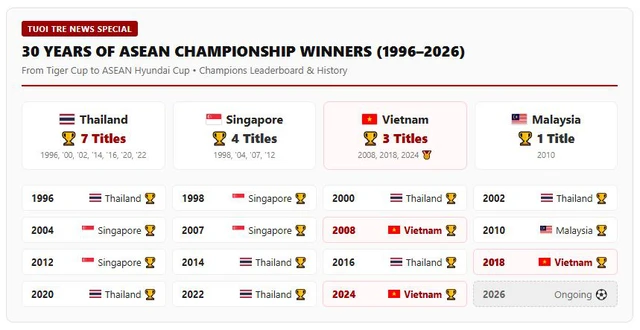
Infographic: Tuoi Tre News
Planned to launch its inaugural edition during the official FIFA Matchday window in September–October 2026, the global governing body promises to elevate Southeast Asian football with higher-quality matches, mandatory club releases, and unprecedented global exposure.
But Southeast Asian football aficionados might point out that no one actually asked if they wanted it in the first place.
More than a tournament
To understand the madness, one must look beyond the pitch. As analyst Sudhir Menon Chembazhi in a piece for The Hindu last month, football in nations like Indonesia is discussed with the 'emotion of a religion.'
While the global football media fixates on the UEFA Euro or the FIFA World Cup, the ASEAN Championship has spent three decades evolving into a shared regional language.
This 'crazy' factor is driven by three distinct sociological forces.
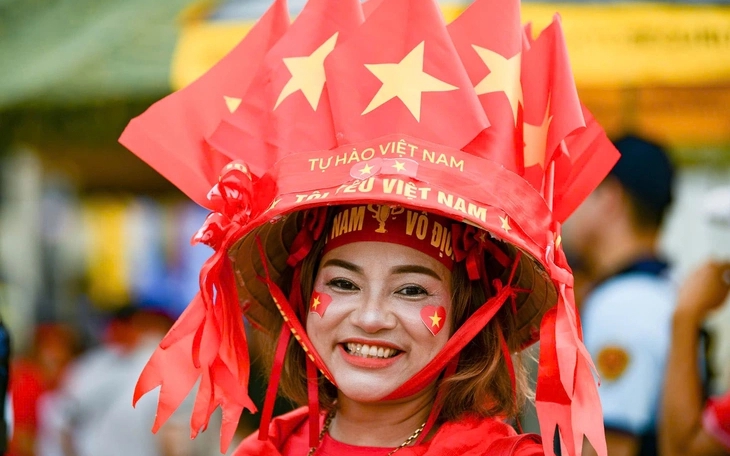
First, as Chembazhi, director of two football clubs in Cambodia and Singapore, points out, the tournament acts as a live map of Southeast Asian mobility.
Because millions of people cross borders within the region for work, such as Vietnamese communities in Singapore or Indonesian workers in Malaysia, every away fixture doubles as a home game for those working abroad.
Second, from the players' perspective, the stakes could not be higher. As Singapore captain Hariss Harun told The Straits Times: footballers in this region see it as their 'form of World Cup' because it is the ultimate gathering of neighbors.
Finally, no other regional tournament in Asia comes close to such level of 'passion and excitement' as the Southeast Asian tournament, according to John Duerden, the author of the 'How Football Explains Asia' Substack.
He recalls the deafening noise of 80,000 fans in Jakarta's Gelora Bung Karno Stadium and the hundreds of thousands who flooded the streets of Hanoi and Ho Chi Minh City to celebrate Vietnam's 2018 triumph.
Lukewarm welcome for FIFA
If the traditional tournament represents the 'soul,' the proposed FIFA ASEAN Cup is marketed as the 'solution.' But is it necessary? Logically, yes; sentimentally, no.
FIFA's version, spearheaded by President Gianni Infantino, aims to officially place Southeast Asian football onto the global calendar.
The primary justification for involvement of the football's governing body rests on the FIFA International Match Calendar.
Writer Muhammad Firman explains on The Jakarta Post that because the traditional AFF Championship falls outside this official window, professional clubs, especially in Europe, are under no obligation to release their players.
This has long been a 'curse' for regional national teams, preventing sides like Indonesia, Vietnam, or the Philippines from fielding their absolute strongest, European-based squads.
A FIFA-sanctioned event forces club compliance, instantly elevating the technical quality on the pitch. Furthermore, reports indicate the FIFA version offers up to US$1 million in prize money for the champions, dwarfing the traditional $300,000 purse.
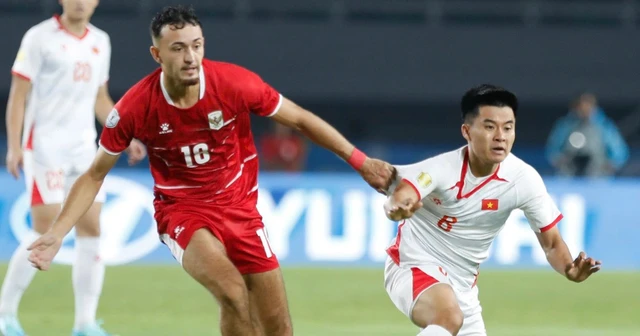
Vietnam (white) and Indonesia players fight for the ball during an ASEAN Cup match. Photo: Anh Khoa
Despite the lucrative perks, public reception has been lukewarm at best.
On fan forums and social platforms, supporters have been brutally candid, arguing that FIFA is simply trying to extract commercial value from a region it previously neglected for decades.
More importantly, there is the alarming risk of player burnout.
Hariss Harun warned that inserting more fixtures into an already congested calendar is 'very tricky' for athlete longevity. Analysts increasingly agree that the two tournaments cannot peacefully coexist in the long run; eventually, one format will swallow the other.
Fresh off their national team's march to the ASEAN Cup 2026 semifinals, Thai media outlets are redirecting their affection back to the very homegrown tournament they once dismissed as declining.
In late July, Thairath had openly favored the new venture, dismissing the traditional championship as structurally outdated compared to FIFA's modern alternative.
Yet just this week, the major Thai outlet executed a swift U-turn, criticizing world football's governing body for being 'overly obsessed with money,' while Siamsport voiced shock at the staggering price tag for an unproven tournament.
The culprit behind this sudden change of heart? FIFA's exorbitant broadcast rights fee, reported at an eye-watering 100 million baht (roughly US$2.9 million).
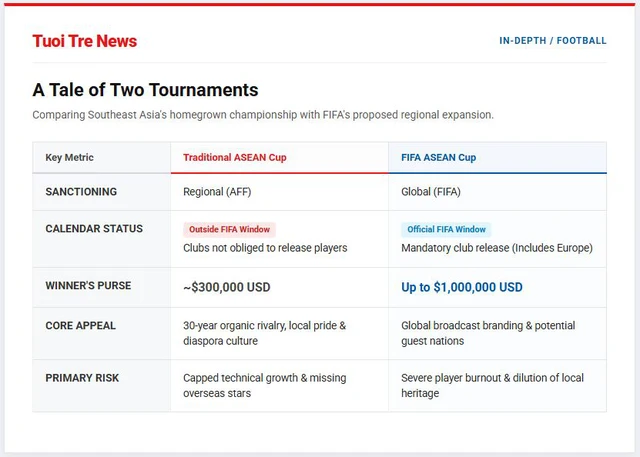
Infographic: Tuoi Tre News
Soul vs. status
The irony is palpable. Southeast Asia is wildly passionate for the ASEAN Cup precisely because it belongs to them, self-hosted, self-played, and forged through decades of intense, bitter rivalries.
FIFA's alternative, which has even floated inviting non-ASEAN guest nations like India or China, feels like a sterile, globally branded product trying to claim space over something that grew naturally from local soil.
As Substack author Duerden acutely notes, the traditional tournament's immense popularity has been both a blessing and a curse.
While it provides the lifeblood that keeps Southeast Asian football thriving, it can also trap national teams into limiting their ambitions to merely being 'the best in ASEAN' rather than evolving into true continental powerhouses.
Is a FIFA ASEAN Cup logistically necessary for ranking points and player availability? Perhaps.
But as the 2026 semifinals kick off, one truth remains undeniable: tradition is not easily replaced.
For now, Southeast Asia remains fiercely loyal to its homegrown identity, while treating the global giant's arrival with the quiet suspicion reserved for an uninvited guest at a family reunion.
Scheduled for September 24 to October 4, 2026, the proposed FIFA ASEAN Cup features a two-tiered format: a top-tier 'Premier' division consisting of eight teams, including host Indonesia, Thailand, Vietnam, and guest nation India, alongside a 'Challenge' tier for nations like Cambodia and Laos. Despite FIFA's promises, the event remains mired in controversy over its actual competitive appeal, commercial viability, and aggressive pricing strategy.
Son Luong / Tuoi Tre News
Link nội dung: https://news.tuoitre.vn/why-does-se-asia-fight-for-homegrown-asean-cup-in-face-of-fifa-ruled-alternative-103260812133200769.htm