
Why does Vietnam struggle to cut interest rates despite its $410bn stock market?
Vietnam's heavy reliance on bank loans is putting pressure on banks' funds and pushing up interest rates. With outstanding loans already equal to 145 percent of GDP, experts say the country needs to make better use of its growing VND10.7 quadrillion (US$410 billion) stock market to help businesses raise capital.

Vietnam needs to diversify its funding sources to ease pressure on the banking system. Photo: Quang Dinh / Tuoi Tre
The growing demand for loans has made it harder for banks to secure enough funds, highlighting the need to develop alternative financing channels for businesses.
Lowering interest rates and investor losses from IPOs
To bring down interest rates, Vietnam needs to reduce its heavy reliance on bank loans by expanding medium- and long-term funding channels through stock and bond issuance.
Tran Hoang Son, head of market strategy at VPBank Securities (VPBankS), said Vietnam's stock market has significant room to grow as a source of medium- and long-term capital for the economy, helping ease pressure on the banking system.
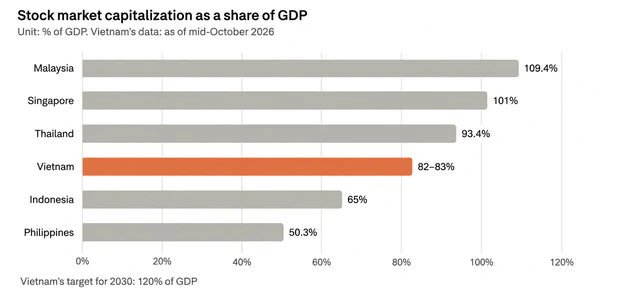
By the end of September 2026, the stock market's capitalization had reached approximately $404 billion (over VND10 quadrillion). By mid-October, it had risen to around VND10.7 quadrillion ($413.89 billion), equivalent to 82-83 percent of GDP.
This ratio was higher than Indonesia's 65 percent and the Philippines' 50.3 percent, but remained below Thailand's 93.4 percent, Singapore's 101 percent, and Malaysia's 109.4 percent.
Data: VPBankS
Vietnam aims to raise its stock market capitalization to 120 percent of GDP by 2030, with an additional VND5.4 quadrillion (about $209 billion) expected to be raised through the market, double the amount recorded during 2020-25.
Data: VPBankS
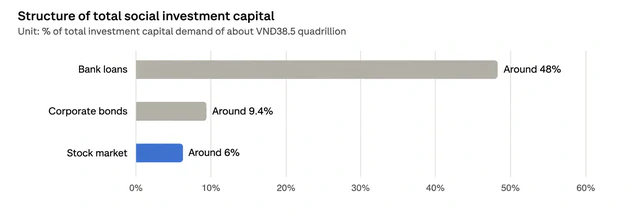
The country's total investment needs are estimated at VND38.5 quadrillion ($1.49 trillion) over the period.
Under the projected funding structure, bank loans would still account for around 48 percent of total investment capital, compared with just 6 percent from the stock market and 9.4 percent from corporate bonds.
"This gap shows there is plenty of room for growth, but bridging it will require long-term investment rather than relying on short-term capital," Son said.
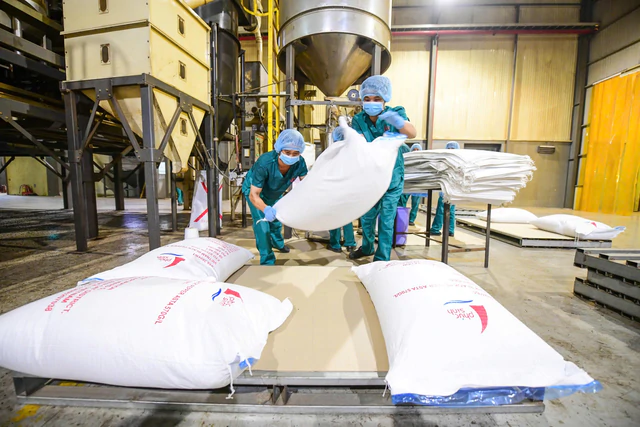
Capital-raising channels have become more effective for businesses, but small and medium-sized enterprises still struggle to attract investors. Photo: Quang Dinh / Tuoi Tre
According to Son, several factors have prevented Vietnam's stock market from attracting long-term investment.
Many initial public offerings (IPOs) and additional share issuances in recent years have failed to deliver the returns investors expected. Periods of sharp market volatility have also weakened investors' confidence in making long-term commitments.
Dang Tran Phuc, chairman of AzFin Vietnam JSC, said this is a major concern for many investors in Vietnam's stock market, particularly those participating in IPOs.
AzFin Vietnam's review of past IPOs found that investors in more than 80 percent of the offerings generally suffered losses one year after the shares were listed.
Vietnam urged to repeat success of major state divestments
Son said attracting long-term investment, particularly from international funds, requires more high-quality stocks on the market.
Major investment funds typically look for companies of sufficient size, with sound financial health, clear growth prospects, and strong corporate governance. Stocks also need sufficient liquidity to allow funds to buy and sell shares or adjust their portfolios easily.
For institutional investors, market capitalization reflects a company's size, but the number of shares actually available for trading determines whether they can buy or sell large holdings when needed.
Many large companies have low free-float ratios, with much of their stock held by related shareholder groups, making it difficult for major funds to invest on a large scale.
Son therefore called for increasing the proportion of shares genuinely available for public trading, excluding holdings by strategic investors and related parties, while improving liquidity and gradually easing foreign ownership limits.
To expand the supply of quality stocks, he proposed encouraging more high-growth companies, particularly in technology and emerging sectors, to list on the stock market.
He also urged faster equitization and state divestment at suitable enterprises, alongside greater transparency and improvements in business performance.
Son pointed to 2016-17, when major state divestments involving Vinamilk (VNM) and Saigon Beer-Alcohol-Beverage Corporation (Sabeco, SAB), together with the listing of major companies such as Airports Corporation of Vietnam (ACV), Vietnam Airlines (HVN), Petrolimex (PLX), and Vietnam National Textile and Garment Group (VGT), drew strong interest from domestic and foreign investors.
He said Vietnam needs to recreate such successful moments more frequently to attract greater investor interest and make its stock market more appealing.
Meanwhile, Phuc proposed several measures to improve IPO quality, encourage investors to make long-term commitments to businesses, and strengthen the stock market's ability to raise capital.
Vietnam Capital Forum 2026 set for Friday
Removing barriers to international investment will be a key focus of the Vietnam Capital Forum 2026, themed "New Capital Flows – A New Position for Vietnam's Stock Market."
Organized by Tuoi Tre (Youth) in coordination with the State Securities Commission of Vietnam, the forum is supported by TPBank, Techcombank, HDBank, Saigon-Hanoi Securities (SHS), Viettel, VPBank Securities (VPBankS), F88 Investment, and Van Phu Real Estate Development.
The event will take place in Ho Chi Minh City on the afternoon of October 30, bringing together representatives from regulatory agencies, FTSE Russell, investment funds, banks, securities firms, and financial experts from Vietnam and abroad.
A panel discussion titled "Vietnam Welcomes Global Capital" will examine barriers to foreign investment, including foreign ownership limits, market access, trading and settlement mechanisms, and exchange rate risk management.
Speakers will also discuss how Vietnam can capitalize on its recent market upgrade by FTSE Russell and make further improvements toward meeting MSCI's upgrade criteria, with the aim of attracting more long-term international investment.
Registration is available here.

Tuoi Tre News
Link nội dung: https://news.tuoitre.vn/why-does-vietnam-struggle-to-cut-interest-rates-despite-its-410bn-stock-market-103261029142410508.htm