
Why US crude oil remains limited option for Vietnam's refineries
Editor’s note: The following opinion piece is authored by Vu Ngoc Bao, an expert working at PetroVietnam Technical Services Corporation. The piece was originally published in Vietnamese and has been translated into English and edited by Tuoi Tre News for clarity, consistency, and coherence.
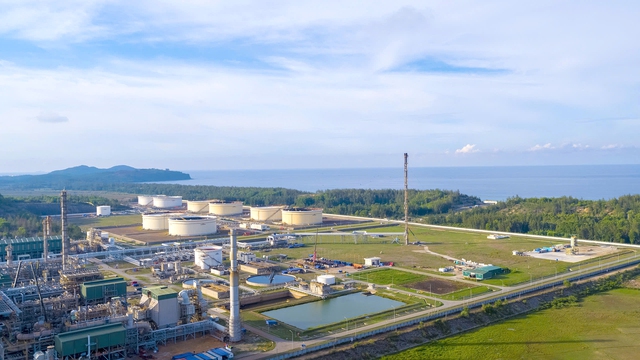
The Dung Quat refinery in Quang Ngai Province, central Vietnam. Photo: Tran Mai / Tuoi Tre
The Strait of Hormuz remains at risk of renewed tensions.
At the same time, crude oil supplies from the United States are abundant.
Why, then, have Vietnam's oil refiners shown limited interest in importing them?
Vietnam has two oil refineries.
While the Dung Quat refinery mainly processes domestically produced crude oil, the Nghi Son refinery primarily relies on crude imported from Kuwait, which is heavily exposed to tensions around the Strait of Hormuz.
However, changing crude oil feedstock is influenced not only by physical and chemical properties and refinery design, but also by international commitments.
Changing crude oil is not straightforward
Hundreds of crude oil grades are traded on the market, but they differ in several fundamental characteristics.
One is density. Light crude, which is lighter than water, has low viscosity and flows easily at room temperature, reducing the need for heating in pipelines.
It is also more volatile and easier to separate during distillation.
These properties allow refiners to produce larger volumes of high-value products such as aviation gasoline and motor gasoline.
Another key factor is sulfur content. Crude is classified as 'sweet' when sulfur content is below 0.5 percent.
Above that threshold, it is considered 'sour.'
The higher the sulfur content, the more acidic compounds the crude contains, increasing corrosion of refinery equipment and requiring more complex and costly refining technology to remove sulfur.
Every refinery is designed around highly specific assumptions about its feedstock, making it impossible to switch crude grades freely.
The Dung Quat refinery, operated by Binh Son Refining and Petrochemical (BSR), was designed to process Vietnam's core crude stream from the Bach Ho field, a light sweet crude with extremely low sulfur content.
However, production from the Bach Ho field has declined.
BSR has studied and analyzed about 67 different crude grades before gradually increasing the share of imported crude from Russia, West Africa, the United Arab Emirates, and Australia.
But the ability to process a crude grade does not necessarily mean it is profitable.
For example, a barrel of crude priced at US$70 may yield 70-80 percent high-value products, such as diesel, RON95 gasoline, and Jet A-1 aviation fuel.
Another barrel priced at $65 may produce mainly heavy fuel oil or asphalt after distillation, both of which command much lower market prices.
In that case, the $70 barrel delivers significantly greater economic value despite its higher purchase price.
Challenges for US crude oil
Importing U.S. crude into Vietnam presents several disadvantages.
First is the long distance. Tankers sailing from major export ports on the U.S. Gulf Coast, such as Houston or Corpus Christi, take about 40-45 days to reach Vietnam.
By comparison, shipments from the Middle East require only 12-15 days, while cargoes from nearby Southeast Asian producers, including Malaysia, Indonesia, and Brunei, take just three to seven days.
Keeping a very large crude carrier transporting two million barrels of oil valued at roughly $150 million at sea for nearly two months results in substantial financing and commercial interest costs.
During a 45-day voyage, the global geopolitical landscape can change dramatically, while domestic refined fuel prices may decline sharply.
To manage this risk, companies must purchase expensive financial hedging contracts in futures markets, reducing profit margins.
At many points, the price advantage of U.S. West Texas Intermediate (WTI) crude is completely erased, or even turns negative, once freight costs and financing expenses are included.
In addition, much of U.S. shale oil falls into the extra light sweet crude category.
When large volumes of this crude are fed into the crude distillation unit (CDU) at the Dung Quat refinery, its high concentration of light hydrocarbons releases substantial amounts of liquefied petroleum gas (LPG) and naphtha, sharply increasing pressure at the top of the distillation column.
To maintain safe operations, the refinery must reduce throughput, lowering production of diesel and Jet A-1, two of BSR's most profitable strategic products.
In addition, U.S. shale oil production and prices depend heavily on the business cycle of private producers.
Export policies also change with presidential administrations and depend on the capacity of U.S. domestic port infrastructure.
A refinery cannot operate on an irregular basis by processing one cargo from the United States today and then suspending operations tomorrow while waiting for another shipment.
Can these barriers be overcome?
Despite these constraints, Vietnam's energy policymakers do not take a conservative view of U.S. crude oil, or of global crude supplies more broadly.
The long-term strategy of both the Dung Quat and Nghi Son refineries is to diversify supply sources and avoid dependence on any single crude supplier.
Dung Quat has successfully tested and commercially processed imported crude grades including WTI from the United States, Sokol from Russia, Cooper Basin from Australia, and especially Murban crude from the United Arab Emirates, which contains significantly higher sulfur levels than traditional Bach Ho crude.
This represents a major breakthrough.
It demonstrates the adaptability and technological flexibility of Vietnamese engineers.
The refinery is no longer tied exclusively to crude from the Bach Ho field and is prepared to broaden its range of feedstocks when necessary.
However, introducing U.S. crude into the Nghi Son refinery will not be easy.
Nghi Son Refinery and Petrochemical LLC (NSRP) was built around a tightly integrated financial model and value chain under which Kuwait supplies all of its crude oil while the Vietnamese side is committed to purchasing the refinery's products.
In addition, Nghi Son's processing configuration was designed from the outset to handle the heavy sour crude from Kuwait's Al-Ahmadi field, supported by extensive sulfur removal facilities.
If Nghi Son were to change its crude feedstock, the refinery would face not only the risk of international legal disputes worth billions of dollars, but would also leave its own large-scale sulfur treatment facilities underutilized, resulting in significant technological waste.
As a result, under normal commercial operating conditions, U.S. crude cannot replace the refinery's existing feedstock.
A technical supplementary supply
Lessons from the global energy market during 2025 and 2026 show that whenever conflict in the Middle East disrupts supply, Asian refineries immediately increase purchases of U.S. crude as an emergency defensive measure.
However, for Asian refiners, U.S. crude serves only as a supplementary technical supply rather than a complete replacement.
Fully replacing a country's core feedstock would require upgrading refinery technology, changing operating procedures for thousands of engineers, restructuring supply chains and port infrastructure, and renegotiating national commercial agreements.
The cost of such a comprehensive overhaul would almost certainly exceed the short-term gains from differences in crude oil prices.
Tuoi Tre News
Link nội dung: https://news.tuoitre.vn/why-us-crude-oil-remains-limited-option-for-vietnams-refineries-103260626151802422.htm