
Why Vietnam's flashiest TikTok influencers are falling to the taxman
In the traditional world of organized crime, the golden rule is simple: stay in the shadows. But in the neon-lit era of Vietnamese social media, a new breed of 'celebrity' has turned that logic on its head.
From 'Internet gangsters' draped in gold chains to 'self-made' entrepreneurs flaunting fleets of Lamborghinis, these influencers have built massive empires by inviting the world—and, inadvertently, the tax authorities—to watch their every move.
For years, the formula was foolproof. By broadcasting lives of unimaginable opulence on TikTok and Facebook, they amassed millions of followers, which they then converted into lucrative 'live-stream empires' selling everything from perfume to health supplements.
However, a recent and aggressive crackdown by Vietnamese authorities on digital commerce and tax evasion has revealed a recurring, darker pattern: the more they showed off, the more they were hiding from the state.
The paradox of 'Internet gangsters'
To a non-Vietnamese observer, the figure of the 'giang ho mang' (Internet gangsters) is a peculiar cultural phenomenon.
These are men, often heavily tattooed and adorned with thick gold jewelry, who perform a stylized version of the outlaw life.
They do not just commit crimes; they produce content. They release music videos, act in short films about underworld brotherhood, and, most importantly, they live-stream.
The most recent figure to fall from this gilded pedestal is Phu Le (born Le Van Phu). Known for his shaved head and 'tough guy' persona, Phu Le commanded a Facebook following of over 1.4 million people.
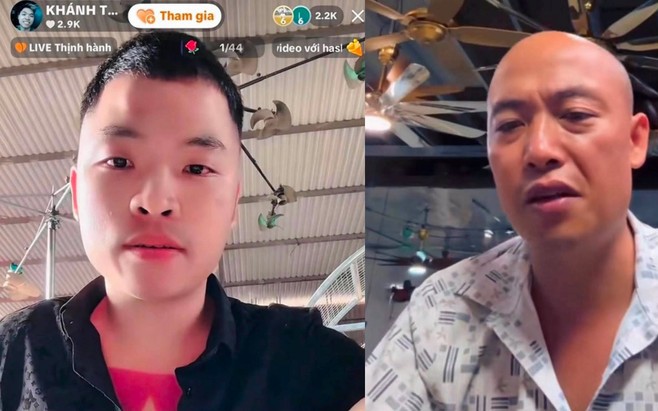
On Tuesday, Hanoi police announced his arrest, alongside his wife, La Thuy Kieu, for serious accounting violations and the illegal trading of invoices.


This combination of photos shows Phu Le and his wife, who was also arrested, with the man seen at the police station in Hanoi.
According to police data, the couple allegedly funneled over VND107 billion (approximately US$4.2 million) in business revenue into 10 personal bank accounts to keep the money off the official company books.
To the public, individuals like Phu Le were successful entrepreneurs; to the state, they were allegedly running a 'matrix' of shell companies to evade taxes.
They were not alone. Huan Hoa Hong, or Bui Xuan Huan, another titan of the 'Internet gangster' genre, saw his 'live-stream empire' collapse just days earlier.
Once famous for 'preaching' morality to his followers while showing off stacks of cash, Huan and his wife were arrested on suspicion of failing to issue VAT invoices for over VND300 billion ($12 million) in perfume sales last week.
For Huan, the very live streams that built his brand became a digital trail for investigators.
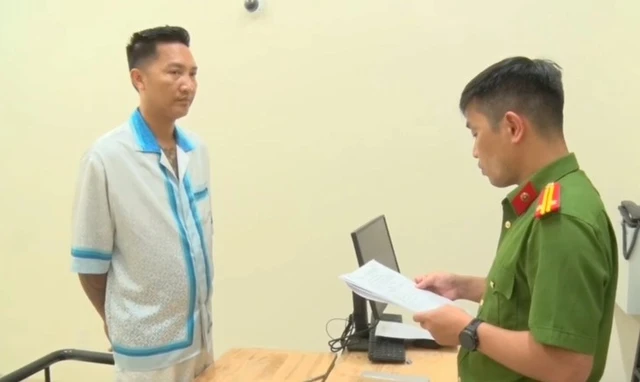
Huan Hoa Hong listens to his arrest warrant. Screenshot from police video
Gilded emptiness
Beyond the gangsters lies a second group: the 'flamboyant entrepreneurs' or practitioners of 'phong bat,' a Vietnamese slang term for creating a flashy, often hollow, facade of success to lure others.
Take the case of Pho Duc Nam, known online as Mr. Pips.
With an IELTS score of 8.5 and a background in IT, Nam was the quintessential 'finance bro' of Vietnamese TikTok. He sat in luxury apartments, wearing Rolexes, and promised his 20,000 Telegram members a 'guaranteed formula' for wealth through foreign exchange and stock trading.
When police raided his operation in late 2024, they discovered that the 'wealth' was a trap. Nam was accused of leading a massive fraudulent scheme that lured 2,660 victims into depositing over $50 million into fake trading platforms. Authorities froze assets including 31 supercars, 125 properties, and nearly 250 kilograms of gold.
"When people see beautiful houses and expensive cars, they are easily attracted and trust you enough to join financial investments," Nam reportedly confessed to investigators.
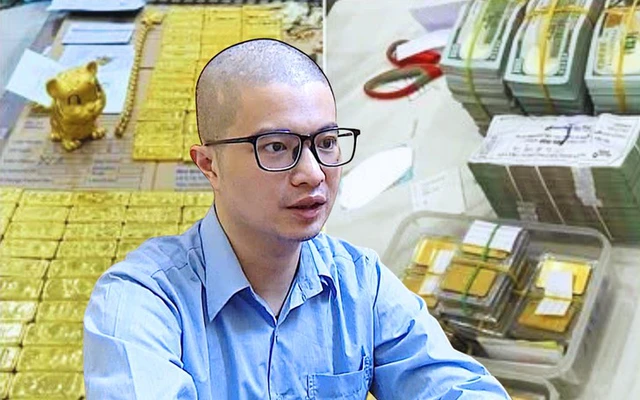
Pho Duc Nam, aka Mr. Pips. Photo: Police
The pattern repeats with Hoang Huong, once dubbed the 'Livestream Queen' for her flamboyant sales of health supplements.
Before her arrest in October 2025, she was famous for 'showering' her viewers with cash and boasting about her mansions. Authorities later alleged she had kept nearly VND1,800 billion ($71 million) in revenue off her accounting books to dodge corporate taxes.
The death of the 'wild west' tax era
Why did these influencers choose such high-visibility lifestyles if their finances were so precarious? Experts suggest it was a calculated business risk that was, until recently, highly effective.
In Vietnam, household businesses enjoy a significantly lighter tax burden than corporations. While a corporation pays 20 percent on profits, a household business may only pay 0.5 percent to 1.5 percent on total revenue.
According to analysts, the common 'script' for these influencers was to register as a small household business while actually running a multi-million dollar corporate operation, effectively 'pushing' massive revenues through a tiny tax loophole.
But the 'wild west' era of Vietnamese live-streaming is over as the government pivots toward a high-tech 'iron fist' policy to tighten its grip on the digital economy.
Under new regulations, e-commerce platforms and live-streamers are required to issue e-invoices, allowing tax authorities to monitor transactions in near real-time while cross-referencing lavish social media lifestyles directly against banking data and tax filings.
"The data on e-invoices and tax management tools can now help authorities detect abnormal signs like hidden revenue almost instantly," lawyer Dang Thi Thuy Huyen told Thanh Nien (Young People) newspaper.
To close remaining loopholes, Vietnam is also phasing out the lump-sum tax, which charges a fixed amount based on estimated revenue rather than actual sales, for large household businesses, forcing them to adopt formal accounting practices and e-invoicing.
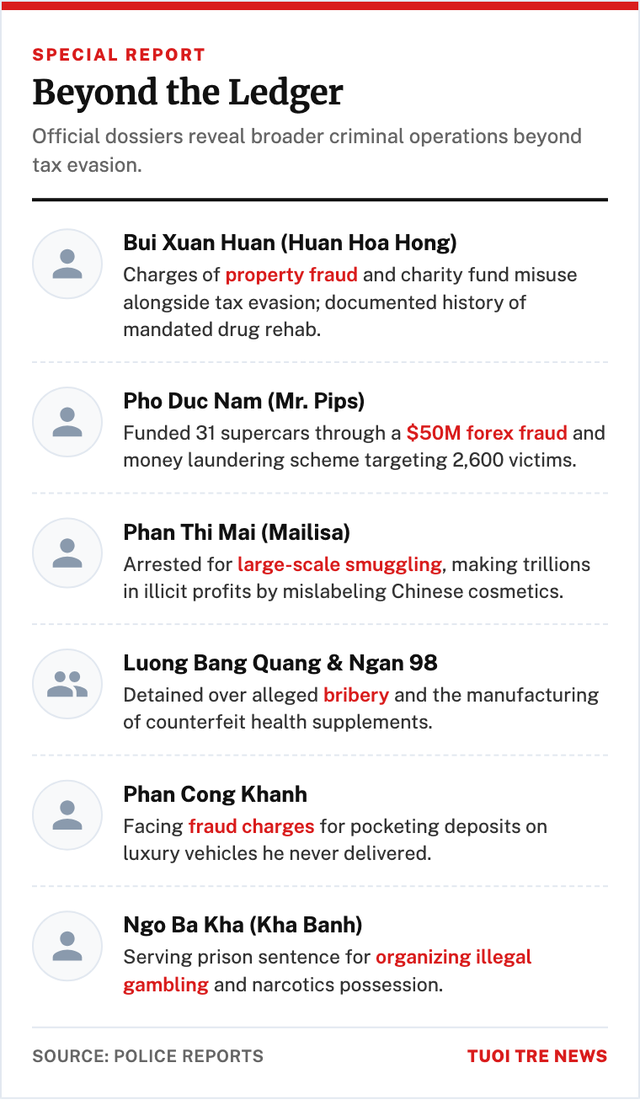
Graphic: Tuoi Tre News
The ultimate irony
There is a profound irony in these arrests. For a traditional criminal, a camera is a threat; for these influencers, the camera was their bank account.
They were caught not because they were sloppy, but because their business model required them to be seen.
Their flashy videos of cars and money served as marketing tools, but they also became the evidence that convicted them.
As the Vietnamese government continues to tighten its grip on the live-streaming economy, the message is clear: the authorities are no longer just watching the show for entertainment. They are counting the invoices.
For Vietnam's 'Internet idols,' the very fame they craved has become their most inescapable prison.


Son Luong / Tuoi Tre News
Link nội dung: https://news.tuoitre.vn/why-vietnams-flashiest-tiktok-influencers-are-falling-to-the-taxman-103260819090715273.htm