
WinCommerce targets 1,000-1,500 new WinMart/WinMart+/WiN stores in 2026
WinCommerce, the retail arm of Masan Group (MSN) and the operator of the WinMart, WinMart+, and WiN chains, has set an ambitious target of opening 1,000-1,500 new stores in 2026, with a strong focus on rural areas.
The plan follows a year in which the company’s operating performance exceeded expectations across most key metrics, underscoring both the scale and efficiency of its expansion strategy.
According to the retailer’s latest report, WinCommerce posted net revenue of VND3,557 billion (US$135.4 million) in December last year, up 19 percent year on year and surpassing its average growth targets.
The strong performance highlighted clear acceleration during the year-end peak season.
Notably, like-for-like (LFL) revenue rose 8.6 percent, indicating that growth was driven not only by new store openings but also by improved performance at existing locations.
December also marked the highest number of new store openings of WinCommerce since the 2019 acquisition, bringing the total number of new outlets in 2025 to 764, well above the company’s upper planning scenario of 700 stores.
Nearly 80 percent of these new openings were WinMart+ Rural stores, reflecting the rapid execution of the firm’s rural penetration strategy and its growing contribution to overall growth.
Notably, 90.3 percent of the stores opened during the year surpassed EBITDA break-even at the store level, demonstrating that expansion has been accompanied by improving profitability rather than scale alone.
Retail sector at its most profound turning point in a decade
Shifting consumer habits from urban to suburban and rural areas is creating new opportunities for modern retail chains.
As transparency regulations tighten, retailers that control their supply loops, such as WinCommerce (WCM), are increasingly well positioned to help shape modern consumption standards beyond major cities, while strengthening their standing as large-scale domestic retail systems.
Vietnam’s retail market is witnessing its most profound restructuring in a decade, where the boundary between traditional shopping and modern retail is no longer confined to metropolitan areas.
Instead, it is rapidly extending into outlying areas and rural communities.
This shift is driven not only by demand for convenience, but also by a broader change in consumer behavior: shoppers are placing greater emphasis on product origin transparency and price stability.
This is seen as a critical phase in the restructuring of Vietnam’s distribution channels, laying the groundwork for new consumption norms nationwide.
The foundation of this transformation is closely tied to domestic consumption, as the consumer sector remains a key pillar of economic growth.
Retail sales of goods in 2025 hit an estimated VND5,335.1 trillion ($203.2 billion), accounting for 76.1 percent of the total revenue of retail sales and consumer services, and representing an eight-percent increase from the previous year.
Despite this growth, experts argue that Vietnam is still in the early stages of retail modernization.
With modern trade channels accounting for around 19 percent of the market, the medium-term growth potential remains substantial.
As trust in quality becomes a priority, well-invested retail models are increasingly able to fill gaps left by traditional channels.
Policy developments are also accelerating this transition.
The implementation of the government’s Decree 70/2025 on e-invoicing and numerous initiatives to elevate Vietnamese products under the Ministry of Industry and Trade’s Decision 2269 are enhancing market transparency.
These measures tend to favor companies that have already standardized operations and quality control processes.
As transparency becomes an unavoidable requirement, adaptability and execution speed are emerging as decisive factors for retail players.
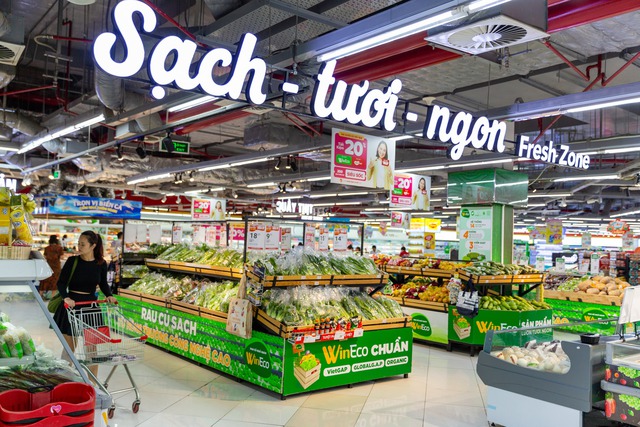
A wide range of fresh, high-quality foods at a WinMart supermarket in Vietnam. Photo: Supplied
WinCommerce and a challenge of scaling with efficiency
Amid this evolving landscape, WinCommerce is focused on converting network scale into operational efficiency nationwide.
Rather than concentrating solely on urban cores, the firm is leveraging its nearly-4,600-store footprint to serve diverse residential areas, from cities to peripheral and rural communities.
With around 1.5 million customer visits per day, WinCommerce operates on the premise that retail strength lies in synergy where incremental improvements in assortment or service processes can generate impact across thousands of outlets.
The company’s progress is also evident in its financial discipline during its expansion.
From operating losses in 2019, WinCommerce targeted positive EBIT of some VND1,000 billion ($38 million) in 2025, showing a marked improvement in operational management.
In an industry where rapid network growth often brings heavy cost pressures, the ability to achieve efficiency at the individual store level is a key measure of sustainable development.
This approach underscores WinCommerce’s focus not merely on store count, but on the long-term viability of its business model.
A critical pillar supporting this strategy is the Supra supply infrastructure within the Masan Group ecosystem.
With 18 ambient and cold storage warehouses, WinCommerce is increasing supply-chain autonomy, enabling tighter cost control and higher on-shelf availability.
Mastery of key supply-chain segments is widely viewed as a way to optimize pricing and ensure consistent customer experience, a path previously taken by regional giant retailers such as CPAll and Alfamart to consolidate their domestic market positions.
Looking ahead to 2026, WinCommerce’s plan to open 1,000-1,500 new stores, particularly in rural areas, signals its ambition to complete the loop from supply-chain management to consumer trust optimization.
Successfully managing complex operations at scale is expected to reinforce the company’s credentials as a leading domestic retail brand.
As Vietnam’s retail modernization accelerates, chains with strong operational foundations are likely to secure a lasting position in the country’s consumer landscape in the years ahead.
Tuoi Tre News
Link nội dung: https://news.tuoitre.vn/wincommerce-targets-1000-1500-new-winmart-winmart-win-stores-in-2026-103260122120234432.htm