
Work begins on first Vietnam-initiated international submarine fiber-optic cable
The Vietnam-Thailand-Singapore (VTS) cable is the first international submarine fiber-optic cable initiated and controlled by a Vietnamese enterprise, marking a milestone in the country’s efforts to gain greater autonomy over its digital infrastructure.
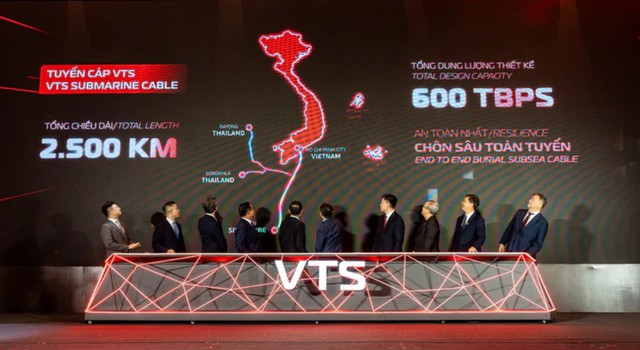
Vietnam will have its own submarine fiber-optic cable, initiated and controlled by a Vietnamese enterprise. Photo: Duc Tho / Tuoi Tre
The VTS consortium, co-led by Vietnam’s Viettel and Singapore’s Singtel, broke ground on the submarine cable in Ho Chi Minh City on Thursday, with completion expected in the fourth quarter of 2030.
A milestone in connectivity autonomy
The entire cable system will span approximately 2,500 kilometers, with a design capacity of 600 terabits per second (Tbps).
Its direct Vietnam-Singapore segment alone will stretch around 1,200 kilometers, with a capacity of 240 Tbps, about 2.5 times the combined capacity of all international submarine cables currently serving Vietnam.

With its direct route, VTS will become the shortest cable link between Vietnam and Singapore, with an expected latency of just 12 milliseconds, approximately 50 percent lower than the average of existing routes.
The system will feature eight fiber pairs and next-generation wavelength-division multiplexing (WDM) technology, with low latency enabling real-time applications such as artificial intelligence (AI) and financial transactions to run smoothly.
To minimize the risk of cable damage from ship anchors and fishing activities, the entire cable will be buried beneath the seabed, with its main trunk buried up to three meters deep, compared with the typical depth of 1-1.5 meters in conventional projects.
What sets VTS apart is the leading role of a domestic enterprise in developing and controlling the infrastructure.
While Vietnamese companies primarily contributed capital and purchased existing bandwidth capacity in previous projects, Viettel jointly initiated VTS with Singtel in April 2024 and took the lead in route planning and design, key stages that determine landing points, system configuration, and performance.
The project also involves Thailand’s AIS and Vietnamese telecommunications and technology companies VNPT, FPT Telecom, and Viettel IDC.
Japan’s NEC Corporation and Singapore’s ASEAN Cableship are the project’s construction contractors.
A boost for Ho Chi Minh City’s financial hub and digital economy
The cable landing station in Ho Chi Minh City will provide a direct data gateway to Singapore, Southeast Asia’s largest telecommunications, data, and financial hub.
Truong Minh Huy Vu, vice-chairman of the Ho Chi Minh City People’s Committee, said the city would integrate the VTS cable into its digital infrastructure development plans, linking it with data centers, technology parks, and financial services zones.
The city will also prioritize protecting the cable corridor in coastal areas to ensure long-term operational safety and lay the groundwork for attracting investment in digital infrastructure.
Keith Leong, deputy CEO for enterprise customers at Singtel, said diversifying connectivity routes was just as important as expanding capacity.
The VTS cable will help distribute data traffic across multiple routes, ensuring that Internet and banking services, as well as business operations across the region, remain stable even when existing cables experience disruptions.
Viettel currently participates in the operation of five of Vietnam’s eight international submarine cables, namely AAG, IA, APG, AAE-1, and ADC, accounting for approximately 65 percent of the country’s international connectivity capacity.
By 2030, the group aims to participate in around 10 international submarine cable systems, including those independently designed and controlled by Vietnam, in line with the Politburo’s Resolution No. 57-NQ/TW on science and technology development and digital transformation.
Ngoc Nguyen - Duc Thien / Tuoi Tre News
Link nội dung: https://news.tuoitre.vn/work-begins-on-first-vietnam-initiated-international-submarine-fiber-optic-cable-103261126155530826.htm