
Youth beside youth: How young Vietnamese are changing the conversation around leadership
As conversations about the future of Vietnam's young leaders have lingered in the months following this year's national university entrance exam, 24-year-old Noel Duong has spent the past few years building one possible answer through the youth-led organization DNA Corner.
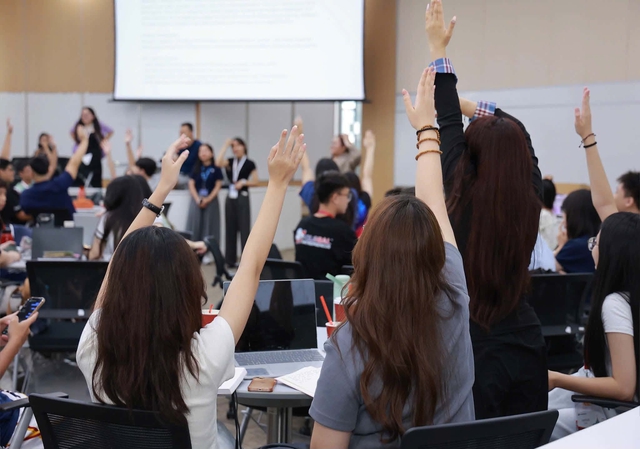
Participants raise their hands during an interactive leadership activity. Photo: Supplied
Whether Vietnam could have its own Steve Jobs or Mark Zuckerberg became one of the most talked-about questions following 2026's Vietnamese national high school graduation exam. What interested me, however, was perhaps not whether Vietnam could produce another Silicon Valley icon, but rather if Vietnam is searching for its next generation of entrepreneurs, what kind of leaders are we actually hoping to cultivate?
Somewhere along that trail of thought, I came across DNA Corner.
At first glance, the name left me briefly wondering whether I had wandered into genetics rather than entrepreneurship. Founded in 2021 by Duong Ngoc Anh (Noel), 24, DNA Corner is one of a growing number of youth-led organizations exploring leadership and entrepreneurship among Vietnamese youth. But the longer I sat with Noel, the less we spoke about startups, and the more our conversation drifted toward something far more elusive: how well do young people know the person they are becoming before deciding what success ought to mean?
Changing the foundations
Like many organizations, DNA had an explanation ready for their name. Discover. Nurture. Accompany. It was neat, straightforward and, if I am being honest, just a little too tidy.
In truth, the most interesting part never quite made it into the brochure.
The deepest forms of change, Noel came to believe, do not only influence how people think. They shift the foundations from which they live, decide and lead, almost as though changing their DNA.
As Noel puts it, "DNA Corner is not about changing who young people are. It is about creating the conditions where they can become who they want to be."
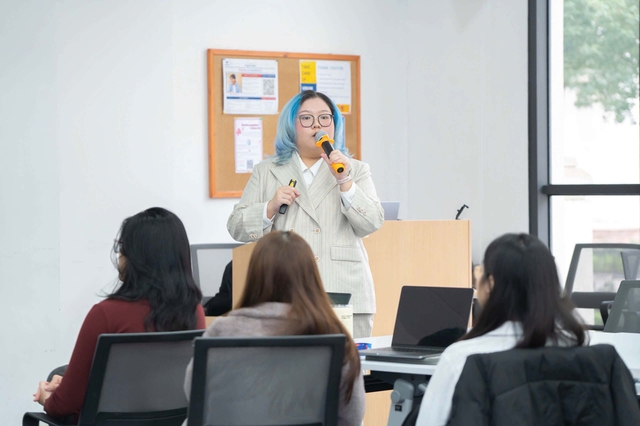
Noel Duong speaks to participants during the BOLD Bootcamp. Photo: Supplied
Putting the human back into entrepreneurship
Calling DNA Corner a mentoring program, a leadership camp or even an entrepreneurship course somehow misses the point. Though oddly enough, none of those descriptions are inaccurate.
Alex Nguyen, director of VinUniversity Entrepreneurship Lab and a standing board member of the Vietnam Higher Education Innovation and Entrepreneurship Center (VNEI), has observed one pattern: Vietnamese students receive strong academic preparation and no shortage of career advice, yet far fewer opportunities to understand themselves before making decisions about their future.
"We often talk about startups as business projects," she says, "but behind each startup is a young person learning to lead, decide, and grow."
Noel never intended to build another entrepreneurship training center. Coaching, experiential learning, and leadership courses were never the destination, but the medium for a different conversation. Rather than beginning with ideas to be pitched or ventures to be launched, DNA Corner begins with something that belongs only to their participants, yet is often the hardest to see: their values, motivations, and the assumptions underlying their decisions.
Linh Dan, a final-year marketing student at VinUniversity, now DNA Corner's marketing manager after first joining as a mentee, describes it as learning to build "the internal navigation that many case studies might overlook in stories about great leaders." She had seen it before, in her mother, whom she always considered a natural leader. But the path from watching someone lead well to learning to do it yourself is hardly straightforward, she says, especially when the space between them is rarely spoken aloud. What DNA Corner gave her, unexpectedly, was people who wanted her growth as much as she did, and a way to finally name and practice "self-awareness, self-regulation and the internal values that guide our leading decisions."
Noel expands on this distinction: "Knowledge can be acquired almost anywhere. What matters is developing the judgement to distinguish determination from stubbornness, flexibility from compromise and confidence from ego."
Pursuing achievements inherited from someone else's definition of success can feel a little like setting sail with someone else's map. It may get you somewhere, only to discover it was never where you hoped to end up. In a society increasingly adept at measuring success, organizations like DNA Corner are trying to make space for a quieter kind of growth: not simply what young people accomplish, but how they come to understand themselves before occupying any role at all.
A success from within
Introducing Noel through her résumé almost feels contradictory. At twenty-four, she has accumulated the kind of credentials many young people aspire to: a business degree from VinUniversity, leadership work with the university's Entrepreneurship Lab and its UNESCO Chair in Environmental Leadership, Cultural Heritage and Biodiversity, and an upcoming master's at the Harvard Graduate School of Education.
It felt faintly ironic that someone headed to one of the world's most prestigious universities had spent the last decade encouraging young people not to mistake prestige for purpose.
"We can give students a certificate if they want one," she explains. "But I believe personal growth is for you. You shouldn't need a certificate for that."
As DNA Corner grew, some programs naturally came to include formal credentials through institutional partnerships, but for Noel, what mattered was not what participants took home on paper.
One of the organization's earliest challenges was that personal growth itself became strangely impersonal. "It took us a while to educate our market," Noel says. "People would invest in almost anything but their understanding of themselves."
This tension seems to have grown alongside Vietnam's startup ecosystem itself. Alex welcomes the rapid vibrancy of the country's entrepreneurial landscape, but notes that it "can sometimes reward visibility faster than substance." There is, she warns, "a risk of pushing young people to become 'someone' before they have built enough depth."
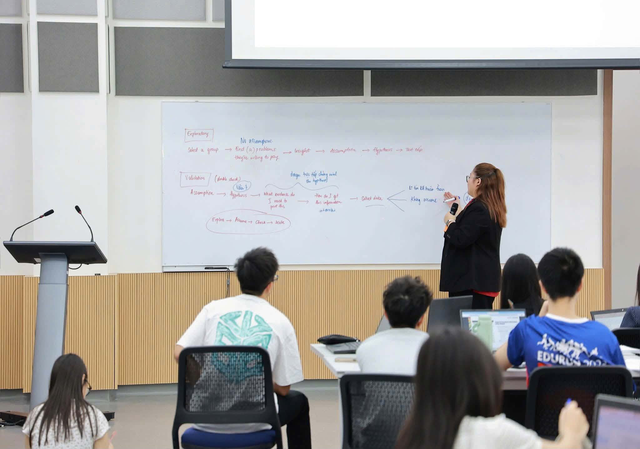
Noel Duong leads a workshop during VinUniversity’s Future Founders Bootcamp. Photo: Supplied
Measuring the immeasurable
Each program begins by asking what participants genuinely need rather than assuming what they should learn. The technical content changes depending on the audience, but the underlying goals remain strictly consistent: encouraging curiosity, resilience, critical thinking, and the willingness to question one's own assumptions.
Success, Noel believes, shows itself through both visible behaviors and subtle shifts that resist easy naming. Participants may become more willing to seek feedback, reconsider their ideas or begin conversations they once avoided. Often, the first to notice these are the program's mentors, or what she explains is similar to 'teaching fellows,' who have wrestled with similar questions themselves. They recognize forms of growth that rarely appear in surveys or paperwork: the confidence to make different choices, the courage to leave familiar patterns behind or simply the willingness to keep asking difficult questions.
"There are countless ways to measure knowledge," Noel said. "But I still haven't found an optimal way to measure human transformation."
That concern eventually became one of the reasons Noel decided to pursue a master's at Harvard. She actually wrote it down in her application, laughing at the thought that an unanswered question had helped earn her a place.
"Knowledge alone is no longer enough to predict someone's likelihood of success. We're looking for more scientific methods, but I doubt how specific they can ever become because of the ethical boundaries involved."
Regardless, the difficulty was telling us something about education itself. To educate a human being is, in essence, to work with things that defy being fully captured. We have spent generations refining ways to assess what students know. Examinations, grades, certificates, and transcripts have become increasingly sophisticated measures of knowledge, and they will likely become even more so. Still, far fewer systems exist to help us understand who students are, or who they are becoming.
It is easy to assume that self-awareness arrives with age, that knowing oneself is simply common sense rather than something that can be deliberately nurtured. Yet common sense, perhaps, is not nearly as common as it seems.
'The capacity to aspire'
One phrase Noel used caught me off guard: "the lack of an ability to have ambition." She did not mean that people lacked ambition, but that many had never been shown a future they could genuinely imagine as possible for themselves. She draws on anthropologist Arjun Appadurai's concept of "the capacity to aspire."
"Your ambition is shaped by the standards and frameworks you're exposed to every day," Noel explains.
The idea felt surprisingly liberating. If ambition could be nurtured rather than merely possessed, then more of who we are may be capable of change than we tend to assume.
Sometimes that influence is obvious through the expectations people place upon us. Other times, it hides in habits we unconsciously commit to. "Imagine someone growing up in a farming family where evenings naturally end in exhaustion. Later, when they work in an office, their body may still remember that's what evenings are for." Not because those habits are right or wrong, she explains, but because they have become the norm.
A young person who grows up in a family where completing middle school is the highest level of education may naturally imagine university as the furthest goal they can set for themselves. Social media may widen that horizon, Noel argues, but it can just as easily reinforce the distance, making extraordinary lives appear reserved for those born into privilege, rather than something within everyone's reach.
"I have met bright, cheerful young individuals who entered the workforce and slowly lost that spark." Noel seems to say it as much to remind herself as anyone. During especially busy periods, she deliberately schedules short mentoring sessions, not because she has spare time, but because those conversations reconnect her with the questions that first led her to start DNA Corner.
Leading with warmth
If self-awareness sat at the heart of DNA Corner, then one of Noel's strongest convictions was that leadership itself is never culturally neutral.
Many of the leadership frameworks available to young Vietnamese have been developed elsewhere, she observed. Yet leading people, in her experience, always begins with understanding the culture, relationships, and expectations of the people standing in front of you.
For Noel, leadership in Vietnam often resembles family, not because professional boundaries disappear, but because care becomes part of leadership itself. "Parents don't need to enter a child's room every day to know something is wrong." Good leaders cultivate the same attentiveness: enough closeness to recognize when someone needs support without intruding unnecessarily, and enough warmth that people feel safe enough to share.
It is not unusual for conversations about work or personal worries to continue over a home-cooked dinner. Sometimes people talk. Sometimes they don't. "Sometimes," she smiled, "the invitation itself is often enough."
That understanding was expensive. Before DNA Corner, Noel tried building an HR club at VinUniversity. By every reasonable measure, the project looked promising: capable people, a great shared mission, and genuine enthusiasm. But things never quite came together.
"Everyone was inspired by the mission, but few found their role to contribute to it."
Noel realized the problem was never the mission. It was the way she had imagined leadership. "If one person didn't perform well, maybe it's their problem. But if twenty people didn't do well, then maybe it's my leadership."
DNA Corner became a chance to rethink the kind of leader she wanted to be, not by changing the dream, but by changing how she hoped to build it.
Someone may naturally be direct, strict or outspoken without ever making others feel smaller in the process, as she recalls words from an early mentor: "Effective leadership has less to do with changing who you are than with learning how your personality affects the people around you."
The seed that finally bloomed
One frustrating thing about writing on personal changes is that words alone are hardly ever enough. It often takes time with people to move beyond the reassuring language and see what, if anything, survives once everyday life resumes.
Phuong Anh, a high school student and former participant, believed she already understood leadership. It was not until she failed to resolve conflict with her own team that she realized what she lacked was not enthusiasm, but the ability to truly listen before trying to solve the problem.
"I no longer think a leader is someone who always has the right answer. Sometimes leadership is knowing when to step back, ask the right questions, and create a space where people can understand one another."
Yet growth did not always announce itself through moments of clarity.
One former member had drawn deeply on the organization's values while navigating a difficult family crisis. But once it all passed, fear pulled her toward what felt like the safer choice instead of the work she genuinely wanted. The job consumed her days until there was barely any time left to sleep, let alone grow.
The decision might have seemed at odds with everything she had spent years working toward at DNA Corner. Only then did Noel intervene. "It's not about what I think anymore. It's about you and your well-being."
Leaving was never simply about a role. DNA Corner had become one of the places where she had learned who she was. Walking away meant, in some ways, letting go of part of that identity.
There will be seasons when fear outweighs conviction. Perhaps that is what sustainable values are really for: not to make someone permanently strong, but to give them something to return to whenever they lose their footing.
Noel does not know what the member will choose next. But she knows this much: "She may not always prioritize herself, but she'll never go back to being the person I first met."
A generation leading itself
Vietnam has never had more young people willing to build something of their own. Competitions, incubators, and startup communities have flourished across the country. Yet entrepreneurship is more than learning to pitch an idea or embrace failure. It is also learning to carry responsibility for teammates, communities, and decisions whose consequences extend far beyond the founder.
Alex cautions that enthusiasm alone is never enough. Sustainable youth initiatives, she argues, require three things: a deep understanding of the problem they hope to solve, a clear model for creating impact, and the operational discipline to sustain that work over time.
Over the past four years, DNA Corner's philosophy has grown into a community of over 33,000 members, largely through referrals rather than advertising. More than 3,000 young people have participated in the organization's diverse, personalized programs.
To Noel, the numbers are not to impress potential partners but are a sign of progress: more young people are looking for spaces where growth is built on trust rather than transactions.
DNA Corner is only one answer among many. But the more I spoke with their participants, the more it became apparent that many of the conversations shaping their understanding of leadership were not happening in classrooms, nor always at home, but in circles created by young people only a few years older than themselves.
That is not necessarily an indictment of schools, families or institutions. If anything, it demonstrates how quickly Vietnam's young people have begun building communities to meet the needs they recognize in one another, and often in themselves. That is something worth celebrating. It is also something worth paying attention to. If these spaces are becoming increasingly necessary, perhaps they are revealing conversations that deserve a more permanent place in how we think about empowering the next generation.
Kel Thai
Link nội dung: https://news.tuoitre.vn/youth-beside-youth-how-young-vietnamese-are-changing-the-conversation-around-leadership-103260803165854675.htm