


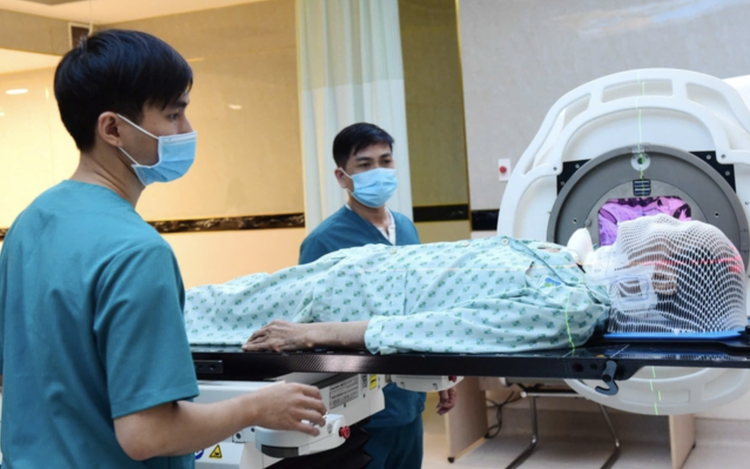
A patient undergoes treatment using modern machinery at Ho Chi Minh City Oncology Hospital, Ho Chi Minh City. Photo: Duyen Phan / Tuoi Tre
The proposal is widely regarded as a strategic, humane step that prioritizes the most vulnerable groups in society.
Patients in desperate need
During discussions on a draft NA resolution on healthcare mechanisms, NA delegate Nguyen Anh Tri from Hanoi underscored that hospital fee exemptions are essential to transforming Vietnam’s healthcare system.
While supporting the long-term 2030 target of free universal healthcare, he insisted that patients with severe, chronic, or high-cost illnesses receive assistance sooner.
“Because there is a roadmap, I propose early fee exemptions for those undergoing treatment for hard-to-cure diseases, chronic illnesses, dialysis patients, and cancer patients using extremely expensive targeted therapies,” he said.
“They are in great difficulty and need support now, not in 2030."

Call for early implementation
NA delegate Nguyen Thi Viet Nga, a member of the Committee on Culture and Social Affairs, expressed full support for the 2030 target of universal hospital fee exemption.
However, she emphasized the need for earlier application to patients with hard-to-treat cancers and severe chronic illnesses, especially those undergoing long-term hemodialysis.
She said that these conditions represent not only grueling medical battles but also an exhausting economic journey.
Costs for medications, frequent tests, hospital stays, travel, and caregiving often exceed what many families can afford.
While some fear early fee exemptions could strain the national health insurance fund, Nga argued that the affected patient groups are well-defined and medically verified, minimizing the risk of fraud.
She suggested accelerating the timeline to 2026 or 2027 and introducing supplementary financial mechanisms to ensure sustainability.
NA delegate Trinh Thi Tu Anh from Lam Dong Province threw her weight behind the universal fee exemption as the strategy shows the state's strong dedication to social welfare.
She stressed that treatment expenses remain the biggest barrier for many patients, particularly as modern targeted drugs and immunotherapies – though highly effective – remain inaccessible due to high costs.
She urged timely updates to the national drug list, especially for new-generation cancer and immunomodulatory medicines.
She called for prioritizing drugs with strong clinical evidence and adopting flexible, internationally aligned updates paired with cost-effectiveness assessments.
Such reforms would protect the rights and financial security of more than 95.5 million people currently covered by health insurance.
Expert perspective: prevention first
Dr. Le Tuan Anh, director of the Oncology Center at Cho Ray Hospital in Ho Chi Minh City, agreed that fee exemptions would significantly benefit cancer and dialysis patients.
However, he cautioned that immediate, full exemption would place heavy pressure on the national budget.
He underlined that long-term, sustainable cost reduction must involve a comprehensive strategy across four key areas: prevention, early detection, diagnosis and treatment, and end-of-life care.
Prevention and screening should be top priorities because early detection dramatically improves outcomes while reducing overall treatment costs, the doctor said.
Yet many screening programs are not currently covered by insurance, leaving patients unable to access tests.
As such, he proposed adding screening services to reimbursable categories.
Regarding diagnosis and treatment, Dr. Anh suggested gradually reducing fees for expensive services such as imaging, pathology, molecular diagnostics, genetic testing, and high-cost medicines before moving toward full exemption.
A family’s struggle
T.L., whose mother is undergoing treatment at Ho Chi Minh City Oncology Hospital, shared that despite receiving 95-percent insurance coverage, her family still pays nearly VND9 million (US$341) per month for targeted therapy.
As her mother’s disease progresses, second- and third-generation drugs cost VND12-45 million ($455-1,700) monthly, even after insurance contributions.
After five months of treatment, total expenses have reached almost VND100 million ($3,790).
“If we hadn’t tried our best, we might have had to give up,” she said.
Fee exemptions or increased insurance coverage for cancer patients are urgently needed to give families a fighting chance, she stressed.








Max: 1500 characters
There are no comments yet. Be the first to comment.