


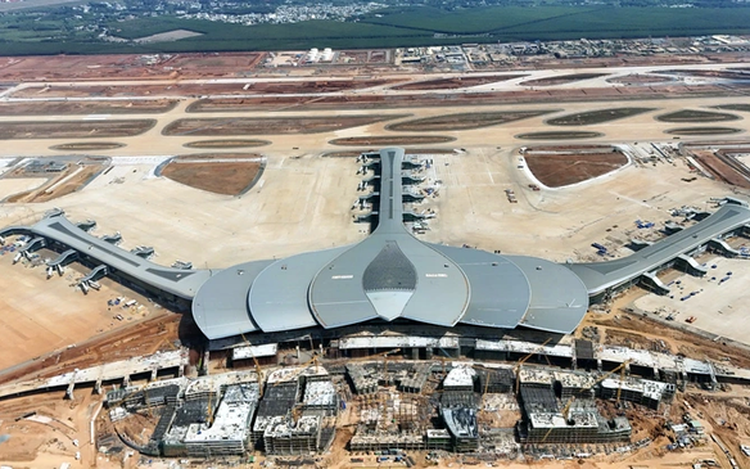
Long Thanh Airport in Dong Nai City, southern Vietnam will be connected with the North-South high-speed railway and two metro lines. Photo: A.B.
The plan features separate station structures arranged in a staggered layout but connected through a centralized passenger transit system to improve accessibility while minimizing impacts on existing airport infrastructure.
The proposal was outlined in a document sent by the Dong Nai City People’s Committee to the Ministry of Construction, Ho Chi Minh City People’s Committee, and the Airports Corporation of Vietnam.
Under the proposal, railway lines would be located within the access corridor leading to Terminal T1 of the airport.
The North-South high-speed railway would be positioned along the central axis of the railway system.
The Ben Thanh–Suoi Tien metro line, planned for extension into Dong Nai, would be located to the left of the North-South high-speed railway when traveling from Ho Chi Minh City toward Dong Nai, while the Thu Thiem–Long Thanh metro line would be positioned on the right side.
Because the area in front of Terminal T1 is constrained by access roads, elevated roadways, parking facilities, and technical infrastructure, Dong Nai authorities proposed arranging the railway stations in a staggered layout.
Under this plan, the North-South high-speed railway station would be located northeast of the Terminal T1 axis and serve as the central hub of the transportation complex, linking Long Thanh Airport with the national railway network and metro lines.
The two metro stations would be situated southwest of Terminal T1, running parallel to each other and symmetrically positioned on either side of the high-speed railway alignment.
The proposed arrangement would allow the high-speed railway station and the two metro stations to operate independently in terms of structure, technology, signaling systems, train control, and operations.
The station areas would be designed with sufficient space for tunnels, passenger distribution levels, stairways, escalators, elevators, emergency exits, and other supporting facilities.
Detailed technical specifications will be determined during subsequent design phases.
For passenger access, Dong Nai authorities proposed connecting Terminal T1 with the railway and metro stations through a network of pedestrian transit bridges, underground passages, or a combination of both.
The final solution will be further studied to ensure compatibility with Terminal T1’s spatial layout, road system, parking areas, passenger pick-up and drop-off zones, and airport operational requirements.
According to the Dong Nai City People’s Committee, the proposal’s main advantage is that it makes use of the airport’s existing technical corridor, thereby minimizing disruptions to infrastructure currently under construction, including access roads, elevated roadways, parking facilities, and utility systems.
The independent arrangement of the North-South high-speed railway, the extended Ben Thanh–Suoi Tien metro line, and the Thu Thiem–Long Thanh metro line would also reduce technical interface risks.
Each project could proceed with investment, construction, testing, operation, and maintenance according to its own schedule.
However, authorities acknowledged that the plan also faces challenges because underground construction space in front of Terminal T1 is limited by both existing and ongoing infrastructure projects.
As a result, minimum separation distances would need to be maintained between tunnels, station boxes, retaining walls, building foundations, and utility systems, requiring appropriate engineering and construction solutions.
The proposal also involves multiple projects and management agencies, making close coordination necessary to control technical interfaces, avoid overlapping construction zones, and prevent design modifications.
Dong Nai authorities assessed that with this proposed positions of rail and metro stations, the transfer distance between the railway stations and Terminal T1 would be approximately 400 meters longer than under an alternative plan in which the stations are directly aligned with the terminal’s main access axis.
However, officials said this drawback could be addressed through integrated transit corridors, pedestrian bridges, escalators, elevators, moving walkways, and wayfinding systems, similar to those used at many international airports worldwide.
Dong Nai authorities added that detailed technical aspects of the proposal will continue to be studied during project implementation to ensure an optimal solution that meets the operational requirements of Long Thanh International Airport.
Long Thanh International Airport is a national key project spanning about 5,000 hectares, with a total estimated investment of more than VND336.63 trillion (US$13 billion).
Construction began in 2020, and the airport is being developed in three phases, making it the country’s largest aviation infrastructure undertaking to date.
Once fully completed, the airport will have a total capacity of up to 100 million passengers and five million metric tons of cargo per year.








Max: 1500 characters
There are no comments yet. Be the first to comment.