


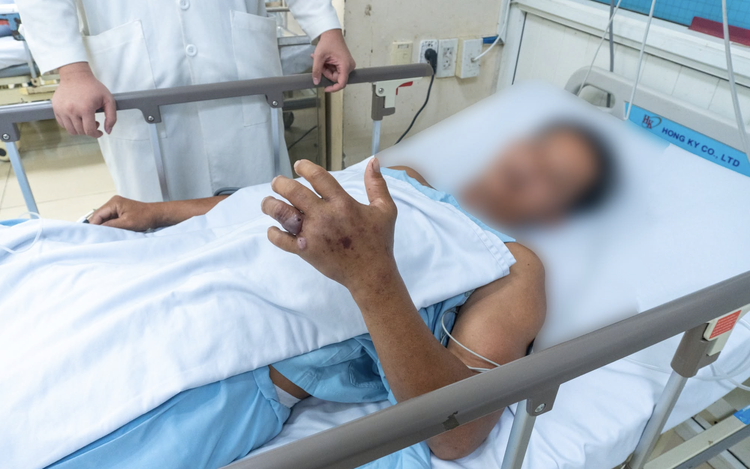
A man receives treatment at Military Hospital 120 in southern Vietnam after being bitten on his hand by a venomous snake. Photo: M.T.
The rainy season in southern Vietnam typically begins in late April and lasts until late November each year, with September marking its peak, local media reported.
Military Hospital 120 in Dong Thap Province said on Thursday that doctors had successfully treated a 44-year-old man for a snakebite.
He was bitten by a green snake while cutting grass in Trung An Ward.
According to the hospital, the man, identified as H.T.T., began experiencing dizziness and lightheadedness just three minutes after the bite.
By the 20-minute mark, he had vomited blood repeatedly.
When he was rushed to the hospital, his left hand was severely swollen, with the swelling extending to his elbow, accompanied by serious blood-clotting abnormalities.
He was given antivenom and fresh frozen plasma and received intensive treatment.
His condition gradually stabilized after 12 hours.
In another incident in late September, Le Tuan Kiet, a resident of Phu Tuc Commune in the neighboring Vinh Long Province, was bitten on his right hand by a red-tailed green pit viper while pruning ornamental plants at home.
The bite caused bleeding and severe pain in his hand.
He was taken to the snakebite treatment unit at Dong Tam Snake Farm in Dong Thap.
Prompt treatment helped reduce the swelling and pain.
Still shaken by the incident, Kiet said he would take greater precautions when tending his plants, including using a stick to disturb concealed areas before reaching into them, where snakes could be hiding.


Prolonged rainfall and rising water levels disturb snakes’ shelters, prompting them to move into gardens, residential areas and even people’s homes, said a representative of the snakebite treatment unit.
Residents should exercise particular caution when gardening, cutting grass or clearing dense vegetation during this period.
The unit treated 83 snakebite patients in September, up 19 cases from August.
Since the beginning of the year, it has treated around 800 people for snake and insect bites.
Venomous snakes accounted for about 55 percent of snakebite cases, with red-tailed green pit vipers responsible for the largest number of incidents.
Doctors warn that the venom of some snake species can cause blood-clotting disorders, bleeding and extensive swelling, potentially becoming life-threatening without timely treatment.
People should not underestimate a snakebite, even when the wound initially appears relatively mild.
A Dong Tam Snake Farm staff member advises residents to clear dense vegetation, keep areas around their homes tidy and avoid leaving objects that could provide shelter for snakes.
When walking at night or working in areas with dense grass, people should use flashlights, wear boots and protective gloves, and use a stick to probe concealed areas before placing their hands or feet there.
People who are bitten by a snake should remain calm, minimize movement, immobilize the affected limb and seek medical attention at the nearest healthcare facility as quickly as possible.
They should never apply a tourniquet, cut the wound, attempt to suck out the venom, or apply leaves or chemicals to the bite, as these measures can cause further injury and delay necessary treatment.








Max: 1500 characters
There are no comments yet. Be the first to comment.