


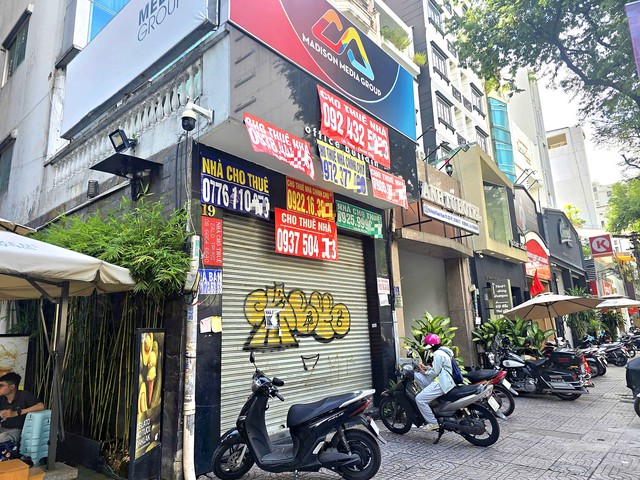
A total of 4,535 real estate businesses registered for establishment in the first nine months, while 2,813 real estate businesses completed dissolution procedures. The photo shows a vacant property with a 'For Lease' sign on Ba Huyen Thanh Quan Street in Ho Chi Minh City in early October 2026. Photo: Cong Trieu / Tuoi Tre
According to a socio-economic report for the third quarter and the first nine months released by the National Statistics Office (NSO) under the Ministry of Finance, Vietnam's GDP grew an estimated 9.01 percent year on year in the January-September period, while third-quarter growth reached 9.95 percent.
Against this backdrop, the country attracted a five-year high in registered FDI, with total registered capital reaching $50.36 billion, up 76.4 percent year on year.
Real estate business remained a major recipient of foreign capital, attracting $6.94 billion in registered capital, including newly registered and additional capital, equivalent to 16 percent of the country's total registered FDI.
The processing and manufacturing sector led FDI attraction with $21.82 billion, accounting for 50.3 percent of total newly registered and additional capital, while other sectors accounted for $14.63 billion, or 33.7 percent.
Despite the strong inflow of foreign capital, the number of newly established real estate businesses also rose, reaching 4,535 in the first nine months, up 10.9 percent year on year.
At the same time, 2,813 real estate businesses completed dissolution procedures, up 123.3 percent from the same period last year.
The construction sector recorded 14,978 newly established businesses during the period, up 33 percent, while 3,646 businesses completed dissolution procedures, a 128.2 percent year-on-year increase.
Across the economy, more than 48,700 businesses completed dissolution procedures in the first nine months, up 118.8 percent year on year.
On average, around 19,100 businesses exited the market each month.
New FDI projects in Vietnam came from 79 countries and territories during the period.
Singapore led investors in newly registered capital with $9.26 billion, accounting for 31.7 percent of the total, followed by South Korea with $5.70 billion, Luxembourg with $4.99 billion, Hong Kong with $3.01 billion, China with $2.27 billion, and Japan with $1.56 billion.
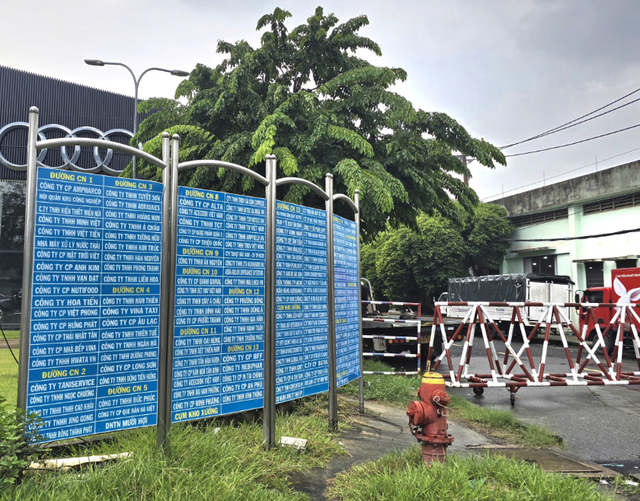
FDI inflows into real estate have increased sharply, but have mainly gone into industrial real estate and mergers and acquisitions. Photo: Cong Trieu / Tuoi Tre
Where is the FDI going?
Experts said international companies' efforts to diversify supply chains and build more flexible production networks are driving demand for new locations, with Vietnam among the countries benefiting directly from the restructuring trend.
This is also one reason behind the strong increase in FDI flowing into Vietnam's real estate sector.
Speaking to Tuoi Tre (Youth) online newspaper on Monday, chairman of the board of directors of ETERNITY Group JSC, a real estate distribution and brokerage company based in An Phu Ward, Ho Chi Minh City, said the FDI inflow into real estate was indeed high, but was concentrated mainly in industrial real estate and several mergers and acquisitions involving high-end projects.
This means the foreign capital has not been distributed evenly across the market.
As a result, many small real estate developers are struggling as they face weak purchasing demand.
"The market has moved beyond the speculative phase toward real estate with real and long-term value. Speculative products such as land plots have therefore weakened. With no new products, weak cash flow and weak purchasing demand, business exits are normal," he said.
Experts also noted that despite the growth in new capital inflows, a large amount of resources remains tied up in projects that cannot yet be implemented due to legal obstacles.
They called for stalled projects to be addressed promptly so that capital and land resources can be put to more effective use.
According to a report from the Ministry of Finance, which serves as the standing body of a government steering committee tasked with resolving problems affecting stalled projects, 5,012 projects nationwide are facing difficulties and obstacles.
These projects cover a combined 213,581 hectares of land and have total investment of VND3.6 quadrillion ($136.7 billion).
Of these, 1,131 projects, with total investment of VND779.047 trillion ($29.7 billion), or 23 percent of the total, are still being handled by ministries, sectors and local authorities within their respective jurisdictions.
Another 158 projects, with total investment of VND229.410 trillion ($8.8 billion), fall under the authority of the National Assembly, the government, and the prime minister.
The Ho Chi Minh City Real Estate Association said that as of September 5, the city still had 1,338 stalled projects facing difficulties and obstacles.
These projects cover more than 30,691 hectares and have a total investment of VND658.084 trillion ($25.1 billion).








Max: 1500 characters
There are no comments yet. Be the first to comment.