


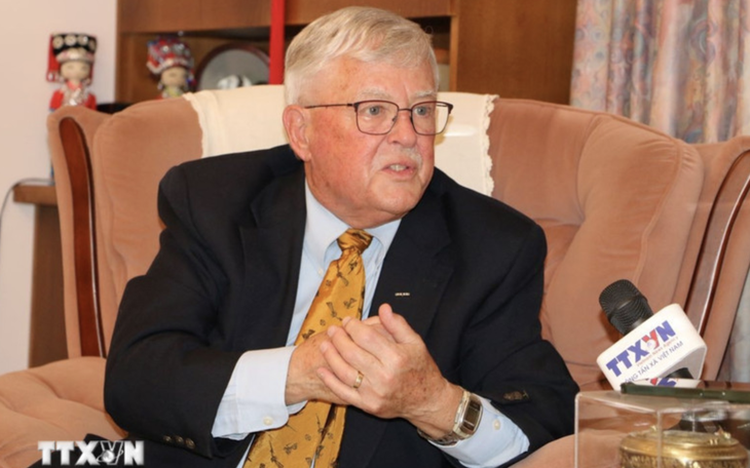
Professor Carl Thayer of the Australian Defence Force Academy at the University of New South Wales. Photo: Vietnam News Agency
He recalled that he first began living in Saigon, now Ho Chi Minh City, in 1967 as a volunteer teacher of English as a second language with the International Voluntary Services.
He said he had been closely connected with and had frequently traveled to Ho Chi Minh City for work for more than 50 years, witnessing its development through different stages of history.
What impressed him most about Ho Chi Minh City's transformation can be summed up in two points, the Australian professor said.
First, by 1981, the state played the leading role in managing the economy, regulating commercial activities, and restoring order.
Second, the most notable changes occurred after 1986 when Ho Chi Minh City was transformed from a city focused on the agrarian economy, including rice cultivation and seafood production, into a service-oriented municipality that gradually became integrated into the global economy.
"Two notable examples are the setting up of the Tan Thuan Export Processing Zone in 1991 and the Saigon Hi-Tech Park in 2002," he added.
The most impressive aspect of Ho Chi Minh City’s transformation came in the mid-to-late 1990s with the construction of skyscrapers and integrated commercial complexes such as the 25-story Saigon Center in 1996 and 33-story Saigon Trade Center in 1997.
Ho Chi Minh City’s skyline continued to rise with the completion of the Bitexco Financial Tower in 2010 and the erection of the Landmark 81 in 2018 as Vietnam’s tallest building.
To achieve these accomplishments, special policies have been very important in the transformation of Ho Chi Minh City such as the Saigon South Master Plan in 1994 that developed Phu My Hung and transformed swampy wasteland in the former District 7 into a vibrant financial, commercial, and residential area with green parks, healthcare facilities, and international schools, according to Thayer.
In 2021, the government merged the former District 2, District 9, and Thu Duc District to create Thu Duc City, which developed into an innovation hub for e-commerce and hi-tech manufacturing.
Other government special mechanisms include the current development of Ring Roads 2, 3, and 4, the Long Thanh International Airport, and the Can Gio International Port.
Focusing on hi-tech, green development
Thayer said "Resolution No. 9 on building and developing Ho Chi Minh City sets out a long-term framework with specific milestones set for 2030, 2045, and 2075."
The resolution places a strong emphasis on science, technology, digital transformation, and innovation to create a global economic, financial, and cultural smart city on a par with Taipei and Seoul, Professor Thayer said.
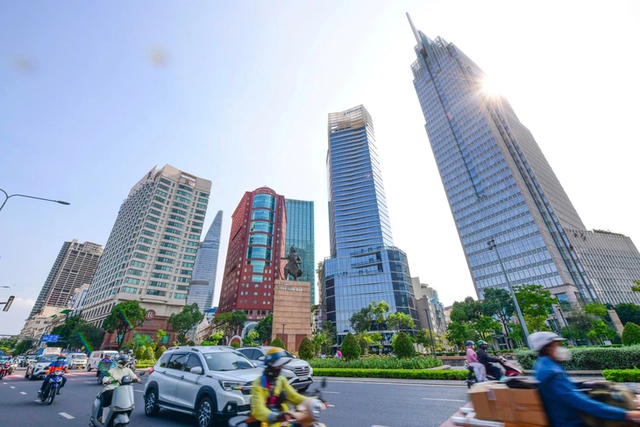
Professor Carl Thayer said Ho Chi Minh City has undergone remarkable transformation over the past 50 years. Photo: Quang Dinh / Tuoi Tre
He noted that the building blocks are clear: devolving decision-making to the municipal government to make its own decisions in urban planning, infrastructure development, and population management.
Ho Chi Minh City is positioned as the hub for Vietnam’s southern region, connecting to global supply chains while developing an education and training ecosystem to produce a highly skilled hi-tech workforce.
In Ho Chi Minh City's next stage of development, he proposed giving absolute priority to promoting transit-oriented development by developing an interconnected urban mass transit system that drastically reduces the need for private cars and motorbikes.
According to Thayer, it is a must to give priority to mitigating the impact of climate change and pollution through flood control, wastewater treatment, and the relocation of slums; along with achieving the goal of net-zero greenhouse gas emissions by 2050.
It is also important to reduce and phase out reliance on hydrocarbons for everyday energy needs by developing clean, green, and renewable energy through solar, wind, and nuclear power, the professor added.
Vietnam must continue to undertake domestic regulatory reform while integrating international standards and best practice, let the private sector flourish, and develop research and development centers.
Human resource training is also a crucial component to create a highly skilled workforce and efficient public service, Thayer proposed.
Only by achieving both economic growth and sustainable development can Ho Chi Minh City and Vietnam sustain long-term, inclusive development, the Australian expert concluded.








Max: 1500 characters
There are no comments yet. Be the first to comment.