


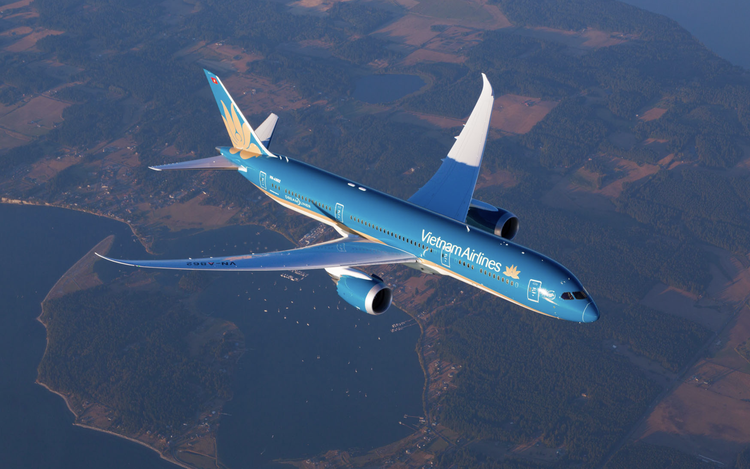
In 2025, Vietnam Airlines carried out the largest international network expansion in its history, launching 14 new routes. Photo: Vietnam Airlines
The resolution does not merely set an ambitious target of having one to three Vietnamese state-owned enterprises among the world’s top 500 largest companies by 2030.
It marks a profound shift in development thinking, from an emphasis on ‘safety and stability’ to one focused on ‘scale, competitiveness, and international integration.’
Resolution No. 79 functions as a strategic compass, encouraging state-owned enterprises to think bigger and engage in longer-term plays within global value chains.
Its core value lies not in numerical benchmarks, but in the creation of a new institutional framework that grants enterprises greater autonomy and room to grow according to market logic.
For Vietnam Airlines, the resolution serves as a strategic lodestar, helping the airline recalibrate its growth mindset and global ambitions.
The airline’s mention as a potential candidate for global ranking status is not driven by expectations of short-term revenue leaps, but by its unique role in a globally scaled industry with strong spillover effects and close ties to national image and connectivity.
Following a deep restructuring period in the aftermath of the COVID-19 pandemic, Vietnam Airlines has returned to a solid growth trajectory.
In 2025, its consolidated revenue exceeded VND123 trillion (US$4.7 billion), while its pre-tax profit reached the highest level in the airline’s history.
These figures underscored its resilience, governance capacity, and operational management in one of the world’s most volatile industries.
Regionally, Vietnam Airlines ranks 86th among the top 100 largest enterprises in Southeast Asia according to the Fortune Southeast Asia 500, and stands among the leading Vietnamese state-owned enterprises outside the energy and banking sectors.
This recognition reflects not only scale, but also a substantive foundation for longer-term ambition.
Notably, the clearer separation between commercial operations and political-social mandates has enhanced transparency in assessing the airline’s true operational efficiency.
This, in turn, improves access to long-term capital and strengthens confidence among international investors and partners.
Besides, new mechanisms governing senior executive appointments, equity-based incentives, and corporate governance aligned with the Organization for Economic Cooperation and Development (OECD) standards are enabling Vietnam Airlines to attract and retain top-tier talent amid intensifying global competition.
In the digital transformation aspect, the airline has moved ahead of the curve.
By 2024, its digital maturity level had reached nearly 74 percent, placing it among the leading state-owned groups.
The application of AI in revenue management, migration of data to cloud platforms, and operational optimization have laid a critical foundation for Vietnam Airlines to evolve from a traditional airline into an aviation-technology enterprise.
From national carrier to multi-pillar aviation group
International experience shows that globally scaled airlines do not rely solely on ticket sales.
Logistics, air cargo, maintenance and repair operations, digital services, loyalty programs, and integrated travel offerings have become key long-term growth pillars.
Vietnam Airlines has begun this transition.
Plans include developing a dedicated cargo airline, building a regional aircraft maintenance hub at the underway Long Thanh International Airport in Dong Nai Province, southern Vietnam, leveraging its loyalty ecosystem, and deploying in-flight Internet services to unlock new digital revenue streams.
As Vietnam emerges as a new manufacturing hub in Asia, rapidly growing demand for air logistics will provide significant opportunities for business segments less dependent on tourism cycles.
At the same time, customer data and digital platforms allow Vietnam Airlines to develop integrated commercial and travel services, mirroring successful models implemented by carriers such as AirAsia and Singapore Airlines.
Vietnam is currently one of the fastest-growing aviation markets in the region, with passenger volumes projected to exceed 150 million annually by 2030.
Vietnam’s strategic geographic position between Northeast and Southeast Asia, coupled with policies promoting transit hubs, opens opportunities for Vietnam Airlines to participate more deeply in the regional ‘hub competition.’
The airline’s largest-ever international network expansion in 2025, featuring 14 new routes, demonstrated a proactive shift toward outward growth where profit margins are higher and market scale far exceeds that of the domestic arena.
In the medium term, the goal of joining the ranks of Southeast Asia’s leading enterprises is both realistic and attainable.
Looking further ahead, inclusion in the Fortune Global 500 need not be viewed as a pressure-driven target, but rather as a natural outcome if Vietnam Airlines effectively leverages the new institutional framework, expands its value chain, and remains steadfast in its long-term growth strategy.
In this way, Resolution No. 79 is creating a runway long enough for national carrier Vietnam Airlines to accelerate decisively when opportunity arises.
On January 6, Party General Secretary To Lam signed Resolution No. 79 on the development of the state economy.
The resolution affirms that the state economy is a ‘particularly important component’ of Vietnam’s socialist-oriented market economy, playing the core role in guiding, regulating, and stabilizing economic activities, promoting growth, ensuring major economic balances, and linking economic development with social progress, national defense, and security, according to the Vietnam News Agency.








Max: 1500 characters
There are no comments yet. Be the first to comment.