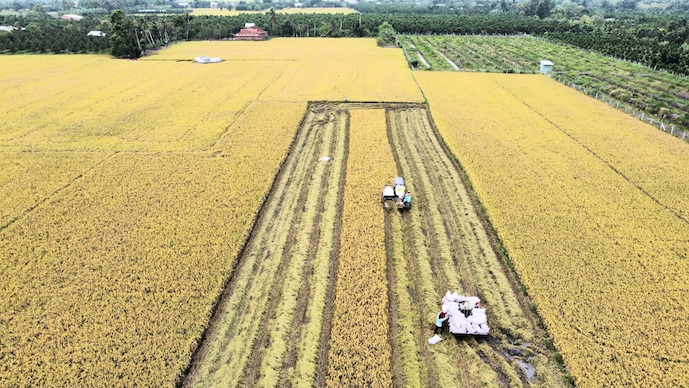
Vietnam's rice sector made US$4 billion in export revenue in the first 10 months of 2023, a record-breaking milestone after 34 years of entering the global rice market. However, industry experts caution that beneath this success lie hidden challenges and uncertainties.
Vietnam’s rice shines in global market
In October, Vietnam exported 700,000 tons of rice valued at US$433 million, a 17% increase in volume and a 35% surge in value compared to the same month in 2022, as reported by the Ministry of Industry and Trade. The figure took the country's total rice exports in the first 10 months of this year to around 7.1 million tons worth US$3.97 billion, up by 17% in volume and 35% in value against the same period last year.
Vietnam has now officially achieved a new historical record in rice exports after 34 years in the export market.
Moreover, Vietnam's rice exports are anticipated to reach eight million tons in all of 2023, valued at US$4.5 billion, making it a bright spot in the export sector, according to Tran Thanh Binh, head of the Import and Export Department at the Ministry of Industry and Trade. Binh made these remarks at a recent seminar titled "Enhancing the Efficiency of Vietnam's Rice Value Chain" in Can Tho City. She emphasized that alongside fruits, the rice sector plays a major role in Vietnam's agricultural, forestry, and aquatic exports this year, contributing significantly to the agricultural export target of US$55 billion in 2023.
Binh mentioned that the year-end performance report from the Ministry of Industry and Trade, scheduled for release in December, will highlight the rice industry as a pivotal contributor to Vietnam's agricultural exports, with the potential to surpass the country's 2023 targets.
Furthermore, Vietnam's rice prices have set new records, surpassing those of its competitors in the same market segment. The Vietnam Food Association reports that Vietnam's 5% broken rice is priced at US$653 per ton, which is US$93 higher than Thailand and US$90 higher than Pakistan. Similarly, Vietnam's 25% broken rice trades at US$638 per ton, surpassing Thailand by US$118 and Pakistan by US$150.
These export achievements, coupled with robust pricing, have led to substantial profits for rice farmers in the Mekong Delta region. With record-high prices ranging from VND9,000-9,500 per kilogram of fresh rice, farmers are now earning VND52-54 million per hectare, with profits exceeding VND30 million per hectare.
Risks of incurring losses
While Vietnam celebrates record-breaking rice exports in terms of both quantity and price, the reality for rice exporters is quite different, with many facing significant losses.
Tran Tuan Kiet, director of Southern Food Import Export Company, revealed in an interview with The Saigon Times that his company is currently dealing with losses amounting to VND6-7 billion in its rice trading operations. He attributed these substantial losses to the sudden surge in rice prices, especially during the procurement period to fulfill prior contracts for African and Philippine markets.
As businesses continue to enter into new contracts, the rising prices pose a considerable challenge for rice exporters. Kiet cited the example of a recent import tender by Indonesia in mid-October 2023, where Vietnamese businesses secured contracts for 100,000 tons of rice at a price of US$625 per ton at the Indonesian port, equivalent to around US$600 per ton at the free-on-board price at the HCMC port. However, with current market prices at US$650 per ton, these exporters now face a loss of US$50 per ton.
Moreover, the procurement of rice lags behind due to difficulties in obtaining bank loans, making it hard for businesses to keep up with the rising prices. Kiet stressed the importance of timely loan disbursement, as delays in fulfilling signed contracts could result in substantial penalties, amounting to VND500-600 million per day for vessels waiting to be loaded.
To mitigate losses in the volatile rice market, some industry experts suggest a proactive approach—warehousing rice before signing contracts, rather than signing export agreements and then procuring the grain, as is the current practice.
Risks of losing clients
Vietnam's rice industry faces challenges and uncertainties despite its record-breaking exports. Nguyen Viet Anh, general director of Orient Rice Company, highlighted the unpredictability of rice prices, which are currently at excessively high levels, carrying significant risks. Businesses are hesitant to stockpile rice before signing contracts, fearing a rapid price decline if India lifts its rice export ban, which may happen in March or May 2024.
Vietnam's rice prices, significantly higher than those of competitors like Thailand and Pakistan, could lead to a loss of lucrative export contracts. In the short term, this impact is already evident, with current contracts shifting as buyers turn to Thailand due to its comparatively lower prices, about US$100 per ton less than Vietnamese rice, according to Anh. Recent tenders in the Indonesian market have also seen Vietnamese firms refraining from bidding due to difficulties in procuring rice for sale.
Looking ahead to 2024, Anh predicts a narrowing gap in export prices between Vietnam and its competitors, as persistent disparities in pricing could pose significant risks and potentially lead to substantial market loss.
Pham Quang Dieu, chief economist at Vietnam Market Analysis and Forecast JSC, emphasized that Vietnam's record rice exports have concealed challenges for businesses. While farmers have benefited from high prices during India's export ban, export businesses have faced numerous difficulties, indicating issues within production structures and export businesses in Vietnam's rice economy.
While Vietnam is set to export a record eight million tons of rice in 2023, the outlook for 2024 remains uncertain. "The rice market is highly volatile, and even the smallest change in weather or policy can have a significant impact on market dynamics," Dieu said.
"Success in rice export requires swift responses from all stakeholders in the value chain," Dieu added, citing the recent flexibility of the State Management Agency in governing exports as evidence that Vietnam is taking advantage of opportunities. "However, if we are too worried about food security and the risk of food price surges and ban rice exports, we will miss the opportunity."