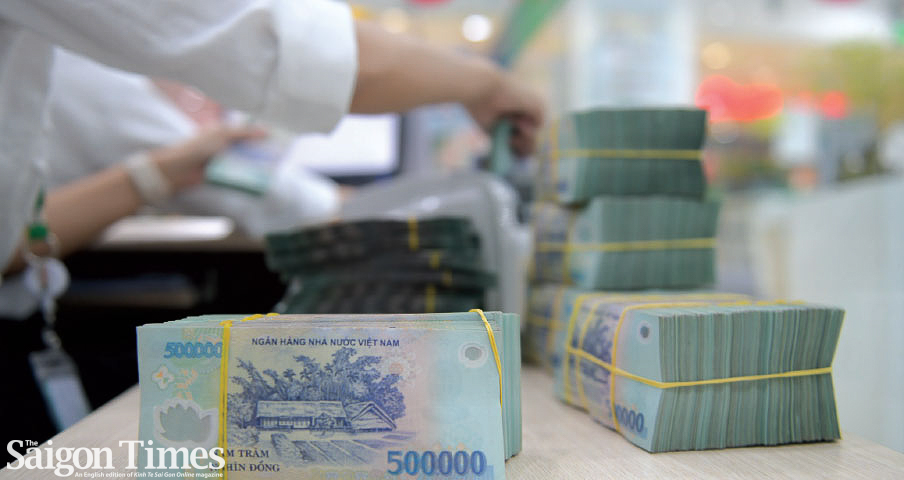
Credit has been expanding rapidly, while capital mobilization is growing at a slower pace, placing mounting pressure on the balance sheets of commercial banks. Against this backdrop, the State Bank of Vietnam (SBV) has just decided to cut the reserve requirement ratio by half for four banks tasked with taking over four weak banks placed under special control. This move is not only an immediate capital support measure but is also seen as a policy “carrot” for institutions shouldering heavy responsibilities.
Rapid credit growth, rising interest rate pressure
According to the SBV, as of July 28, 2025, loans in the banking system had risen by around 9.68% compared to the end of 2024—higher than the same period last year. The surge in capital demand stems from consumption, trade, and investment across both the public and private sectors, helping to boost credit growth across all fields. The National Statistics Office (NSO) reported that total retail sales of goods and services in the first half of the year grew 9.3% year-on-year, while total investment capital in the society increased 9.8%. Public-sector consumption expanded, and trade activities remained resilient despite ongoing tariff-related uncertainties.
Meanwhile, capital mobilization during the same period grew only 6.72%, about 3 percentage points lower than credit growth. In absolute terms, the gap has reached VND1,400 trillion—nearly double the VND760 trillion recorded at the same time last year. This wider gap signals increasing liquidity pressure, leaving the banking system in a bind: tasked with expanding credit aggressively while still safeguarding the safety of its capital base.
The Government has also just raised its 2025 GDP growth target to 8.3%, which implies credit growth of 18–20% will be needed to support it. With credit expansion having reached only about half that level in the first seven months, pressure on the remainder of the year is immense. At the same time, banks are expected to keep lending rates low to aid economic recovery—forcing them to cut loan rates even as deposit rates are unlikely to fall further. The result is a squeeze on net interest margins (NIM), which have already narrowed significantly from 3.31% in Q4 2024 to just 3.12% in Q2 2025.
In the long run, to balance capital supply and demand, banks will be compelled to close the gap between deposits and loans by making deposits more attractive—through rate adjustments and ramped-up bond issuance—to sustain a more stable funding structure.
The policy puzzle: balancing interest rates and exchange rates
The biggest challenge in monetary policy management today is ensuring sufficient credit growth to support economic expansion while keeping interest rates at reasonable levels and maintaining exchange rate stability. This task has become even tougher as the U.S. Federal Reserve (Fed) keeps interest rates high for longer than expected, while Vietnam’s foreign reserves remain limited due to sluggish inflows of trade and foreign investment—partly because of unresolved tariff issues.

As a result, stabilizing the U.S. dollar/Vietnam dong exchange rate has remained a persistent challenge throughout the first half of the year, forcing the SBV to adopt highly flexible policy maneuvers.
Facing liquidity strains, the SBV has continuously injected and absorbed capital through treasury bills and the open market operations (OMO) channel, with net positions at times reaching nearly VND250 trillion across multiple maturities. Nevertheless, in order to manage the exchange rate, the SBV has flexibly adjusted interest rates, maintaining a suitable rate environment to minimize the gap with external interest rates (particularly the U.S. dollar). Analysts are currently most optimistic about the possibility of the Fed cutting rates in September 2025, followed by another cut in December 2025, which would gradually ease the pressure on the Vietnamese dong. However, uncertainties remain, and the SBV is expected to continue its flexible and cautious policy management—ensuring ample liquidity while at the same time keeping the interbank rate at around 4% to stabilize the exchange rate.
In this context, the SBV has just issued Circular 23/2025/TT-NHNN, halving the reserve requirement ratio for four banks that have been mandated to take over four commercial banks under special surveillance. This policy frees up about VND50–60 trillion in reserve capital, thereby enhancing liquidity and lending capacity for the receiving banks. More importantly, it signals the regulator’s willingness to share the burden with institutions entrusted with this state mission.
A motivation for mandated banks
Taking over weak banks for restructuring has long been a heavy burden, involving the resolution of massive bad debts, governance reform, and the acceptance of prolonged opportunity costs. Alongside the various regulations previously issued to support banks tasked with restructuring troubled institutions, this time, the reserve requirement cut can be considered a tangible “carrot”—equivalent to trillions of Vietnam dong in saved opportunity costs each year. This capital advantage allows these banks to continue expanding credit, ease funding pressure, adjust lending rates more flexibly, and strengthen competitiveness.
In addition, banks carrying the restructuring mandate are also prioritized with higher credit limits, easier access to refinancing, and preferential support packages. As a result, they enjoy a differentiated position within the system, turning liquidity advantages into the ability to provide capital at lower costs.
Of course, such incentives come with heavy responsibilities. The effectiveness of restructuring depends not only on supportive policies but also on each bank’s management capacity and financial resilience. Therefore, the reduction in reserve requirements should be seen both as a motivation mechanism and as a commitment from the State to accompany and share risks with institutions that take on major responsibilities.