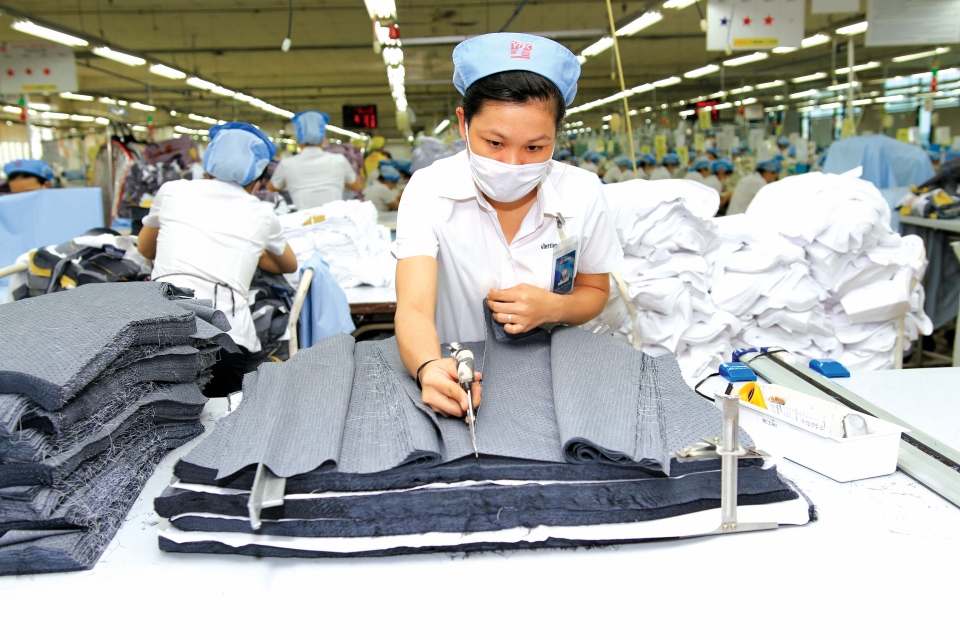
There is a glimmer of hope on the horizon for Vietnam’s textile and garment industry, as signs of recovery have started to surface.
The fall in orders bites
Vietnam’s textile and garment exports have encountered a raft of challenges since the beginning of 2023. Factors such as rising global inflation and sluggish economic growth have dampened demand from major export markets, significantly impacting the profitability of businesses in the sector, particularly those heavily reliant on exports.
Most textile and garment companies posted lower profits in the first nine months of 2023 than in the same period last year, with some even incurring substantial losses. Thanh Cong Textile Garment Investment Trading JSC’s (TCM) profit in January-September fell by half year-on-year to VND111 billion. This year, TCM aims for after-tax tax profit of VND245 billion, which is already 13% lower than in 2022. However, this target is now tough to realize under the current circumstances.
Similarly, Century Synthetic Fiber Corporation (STK) grappled with a 36% year-on-year drop in net revenue and a significant 72% decrease in net profit, totaling VND1,073 billion and VND56 billion, respectively. Viet Thang Corporation (TVT) posted profit of just VND6 billion in the first three quarters, a mere one-tenth of the previous year’s earnings.
In a similar vein, Garmex Saigon Corporation (GMC) posted a drastic 97% reduction in net revenue, plunging from VND275 billion in the first nine months of 2022 to a meager VND8 billion in the corresponding period this year. During this period, its net losses surged from VND7 billion in 2022 to VND44 billion in 2023.
Hanoi Textile and Garment Joint Stock Corporation (HSM) experienced a significant reversal in fortunes in January-September this year, transitioning from a profit of VND23 billion in the same period last year to a loss of VND55 billion. Gilimex (GIL) also faced substantial financial setbacks, reporting net losses exceeding VND63 billion, a stark contrast to the profit of VND352 billion recorded in the first nine months of 2022.
The weakened demand in export markets was the primary driver behind the significant profit declines among textile and garment companies, leading to a reduced volume of new orders. For instance, GMC, one of the most severely impacted companies, saw no revenue from their partner GIL, potentially due to the fallout from a legal dispute between GIL and the e-commerce giant Amazon Robotics LLC. This not only affected GIL but also had a ripple effect on affiliated businesses like GMC. The Amazon case serves as a compelling illustration of the perils associated with overdependence on a single client. When such a customer alters its policies, companies like GIL find themselves in a precarious position, with their production and business operations severely disrupted.
In addition, TNG Investment and Trading JSC (TNG) reported that the revenue generated in the third quarter primarily originated from orders placed in June 2023. Global uncertainties prompted some key clients to scale back their order volumes, while production and business operation costs remained constant, resulting in a significant profit decline for TNG. Similarly, STK attributed its diminished sales volume and discount pricing to the contraction in the volume of orders received from its clients.
A brighter outlook

The textile and garment industry in Vietnam has faced a multitude of challenges since the beginning of 2023, including global trade disruptions and excessive inventories that have significantly dampened consumer demand, particularly for textile and garment products. Businesses within this sector have been grappling with the difficult task of securing new orders while safeguarding their established export markets.
Notably, profit margins for textile and garment companies have contracted due to a sharp drop in prices, with some even resorting to offering half-price discounts. Despite these obstacles, many companies have chosen to embrace lower prices to maintain their production operations and business partnerships. Furthermore, Vietnam’s textile and garment industry faces intense competition from Bangladesh, which, along with 44 other developing nations, enjoys duty-free access to the European Union.
According to a Survey of Large Retailers, Vietnam receives higher ratings for product quality and manufacturing capabilities, yet Bangladesh holds a cost advantage due to various government incentives, including customs benefits and interest subsidies.
A recent report from SSI Research indicated that cost is one of the most critical factors when retailers select manufacturing partners, especially during economic downturns. Bangladesh offers a minimum wage of US$75 per month, significantly lower than Vietnam’s US$199 per month and China’s US$300 per month. Despite these cost differences, SSI Research remains optimistic, highlighting Vietnam’s strengths in product quality, labor productivity, and delivery times, which are all essential factors for retailers during an economic and demand rebound.
Despite ongoing challenges, there are promising signs of recovery for Vietnam’s textile and garment industry. According to data from the General Department of Vietnam Customs, Vietnam’s textile and garment exports surpassed US$9.35 billion in the third quarter of 2023. While this figure represents a 10% decline compared to the same period last year, it marks the second consecutive quarter of growth in textile and garment exports, indicating that the industry is gradually recovering its momentum.
Moreover, most companies in the industry reported disappointing business outcomes in the fourth quarter of 2022, prompting expectations of a reversal and positive profit growth from the fourth quarter of 2023. Historical data suggested that when the peak of clothing inventory in the U.S. was reached in January 2007, it took two years for the market to absorb this excess before embarking on a recovery that lasted until December 2009. Therefore, it is anticipated that demand for textile and apparel products in the U.S. will resume its growth trajectory starting from the first quarter of 2024, fueled by an improved macroeconomic environment.
Simultaneously, strong demand during the year-end holiday season could boost sales and reduce the current inventory, creating opportunities for new orders to meet the needs of the spring-summer season of 2024.