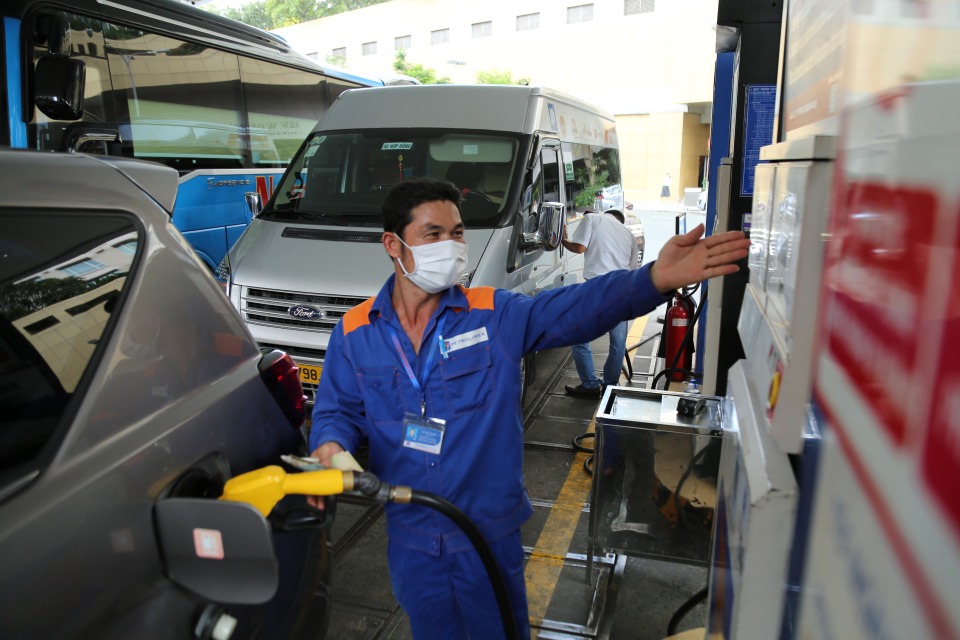
Volatile fuel prices and the risk of energy supply disruptions are testing Vietnam’s ability to manage systemic risks as global geopolitical tensions grow increasingly unpredictable
Fuel price surge jolts households and businesses
A fuel price shock triggered by supply disruptions linked to the conflict in the Middle East has affected economies worldwide, including Vietnam, which still relies heavily on imported fuel.
Vietnam’s two oil refineries—Dung Quat and Nghi Son—currently meet about 70% of domestic fuel demand. However, to produce that volume, the country must import around 19 million tons of crude oil as feedstock.
To cover the remaining 30% of demand, Vietnam imports another 10 million tons of refined petroleum products.
“The total cost of importing refined fuel and crude oil is about US$18 billion. In addition, Vietnam imports more than 3.2 million tons of liquefied gas, valued at over US$2 billion, to supply power plants and domestic consumption,” said Nguyen Quang Khai, who previously served as Vietnam’s ambassador to Iraq, the UAE and several Middle Eastern countries.
This dependence means Vietnam’s economy is vulnerable whenever global oil prices rise, pushing up import costs and domestic retail fuel prices. The effects have become more immediate under a new pricing mechanism that allows authorities to adjust domestic fuel prices instantly when global prices fluctuate by 7% or more within a single day.
Between March 7 and March 10, fuel prices repeatedly hit new highs, far above levels recorded a week earlier. Concerns about possible shortages triggered panic buying.
According to the Department of Industry and Trade of Hanoi City, fuel consumption in the city jumped 30–50% compared with the previous day, overwhelming many gas stations. Market surveillance authorities reported that about 20 fuel stations temporarily halted sales or ran out of fuel by March 8 as supplies could not be replenished in time.
At a meeting on March 10, Nguyen Sinh Nhat Tan, deputy minister of Industry and Trade, said mandatory reserves held by major distributors could ensure 20 days of supply, meaning Vietnam had not yet needed to tap national reserves, which are intended only for severe supply disruptions.
Still, long queues were reported that day, with many people waiting 30–45 minutes to refuel.
From the production side, Nguyen Viet Thang, general manager of Binh Son Refining and Petrochemical JSC, said the company had raised inventory levels, adjusted production in line with market demand and diversified crude supply sources since early 2026 to prepare for double-digit growth and potential global disruptions.
However, 30–35% of the crude oil used at the Dung Quat refinery is imported from West Africa, the Mediterranean, the United States and partly the Middle East. Thang warned that crude prices, surcharges, freight costs and insurance premiums could rise further if the conflict persists, increasing input costs and financial risks.

Deputy Minister Tan said Vietnam sources crude oil from Southeast Asia, the United States and the Middle East. Some shipments from the Middle East have been delayed due to regional tensions, though global supply remains sufficient, with price being the main concern.
Another risk is potential supply chain disruption if exporting countries restrict shipments to prioritize domestic demand. This could affect refinery operations, particularly in late second quarter and early third quarter of 2026.
“When geopolitical tensions escalate in the Middle East, demand for domestic crude rises, leading to fierce competition in international tenders,” Thang told reporters.
For Vietnamese businesses, rising costs remain a key concern. A recent survey by Vietnam Report found 70.4% of enterprises identified energy and raw material price volatility as the second-biggest challenge in 2026.
The combination of geopolitical instability and input price swings suggests that external shocks are quickly factored into domestic production costs, adding uncertainty to business planning.
Building multi-layered shock absorbers
Given that fuel is a strategic commodity and a finite resource, Nguyen Thuong Lang, associate professor at the School of Trade and International Economics under the National Economics University, said Vietnam needs more proactive measures to stabilize the fuel market.
In the short term, the Government should clearly disclose national fuel reserves, supply capacity and market management plans. Transparent information could help ease public concerns and reduce panic buying.
Authorities should also tighten oversight to prevent hoarding, speculation or market manipulation.
“Fuel distributors and large petroleum companies should proactively disclose supply information and their ability to meet demand to strengthen consumer confidence,” Lang said.
He added that the Government’s energy security task force should advise on negotiation strategies with fuel exporters. Amid global market volatility, some suppliers may attempt to push prices higher.
“Appropriate negotiation mechanisms are needed so partners share risks with Vietnam and avoid taking advantage of volatility to raise prices excessively,” Lang said.
In practice, Binh Son Refining and Petrochemical JSC began purchasing high-octane gasoline blending components in February 2026. However, by March it had not secured the planned volume because of tight supply and strong market volatility.
The company has sought priority access to domestically extracted crude oil and condensate. It also suggested temporarily prioritizing domestic crude for the Dung Quat oil refinery while limiting crude exports during the high-risk period through the end of the third quarter of 2026 or until global markets stabilize.
Beyond short-term measures, Vietnam plans to build dedicated fuel storage facilities to raise reserves to the equivalent of 15–20 days of net imports by 2030, under Decision 861/2023 on fuel and gas storage infrastructure.
After 2030, reserves of refined fuel and crude oil are expected to increase to 25–30 days of net imports.
Together with commercial and production inventories, Vietnam aims to raise total national crude and fuel reserves to 75–80 days of net imports, with a longer-term target of 90 days.