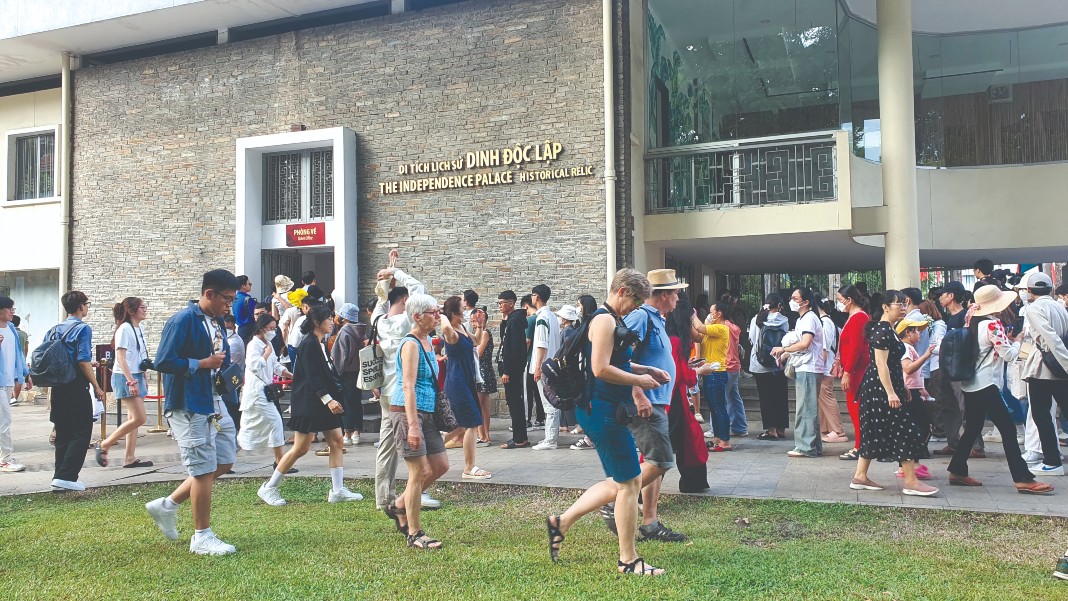
Total retail revenue of goods and services are slowly recovering, indicating that consumers are still restricting spending amid inflation concerns.
Low demand
In April, total retail sales slightly increased from the previous months, reaching VND522.1 trillion. This marginal rise is a clear indication that domestic consumer spending remains largely lackluster.
Spending on accommodation, dining, and travel improved mildly, primarily driven by a surge in international tourism. In the first quarter of the year, international visitor arrivals rose by a sharp 68.3% compared to the same period last year to 6.2 million. Domestic tourism also grew steadily, with the number of local tourists rising by 6.5% to 40.5 million. Despite these positive signs in the tourism sector, overall domestic spending on these services has not expanded significantly, continuing the trend of sluggish spending that began in late 2023 and persisted through the early months of 2024.
Looming inflation hits consumption
The first four months of 2024 saw average inflation of 3.93% compared to the same period in 2023, signaling greater economic pressure and dampening consumer spending. In contrast to 2023, where the consumer price index (CPI) benefitted from a significant drop in transport costs during the first half of the year, 2024 has seen a general upward trend across major CPI components, including catering and dining services, housing and building materials, and notably, transport.
Transport costs have edged up from the low base recorded in the second quarter of 2023. With oil prices remaining high, the transport sector is expected to drive a significant rise in the CPI in the latter half of the year. The CPI for catering and dining services has been steadily increasing, further contributing to the overall growth in CPI in recent months.
This uptick in inflation is largely driven by cost-push factors, such as rising prices of materials and raw goods essential for production. As a result, consumers face higher costs for basic necessities like food, electricity, and building materials. This increase in living costs directly curtails their discretionary spending on activities such as dining out, shopping, and traveling, ultimately impacting overall consumption patterns.
Room for consumption stimulus?

In an effort to boost aggregate demand, the Government has presented a proposal to the National Assembly that includes continuing a two-percentage-point reduction in the value added tax (VAT) for certain goods and services currently subject to the standard 10% rate. This VAT cut, initially implemented in the first half of 2024, is part of a broader package aimed at fueling economic growth into the second half of the year.
Alongside the VAT cut, the Government's proposal includes extending the deadlines for payment of VAT, corporate income tax, special consumption tax, and personal income tax. It also suggests lowering some fees, charges, and land rent, maintaining the supportive measures introduced in 2023 to alleviate challenges and bolster production and business.
While these fiscal policy measures are designed to spur consumption in the latter half of 2024, their effectiveness may be constrained by fundamental economic issues, particularly stagnant income levels. As incomes remain unchanged, the scope for stimulating consumption through fiscal measures alone appears limited, indicating that broader economic strategies may be needed to effectively boost consumer spending and drive economic growth.