Vietnam’s woodwork industry is grappling with a critical weakness in raw materials amid stricter origin-tracing requirements
A truck laden with acacia wood, harvested from Le Hoan’s planted forest, crawled through the rugged terrain of Ky Anh, a mountainous district in Ha Tinh Province. Even the very people who cultivated the trees had no idea where the timber was headed. Perhaps it would be pulped into paper, or sawn, painted, and transformed into dining tables or wardrobes, destined for export to Europe at the discretion of the buyer.
That was the story of the past. Today, anonymity is no longer an option for timber. To leave Haiphong Port or Cat Lai Port for Europe, every woodwork consignment must carry a “passport”—a detailed record that includes the precise coordinates of the tree’s origin, proof that the land used for cultivation was not subject to deforestation or forest degradation after December 31, 2020, and legal documentation for every stage the wood has undergone.
This is the new commercial reality for timber and wood products under the EU Deforestation Regulation (EUDR), which will apply to large companies starting in December 2025 and to smaller businesses from June 2026. For Vietnam—where the EU remains the leading market for wood exports—the EUDR has laid bare a critical vulnerability in the industry’s supply chain: the weakness in sourcing compliant raw materials.
Stricter rule
Europe has long sought to keep illegal timber out of its market. As early as 2003, the EU began encouraging countries to adopt legal wood sourcing practices. This effort culminated in the European Union Timber Regulation (EUTR) in 2010, which prohibited the import of illegally harvested wood into the bloc. Now, the EUDR takes that commitment further—requiring businesses to demonstrate, through spatial data and risk assessments, that their products are not linked to deforestation or forest degradation. The scope of the EUDR extends beyond timber, also covering commodities such as coffee, cocoa, soybeans, palm oil, livestock, and rubber.
Its focus is the Due Diligence System (DDS), which covers: (i) Information collection – Name of wood, volume of wood, country of exploitation, accurate coordinates of the forest lot, supplier information, and evidence of legal exploitation. In particular, this information must always be available for presentation to the competent authority upon request. (ii) Risk assessment – Analyze the collected information and apply measures to identify the possibility of EUDR violations, based on the origin of wood, regional deforestation trends, the rights of native communities, and the quality of the dossier. (iii) Risk reduction – If the risk exceeds the “insignificant” level, businesses must provide additional proof, conduct independent inspections and assessments, or restructure their wood supply sources.
If businesses fail to comply, they can be fined up to 4% of their revenue in the EU. For a middle-size woodwork exporter in Vietnam, this fine can “erode” the profit of the year.
Small forests and the supply bottleneck
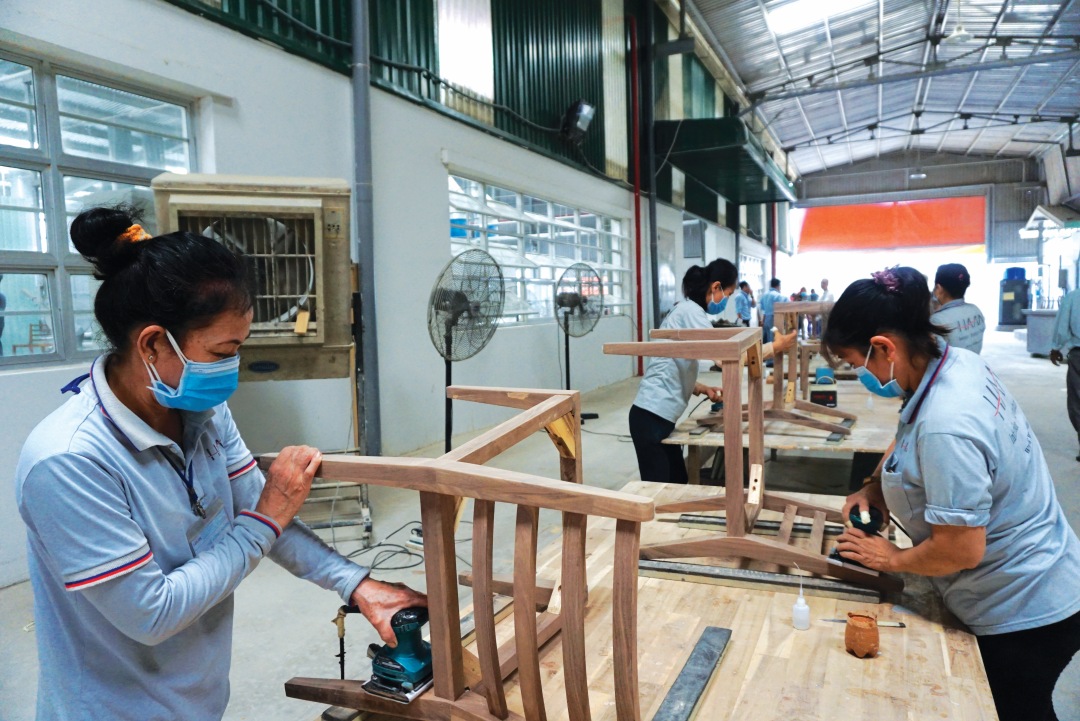
Vietnam’s woodwork industry owes its export success to large-scale processing for the global market. In 2024, exports of wood and wood products reached a record high of US$16.25 billion, according to the General Department of Vietnam Customs. However, the picture behind the raw material supply remains fragmented. Over 80% of production forests are owned by households, each managing small plots of less than two hectares. In many cases, the land use right certificates held by these households do not accurately reflect the actual land area, creating inconsistencies in documentation and traceability.
Wood often passes through multiple traders before reaching the factory, and is typically blended from various lots to meet shipment requirements. This process disrupts the chain of custody (COC), making traceability difficult. Domestic wood sources still fall short of meeting material demand. In just the first half of 2024, Vietnam imported wood from 102 countries—over 83% of which was raw material. Notably, about one-third of these imports originated from areas classified as “high risk” under the EUDR.
Even when wood export countries issue legal papers, these documents often lack information on coordinates or are based on old surveys. In countries with political unrest, the documents may be inconsistent, incomplete or falsified. When the wood is mixed by traders, origin tracing is nearly impossible.
“The EUDR requires information for coordinates and evidence for regulatory compliance by the forest lot and the initial material across all phases of the COC. This is a big challenge for businesses,” said Luu Cong Sang, senior assessment expert of SGS Vietnam, which specializes in international inspection, testing and quality certification.
That said, to comply with standards, even a foot of a chair sold in Paris must allow for tracing to a specific land lot in Ha Tinh Province of Vietnam or somewhere in South America.
Two parallel wood sources—timber from domestic planted forests and imported wood—are often intermingled, creating bottlenecks that are difficult to resolve. Meanwhile, the EUDR requires exporters to consolidate fragmented data into a coherent chain of evidence, enabling precise traceability down to each square meter of forest. In other words, holding a legal permit is merely the starting point; it must be supported by a comprehensive and verifiable documentation trail.
Small businesses, big pressure

Businesses with vertically integrated information systems and ownership of forests in low-risk areas are better positioned to adapt. Their ability to measure once, input data into the DDS, and oversee the entire production process gives them a clear compliance advantage. However, the majority—nearly 6,000 timber and forestry production and processing enterprises—face a far more difficult path. To meet EUDR requirements, they must rebuild their systems from the ground up: hiring compliance personnel, training suppliers, measuring each forest plot, and even redesigning factory layouts to separate compliant and non-compliant materials. This separation comes at a high cost. It requires distinct warehouses, production lines, and rigorous container-level inspections. The expense of full EUDR compliance rises in proportion to the complexity of the supply chain.
Then, the noticeable reaction from big exporters is to drop risky suppliers, leading to concentration. This can eliminate the opportunity to access the EU market for micro and small businesses.
Existing forest certification systems offer only partial support and cannot serve as a definitive “passport” under the EUDR. The FSC (Forest Stewardship Council) certification has been updated with a “legal module” to align with EUDR requirements, including geolocation data, DDS operation, and risk control. Businesses holding FSC certification can demonstrate that they have established management and oversight processes. However, under the stringent demands of the EUDR, the certificate is regarded as supplementary evidence—not a guarantee of compliance. Woodwork shipments may still be halted if authorities request original data or conduct unannounced inspections.
Risk reduction
According to experts from SGS, Vietnamese wooden goods exporters aiming to meet EUDR requirements should begin their risk reduction strategy with clear and transparent identification of the wood dossier. The wood species must be accurately named, and all legal documents—including permits from FLEGT (Forest Law Enforcement, Governance and Trade), CITES (Convention on International Trade in Endangered Species of Wild Fauna and Flora), and CCR (Continuing Certification Requirements), as well as the forest product list—must reflect actual conditions. For imported wood, priority should be given to sourcing from countries with low risk profiles, valid land use right certificates, and verifiable evidence of no deforestation since December 31, 2020.
If a wood consignment includes multiple species or timber sourced from various forest plots, each component must be accompanied by its own set of coordinates and documentation. Transaction records must remain consistent throughout, and the details of every supplier in the supply chain must be fully documented. The most effective approach is to streamline the process by importing wood directly from producing countries, reducing the number of intermediaries, and prioritizing suppliers with strong compliance records and internationally recognized certifications such as FSC or PEFC (Program for the Endorsement of Forest Certification). “The wood lots should be separated—even within the same container—to minimize losses in case of risk,” advised Sang of SGS Vietnam.
Legal compliance in producing countries is equally rigorous. Businesses must demonstrate that they have fulfilled tax obligations, adhered to anti-corruption regulations, and respected local customs and practices. Environmental permits and, where applicable, environmental impact assessment reports must be formally approved. Labor documentation must include employment contracts, payroll records, social insurance contributions, and proof of compliance with occupational safety standards. Human rights must also be upheld—companies are required to respect third-party rights and avoid involvement in disputes or litigation.
Commercial and transport documents—including contracts, invoices, bank transfers, and delivery receipts—must align with the wood origin records. For businesses that directly harvest timber, full adherence to legal procedures is essential. Ideally, they should operate under internationally recognized sustainable forest management certifications such as FSC, PEFC FM (PEFC Forest Management), and COC.
On a positive note, experts from SGS view EUDR compliance as a strategic opportunity for businesses to strengthen their reputation, boost competitiveness, and elevate product value—opening doors to one of the world’s most demanding markets.
In summary, while the EUDR imposes strict requirements, it can serve as a powerful lever to propel Vietnam’s wood industry into a higher-value segment. A transparent supply chain not only facilitates entry into the EU but also positions businesses to win over premium customers in other markets where sustainability is a non-negotiable standard.