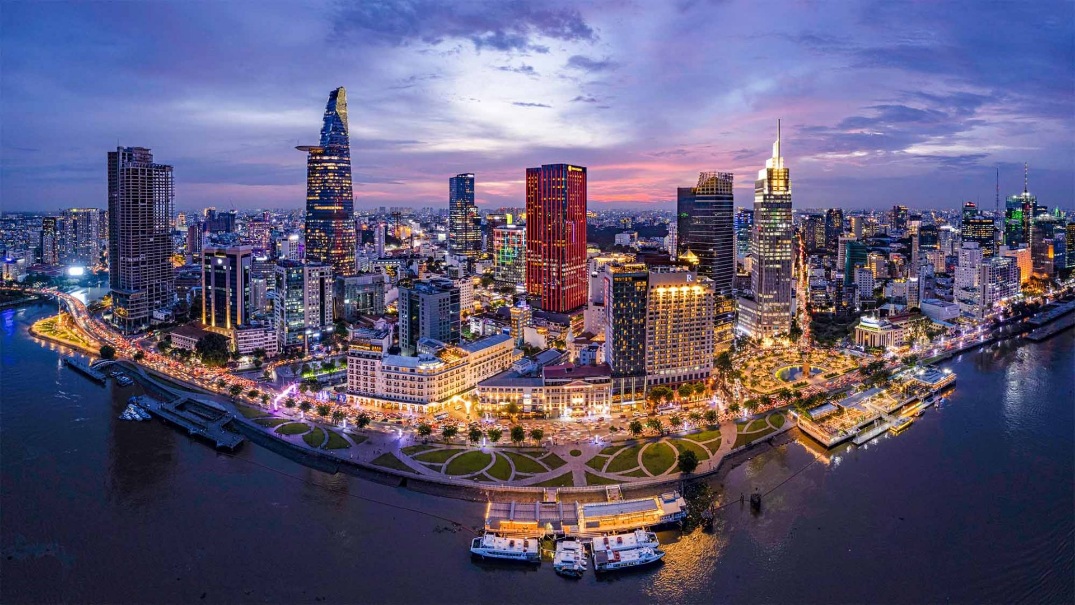
June 2025 marks a historic milestone in Vietnam’s development, as the National Assembly passed Resolution 202/2025/QH15 on June 12, approving the restructuring of provincial-level administrative units. This landmark decision paves the way for the creation of a greater Ho Chi Minh City (HCMC) through the merger of Binh Duong and Ba Ria-Vung Tau provinces into the current HCMC.
The estimated gross regional domestic product (GRDP) of this megacity surpasses VND2.7 quadrillion, contributing nearly one-fourth of the national total. This positions the new HCMC as a highly anticipated economic powerhouse, poised to become a leading center for commerce, science, and technology on both regional and global scales.
However, unlocking this immense potential requires a strategic, well-coordinated development plan with a long-term vision. To gain deeper insights into the planning framework and key economic growth drivers for the promising megacity, The Saigon Times spoke with Pham Tran Hai, who holds a Ph.D. and works for the HCMC Institute for Development Studies.
Local authorities decide, act and take responsibility
The Saigon Times: What opportunities and challenges will arise from the merger of HCMC, Binh Duong and Ba Ria-Vung Tau provinces in shaping a unified and effective planning strategy for the megacity?
Pham Tran Hai: The restructuring of provincial-level administrative units and the development orientations of the merged provinces and cities are matters of utmost urgency, particularly for the new HCMC. As the nation’s largest economic hub—boasting GRDP of an estimated VND2.72 quadrillion, or around 24% of Vietnam’s GDP—strategic planning and coordinated governance will be essential to ensuring sustainable growth and unlocking its full economic potential.
A clear and unified planning orientation will serve as a guiding principle, ensuring synchronized, efficient, and sustainable development across the three merged provinces. This approach will help streamline growth efforts, minimize redundancies, and optimize resource allocation.
To prevent legal “gaps” and ensure continuity in socio-economic activities, particularly public investment, the previously approved provincial planning framework should be integrated into the new HCMC planning for the 2021-2025 period, with a lo vision extending to 2030.
The prime minister should approve the new HCMC planning immediately after the provincial merger. A crucial aspect of this process is delegating power to the People’s Committee of the new HCMC, enabling them to approve adjustments to the planning. These modifications should be made after consulting the Ministry of Finance and securing approval from the city’s People’s Council. This approach fully aligns with the principle of “local authorities decide, act, and take responsibility.”
To achieve double-digit economic growth for the new HCMC, what key development strategies should we focus on in the upcoming adjusted planning?
To achieve double-digit economic growth in the region, the new HCMC planning for the 2021-2030 period with a vision to 2050 should be urgently revised. The focus should be on key development strategies and priority investment projects.
I have several suggestions for reviewing and refining development strategies, beginning with restructuring key development zones. A comprehensive reassessment of existing growth areas in HCMC, Binh Duong, and Ba Ria-Vung Tau is essential. The goal is to fully leverage the unique strengths of each former locality while preventing unnecessary competition among projects, which could lead to unintended negative consequences.
An effective restructuring strategy will ensure that social and economic resources are allocated strategically, maximizing both economic and social benefits for the entire new HCMC.
Second, strengthening connectivity between development zones. The merger will significantly expand the geographical scope of the new HCMC, making it crucial to prioritize modern, integrated transportation infrastructure alongside advanced digital transformation to bridge the increased physical distances. Enhanced connectivity will streamline the movement of goods, services, and labor across regions, fostering comprehensive and sustainable economic growth.
Third is enhancing infrastructure sharing and utilization. It is essential to encourage and facilitate shared usage of both technical and social infrastructure among the formerly separate regions of HCMC, Binh Duong, and Ba Ria-Vung Tau.
This approach would optimize resources by pooling investment in key facilities such as wastewater treatment plants, solid waste management sites, water supply systems, and transportation hubs. Additionally, the joint utilization of educational institutions, healthcare facilities, and cultural-sports centers would ensure more efficient service delivery while reducing operational costs.
Fourth is synchronizing infrastructure development. A well-defined roadmap and a strategic planning approach are crucial for harmonizing the development of technical and social infrastructure across regions. The goal is to minimize disparities in development levels among different areas, fostering balanced and stable growth for the new HCMC.
Removing non-essential projects from the priority investment list
Regarding economic growth drivers, what policy priorities should be set to attract domestic and foreign investment into key sectors of the megacity?
I have several suggestions based on the review and adjustment of the development strategies above. The assessment and refinement of priority investment projects must be conducted carefully and systematically. For projects previously listed in the approved provincial planning priority categories, they should be classified into two main groups: projects with increased urgency and projects with reduced urgency or no longer essential.
In the context of the provincial merger, certain projects will become more urgent than ever and must be prioritized for investment allocation through 2030. I believe these fall into the high-priority project group.
Typical examples include urban railway projects, beltways such as Beltway 4, and radial and central highways connecting different areas. Additionally, social housing projects, as well as housing for government officials, civil servants, and public employees, must be prioritized to meet the settlement and living needs of residents in the new HCMC.
Accelerating digital infrastructure and transformation projects will support the growth of the digital economy. These initiatives will enhance technological connectivity, streamline governance, and foster innovation-driven development.
A key priority is addressing disparities in technical and social infrastructure among the formerly separate regions of HCMC, Binh Duong and Ba Ria-Vung Tau. Focused investment must be directed toward underdeveloped areas.
Conversely, some projects have decreased in urgency or may no longer be suitable within the context of the new HCMC. It is crucial to carefully assess investment allocation for these initiatives—or even boldly reconsider removing them from the priority investment list for the period leading up to 2030.
Some projects, such as administrative and political buildings, may no longer be relevant given the streamlined governance structure and the current two-level local government model. Likewise, industrial zone developments in suburban areas undergoing urbanization within the existing HCMC may be put under review to avoid unnecessary competition with well-established industrial zones in Binh Duong and Ba Ria-Vung Tau.
Similarly, technical and social infrastructure projects from previously separate provinces that overlap or compete with one another must undergo thorough reviews.
Additionally, high-priority projects arising from the provincial merger must receive special attention. These new initiatives have emerged from the need for enhanced connectivity and comprehensive development within the new HCMC. They should be prioritized for investment allocation through 2030.
For example, waterway and high-speed rail networks connecting key economic zones in HCMC, Binh Duong, and Ba Ria-Vung Tau will serve as vital arteries for trade and transportation. Extended urban railway lines linking downtown HCMC with major urban centers in Binh Duong and Ba Ria-Vung Tau must also be prioritized to address traffic challenges and reinforce regional connectivity.
To realize the planning vision and economic growth drivers of the new HCMC, what long-term issues should we prepare for in the future?
After the urgent adjustments to the 2021-2030 planning vision for the new HCMC to support short-term socio-economic development, the next phase of strategic planning—post-2030—must be initiated without delay.
The key goal is to ensure that this long-term plan is approved as early as possible, ideally before 2030, so that the city benefits from a stable and sustainable legal framework to guide its development over the decades ahead.
The development of long-term planning requires broad participation from experts, scientists, the business community, and the public to ensure it is scientifically sound, feasible, and aligned with societal aspirations. I firmly believe that with determination and collective consensus across society, the new HCMC will grow strongly and sustainably in the future.
Reported by Quoc Ngoc