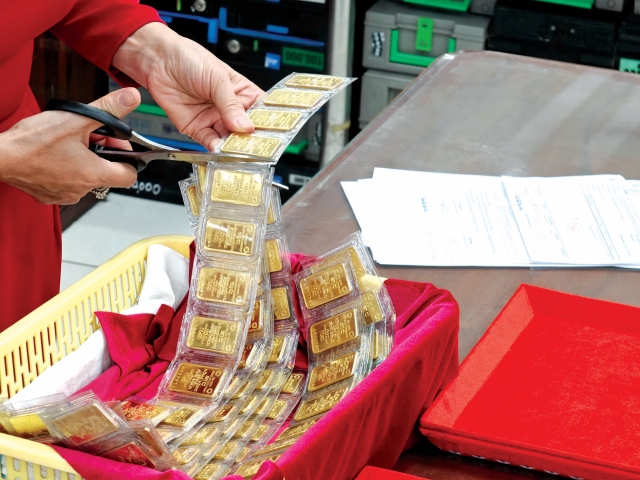
Large amounts of gold still remain in private hands. This gold held by the public is often seen as idle capital, yielding no returns and wasting resources. It seems that whenever the national economy encounters challenges regarding investment capital, the story of “gold in the populace” resurfaces, serving as a metaphor for an untapped and overlooked financial potential.
However, another view suggests that citizens hoarding gold actually indicates something different: their confidence level in the national currency, financial institutions, and the commitments to macroeconomic stability.
Therefore, the question is not merely “how to mobilize the gold,” but rather “why is the gold being held by the populace.” When looking at it from social-psychological and economic-policy viewpoints, gold mobilization is not simply a matter of routine financial operations; it is a test of the system’s credibility and the society’s trust in governance.
Multi-dimensional analysis of gold mobilization
Social-psychological perspective
Vietnamese people’s tendency to hoard gold has deep historical roots. Many generations, especially over the last fifty years, have experienced periods of high inflation, currency swings, and crises like the collapse of the capital mobilization and credit cooperatives from 1989 to 1991. In such times, gold acts as a “memory asset”—a lasting symbol of security. It functions not only as a means to preserve value but also as a “refuge for confidence” whenever the domestic currency is unstable.
According to the perspective of Kahneman and Tversky (1979), human financial behavior is often driven by loss aversion and risk memory—meaning people fear losses more than they desire gains. As a result, in an environment where confidence in the currency and financial institutions is not fully established, the people’s choice of gold as a “store of confidence” is a rational response rather than just a sign of conservative or wasteful habits.
Economic-financial perspective
From a financial standpoint, the mobilization of gold into the banking system does not equate to creating additional real capital for the economy. In many cases, the gold is merely “converted in form”—shifting from a private storage asset to a liability for public or private financial institutions. If the capital raised through this mobilization is not linked to profit-generating investment projects, the resulting financial efficiency—let alone the broader economic effectiveness—will fall short of initial expectations.
The period from 2010 to 2013 illustrates this well. When joint-stock banks aggressively mobilized gold for lending, the market quickly became unstable: the gold mobilized was mainly short-term, while the loans were mostly medium- to long-term. As a result, sudden gold price swings created a dual risk for banks: one related to changes in the gold price in domestic currency, and the other due to the gap between domestic and international gold prices.
When depositors rushed to withdraw their gold en masse, the system was compelled to halt these operations. The State Bank of Vietnam then had to order a complete halt to gold mobilization and lending activities for the commercial banking system. This lesson showed that gold is neither “cheap capital” nor “easy capital,” but rather an asset highly sensitive to market price movements as well as fluctuations in trust and expectations.
Policy and government solvency perspective

The main challenge in mobilizing public gold holdings lies not in the technical method but rather institutional trust. Fukuyama (1995) famously argued that an economy’s prosperity heavily depends on “social capital”—that is, the level of trust citizens have in each other and in government. In financial policies, building and maintaining this trust is crucial for citizens to feel comfortable to “entrust” their assets to the system.
A government can only successfully mobilize gold if it guarantees two conditions: (i) a highly credible commitment to repayment, and (ii) a transparent, stable conversion mechanism that is not dependent on short-term market volatility. If this confidence level is inadequate, then any appeal for mobilization might unintentionally send a market signal, possibly causing citizens to hold onto their gold more firmly and in larger amounts.
Furthermore, given the limitations of a tight budget, where fiscal deficits and public debt still need strict management, a commitment to repaying gold or converting its value in the future would create a substantial fiscal burden. Friedman (1956) has long emphasized that the strength of the currency and the ability to control inflation are the key factors influencing asset-holding behavior. A stable domestic currency will naturally decrease public demand for gold without requiring numerous administrative measures.
When citizens keep choosing to hoard gold over bank deposits, the issue isn’t with the gold itself. Rather, it acts as an important signal prompting the policy system to re-evaluate the real-world practicality of its planning, implementation, and oversight of those policies. Building trust is essential for any mobilization effort, especially during tough times. Once confidence is firmly established, the flow of gold will “voluntarily” return to the system without the need for heavily administrative solutions.
Lessons learned and policy direction
Instead of concentrating on “gold mobilization,” policies should focus on “rebuilding trust.” A transparent financial sector, stable exchange rates, effective inflation management, and strong protection of depositors’ rights will naturally reduce the desire to hoard gold. When citizens believe that holding the domestic currency is just as safe as holding gold, private capital flows will naturally shift into a resource for national development.
Furthermore, the government could consider expanding alternative investment channels: developing a healthy corporate bond market, encouraging investment in open-ended funds, or issuing savings instruments linked to sustainable development goals. These options allow citizens to convert “static” assets into “income-generating” assets, but within a clearer legal framework and with increased confidence assurances.
The story of “mobilizing private gold” reflects a desire to find new resources for development investment, but it also highlights the maturity level of financial institutions. Gold cannot be dismissed as “dead capital” when it actively serves as society’s “trust index.” One might see that every unit of gold held by the public can be viewed as a unit of credibility that the State must restore, rather than simply proposing coercive mobilization solutions.
(*) University of Economics Ho Chi Minh City