As countries and territories worldwide aim for carbon neutrality by 2050, carbon pricing policies are emerging as a crucial tool in achieving this target. By proactively adapting to this global trend, businesses can optimize costs while fulfilling environmental expectations of customers and investors.
Carbon pricing
Carbon pricing has emerged as a vital policy tool for addressing climate change in many countries and territories. The first carbon tax was introduced by Finland in 1990. By May 2020, 82 carbon tax initiatives were launched across 48 countries and territories.
Beyond individual national policies, the European Union introduced carbon taxation in 2005 and, more recently, initiated the Carbon Border Adjustment Mechanism (CBAM). Piloted from October 1, 2023, and set for full implementation by 2026, CBAM imposes carbon tax on certain goods shipped to the EU, based on their production-related greenhouse gas emissions. Initially, this mechanism targets six sectors: iron and steel, aluminum, cement, fertilizer, electricity, and hydrogen.
If a domestic carbon pricing system is implemented with industry emissions remaining at current levels, the EU’s CBAM alone could decrease Vietnam’s GDP by up to US$6.4 billion in 2030 and US$11.1 billion in 2035, according to the Ministry of Industry and Trade. The impact could be even greater if the EU expands the list of regulated goods, given that it is a major export market for Vietnam.
Domestically, Vietnam is also taking steps toward carbon pricing. The Government’s Decree No. 06/2022/ND-CP outlines a roadmap for developing a domestic carbon market and reducing greenhouse gas emissions. Vietnam ranks 21st globally for carbon emissions, and besides exports, many industries also import raw materials and components from other countries. With carbon pricing becoming a global norm, Vietnamese businesses must assess the potential impact on their operations and adopt proactive strategies to adapt.
Adaptation strategies for businesses
Carbon pricing comes in several types, with two commonly adopted by countries and territories around the world:
The first is carbon tax, which imposes a direct cost on greenhouse gas emissions, requiring businesses to pay for each ton of carbon emitted. Therefore, this is a financial measure for companies to reduce emissions by adopting more efficient processes or transitioning to cleaner fuels, ultimately easing the tax burden.
The Emissions Trading System (ETS), also known as a cap-and-trade system, sets a limit on total greenhouse gas emissions for specific sectors and establishes a market for trading emission allowances (in the form of permits). This approach allows businesses to meet reduction targets flexibly and cost-effectively by buying or selling allowances as needed.
Based on these two pricing mechanisms, businesses can adopt the following three strategies to adapt:
First, they can adjust their production scale, which in turn directly adjusts their total carbon footprint. Second, companies can invest in green initiatives and sustainable practices to make industrial processes cleaner. Third, under the ETS, they can manage and trade carbon credits for optimal efficiency.
Due to the flexibility in choosing adaptation strategies, the net emissions of companies change over time and depend on the choices they make.
Carbon tax represents an additional expense added to operating costs. To effectively manage this, businesses must ensure compliance while staying informed about evolving carbon pricing policies across relevant countries and regions. This enables them to assess the tax’s impact on the final prices of their products and services and develop appropriate adaptation strategies.
Tracking the carbon tax, however, can be challenging. Under the European Green Deal, for instance, the EU allows member states to decide how to implement the carbon tax and establish their own monitoring mechanisms. Data from 2019 illustrated this variability: Norway’s carbon tax covers 60% of its total emissions, while Spain’s limited tax scope addresses only 3%.
Thus, to be more proactive, businesses need to anticipate carbon pricing policies and incorporate them into all their business processes from the outset. Experience suggests that companies should begin by integrating vertically across their supply chain—evaluating everything from sourcing, processing, and production to sales and logistics. Within this approach, conducting a product lifecycle assessment becomes essential for identifying areas to reduce emissions and align with environmental goals.
It is also crucial to emphasize that the rapidly evolving carbon pricing policies are not necessarily a threat. Many businesses have seen the value in investing in low-carbon supply chains and cleaner technologies, as they not only gain intangible benefits but also take advantage of tax credits and subsidies offered by governments to incentivize investment in clean technologies.
At this stage, it is worth exploring green investments in greater depth. Bustamante and Zucchi (2023) identify two distinct types of green investments that businesses can pursue, each with its own advantages and challenges.
The first type focuses on investing in pollution abatement projects, which work to partially offset a company’s emissions. These projects aim to “clean up” emissions produced during the production process through initiatives like tree planting or carbon capture and storage. While such efforts immediately lower a company’s net emissions, they do not lead to structural or technological changes within the business.
The second type, green innovation, drives the development and adoption of new, sustainable technologies that provide long-term benefits. Unlike abatement, green innovation permanently reduces a company’s environmental footprint, making its operations less polluting. However, this approach is more expensive, requires lengthy preparation, and carries uncertain outcomes. As a result, coupled with the pressure to create value for shareholders on the basis of short-term financial reporting, polluting firms tend to favor short-term mitigation efforts over green innovation.
This explains why governments worldwide have integrated subsidies for green innovation into their carbon pricing policies. Such subsidies not only encourage greater participation in green investments but also promote a shift toward supporting green innovation. For this reason, businesses must be aware of incentive opportunities, such as tax credits, cash grants, and other benefits available through government recovery programs globally, to maximize their advantage.
Transitioning toward long-term values
Corporate environmental responsibility has become a cornerstone of modern business strategy. Companies are under increasing pressure to demonstrate their commitment to sustainability, not only to meet legal requirements but also to align with evolving consumer preferences and investor expectations.
The global shift toward carbon pricing policies does not necessarily diminish shareholder benefits. Empirical evidence suggests that the impact of climate regulations varies across businesses. Companies that early adopt adaptation strategies and proactively approach carbon pricing policies, rather than merely a cost, can unlock financial benefits such as reducing tax expenses, minimizing financial risks related to future carbon pricing mechanisms, and ensuring regulatory compliance. These businesses often experience enhanced reputational value and position, stronger customer loyalty, access to incentive policies, and improved shareholder relations and perceptions of long-term value. Together, these factors contribute to boosting revenue and profitability.
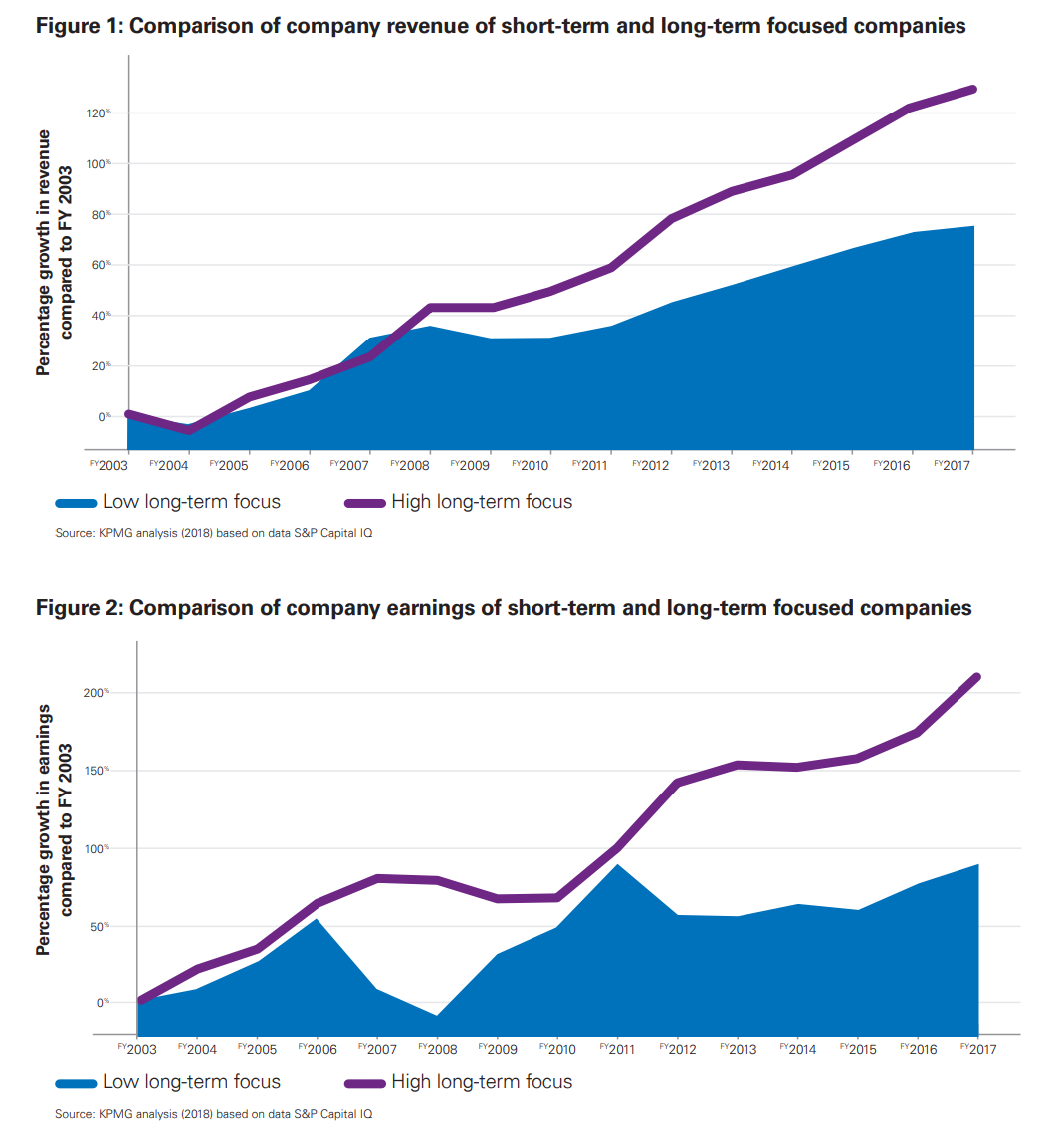
According to a synthesis by Friede, Busch and Bassen (2015), up to 90% of empirical studies show a positive relationship between sustainable business practices and corporate financial performance. Similarly, a KPMG analysis (2018) of data from S&P Capital IQ over 15 years (2003–2017) revealed that companies prioritizing long-term goals significantly outperformed those focused on short-term gains in both revenue and profit (see Figures 1 and 2).
This growing emphasis on long-term strategies is echoed in PwC’s 2024 Global CEO Survey, where 45% of CEOs expressed concern about their company’s long-term survival if they continue on their current trajectory. This urgency reflects a growing awareness of the need to change business strategies to adapt to policies addressing climate change, as well as other environmental challenges. The survey also indicates that CEOs are increasingly prioritizing climate-friendly investments. This demonstrates their willingness to make complex trade-offs in pursuit of long-term values. This is an advantage for implementing a sustainable business strategy, as the awareness of senior managers regarding the long-term value is considered a key factor in the transition.
However, in a country where 98% of businesses are small and medium enterprises like Vietnam, it may take more time for business leaders and owners to recognize that competitive advantages and market power are evolving. As such, realizing that focusing on creating long-term value for all stakeholders directly boosts benefits for shareholders and business owners may also take more time. In this context, training and communication play a vital role in helping business owners and shareholders understand that: a company’s competitiveness and profitability are increasingly dependent on intangible assets like human capital, natural capital, customer relationships, brand reputation, partnerships, and trust. According to Ocean Tomo’s survey in 2017, the proportion of intangible assets grew from 32% of company value in 1985 to 84% in 2017.

A critical question arises here: how can companies balance the pursuit of long-term value with the pressure to meet short-term objectives? The answer centers on several key points.
First, companies need to assess the two-way relationship: (i) how future social trends may influence the company’s development and financial performance; and (ii) what social and environmental impacts the business may have, and what risks and costs the company may incur in relation to creating those impacts.
Second, companies should identify the necessary changes in their operations to seize opportunities and minimize risks posed by evolving social trends. At this stage, it is crucial to listen to stakeholders’ opinions to pinpoint areas that need adjustment. Additionally, leveraging data-driven insights is critical for making well-informed decisions. Data can guide companies in aligning their strategies with both short-term market trends and long-term industry shifts.
Third, fostering a cultural shift within the organization is vital. Successful change requires more than just the CEO’s vision—it depends on the active involvement of middle-level managers and buy-in from the entire workforce.
Finally, companies should conduct scenario analyses to determine the optimal trade-off strategy and the appropriate “pace” of transformation based on their unique circumstances.
Conclusion
As countries and territories around the world strive for carbon neutrality by 2050, carbon pricing policies are set to play a pivotal role in achieving this goal. The expanding implementation of these policies will create a complex and dynamic tax environment, especially for multinational corporations, with significant implications for their operations. By proactively adapting to those policies, transforming business models to reduce emissions, and capitalizing on available incentives, companies can secure long-term sustainability while aligning with the environmental expectations of customers and investors.
Is your business ready to navigate this new era of opportunity and challenge?
(*) Associate Professor, Dr. Bui Thi Mai Hoai, is the director of the Institute of Sustainable Finance - University of Economics HCMC (UEH)