This research examines the livelihood strategies of both Kinh and Khmer households in the Mekong Delta since the introduction of Doi Moi (reform) policy in 1986.
The study focuses on the impacts of land policy changes, the shift towards a market economy, labor market development, urbanization, industrialization, and rural agricultural growth, all within the framework of Vietnamís neoliberal open market policy. The findings reveal that both Kinh and Khmer landowning and poor, landless households have adopted a mix of similar and different livelihood diversification strategies. These strategies depend on their access to five forms of household capital and external factors influencing the transition process.
The research highlights that household livelihoods have shifted from predominantly on-farm jobs to off-farm and non-farming employment. However, land ownership continues to play a vital role in household livelihoods, and local production is now more integrated into the global market. The study also shows that the transformation in land ownership, agricultural production, local labor demand, and household livelihoods is specific to the Kinh and Khmer communities studied. Therefore, the findings may differ from other research done in different contexts.
One key finding is that land reform resulted in landownership becoming fragmented, leading to increased polarization among farmers. The 1993 Land Law allowed land transactions, enabling wealthier farmers to expand their land holdings, while poorer farmers were often forced to sell their land. Both Kinh and Khmer households experienced this, but Kinh households were more likely to purchase land, while Khmer households were more likely to sell. Additionally, a higher percentage of land mortgaging occurred in Khmer households compared to Kinh households, suggesting that the Khmer were more adversely affected by the Land Law and the shift to a market economy.
Secondly, the social networks of Khmer households have expanded more than in previous periods, though they continue to face significant challenges in their daily lives. Livelihoods for both Kinh and Khmer households are now based not only on landownership but also on additional jobs to compensate for shrinking land sizes. For poor, landless households, access to paid employment is largely facilitated by social and human capital, with social networks playing a crucial role. In particular, better-off households tend to have larger and more connected social networks, as well as closer kinship ties, compared to poorer households.
Thirdly, intensive rice production remains a cornerstone of Kinh and Khmer farm householdsí livelihoods, boosting yields and providing stability. This research demonstrates that livelihood diversificationócombining on-farm activities with off-farm and non-farming workóhelps households mitigate market and production risks. Farm households that continue rice farming tend to earn more net income from rice than from other non-rice crops, livestock, or non-farming activities. Despite this, state policies aimed at fostering sustainable agriculture to ensure food security, increase rice exports, and raise farm incomes have only been partially successful, as farm incomes remain significantly lower than the national average across other sectors.
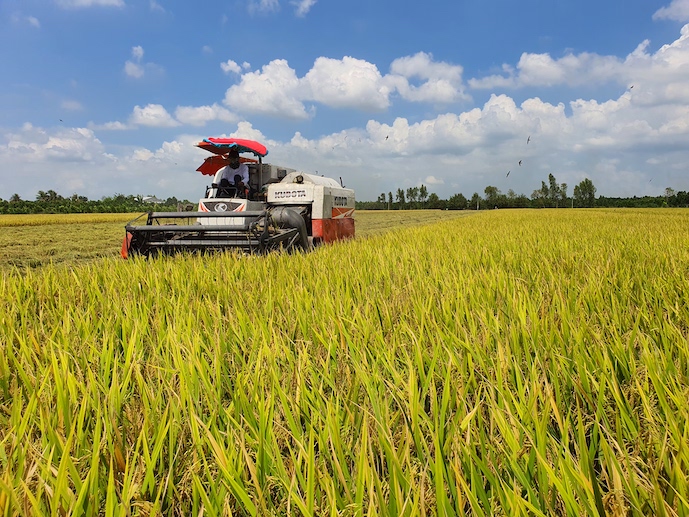
Fourthly, this research found that rural labor migration to the city significantly impacts rural development, particularly by creating labor shortages during peak rice harvest seasons. However, this shift also opens a window of opportunity for hiring workers from other parts of the Mekong Delta to engage in off-farm jobs. Specifically, poor landless Khmer workers from Soc Trang Province often migrate to Thoi Lai District of Can Tho City to help with rice harvest throughout the year. As a result, both Kinh and Khmer farm households have increasingly engaged in a combination of on-farm, off-farm, and non-farming jobs, driven by the demands of the labor market in the Mekong Delta.

Lastly, the research highlights that Can Tho City has transitioned from a primarily agricultural economy to one with a stronger focus on non-agricultural activities, even though agriculture remains crucial for food security and export. The local labor market and the neoliberal economy have pushed agricultural production from subsistence-based to export-oriented intensive production, with shifts from extensive to intensive rice farming, mono-cropping to diversified farming, and local labor to external labor. Additionally, many households have diversified their income sources by taking up multiple jobs.
In conclusion, the research reveals that small-scale intensive farming persists alongside diversification into both farming and non-farming occupations. However, under the pressure from neoliberal market competition, small farmers must organize into cooperative groups and establish strong connections with other stakeholders in the agricultural production and export chains to mitigate risks and increase profitability.
This study provides valuable insights for policymakers and others looking to improve the livelihoods of farmers and vulnerable communities in the context of a neoliberal economy.
(*) Nguyen Quang Tuyen holds a doctorate of Philosophy in Social Science and is senior lecturer at Can Tho University