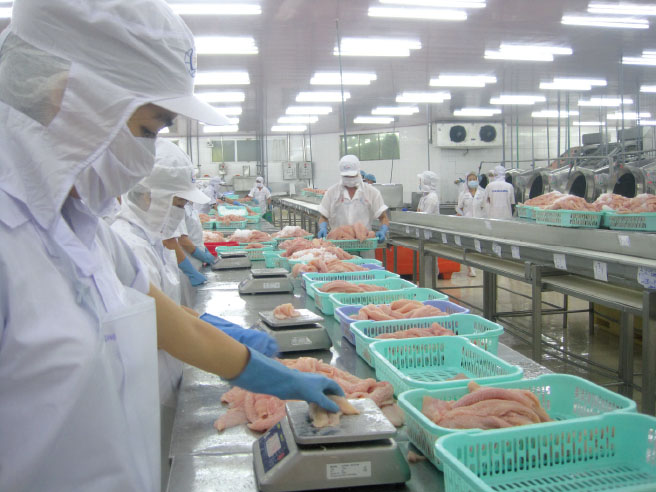
In the first two months of 2025, Vietnam received 16 warnings from the European Union (EU) over chemical and antibiotic residues in agricultural and fishery products, the highest number among Asian countries. This follows 114 warnings in 2024, a 70% increase versus 2023, signaling a serious risk of losing market share as countries are tightening inspections of plant quarantine.
More exports, more warnings
This growing concern was highlighted by a representative from SPS Vietnam (Vietnam’s Office for Notification and National Point for Questions and Answers About Epidemiological Hygiene and Sanitary and Phytosanitary Quarantine) during an online conference on February 24, which focused on compliance with EU food safety regulations.
Vietnam’s agricultural and fishery exports to the EU in 2024 totaled nearly US$4.5 billion, a 25% increase from 2023 and a 55% rise from 2020, according to customs data. However, alongside this export growth, the country received a record 114 warnings from the EU, nearly double the number in 2023. In early 2025, Vietnam got the most EU warnings in Asia, followed by Thailand with six warnings, Indonesia with two, and South Korea with two.
Between 2023 and February 2025, the leading cause of EU warnings has been chemical residues, including pesticides and veterinary medicines. The ratio of warnings over chemical contamination was: 2023: 38 out of 67 warnings (56.7%), 2024: 61 out of 114 warnings (53.5%) and for the first two months of 2025: 5 out of 16 warnings (31.3%).
HCMC and Hanoi have received the most warnings.
The rising number of warnings should not be seen as a normal consequence of increased exports, especially as Vietnam seeks to expand its agro-product market and enhance product value while importing countries continue to raise quality standards.
According to Dang Phuc Nguyen, general secretary of the Vietnam Fruit and Vegetable Association, businesses that fail to take compliance seriously risk losing both market share and access to export markets entirely, causing severe financial losses for both companies and farmers.
A clear example of the "collateral damage" caused by tightening regulations is the severe disruption to durian exports in early 2025. Late last year, Chinese authorities detected Auramine O, a banned, potentially carcinogenic yellow dye, in Thai durians. As a result, China imposed stricter inspection requirements on durian imports from both Thailand and Vietnam starting January 10, 2025. Under these new regulations, durians must be certified free of Auramine O, and testing laboratories must be approved by Chinese authorities.
However, since no laboratories have yet been approved, many businesses have struggled to comply, leading to significant difficulties for durian exports.
Between early January and mid-February, durian exports to China plummeted to just 3,500 tons, an 80% drop compared to the same period last year. Prices collapsed, falling from VND230,000 per kilo during last year’s off-season to around VND90,000 per kilo in early 2025. Many shipments had to be returned for refrigeration or redirected to the domestic market, causing heavy financial losses. With each durian container worth approximately VND3 billion, exporters have suffered severe setbacks.
The rising number of warnings from the EU and China highlights persistent issues in compliance with chemical and antibiotic control regulations among Vietnamese farmers. A major problem is the lack of effective coordination in supply chain supervision and material area control. While the management of farming area codes and packaging facilities has been delegated to local authorities, enforcement remains inconsistent. Many provinces, organizations, and individuals have focused on expanding farming areas and packaging facilities without ensuring strict compliance with international import requirements.
Weak enforcement of phytosanitary regulations has led to inadequate control over plant health standards, increasing the number of shipments flagged for violations. If this trend continues, importing countries may impose stricter controls or even suspend all Vietnamese agricultural imports, causing immeasurable damage to the industry. To prevent this, local authorities must allocate sufficient resources to inspect and supervise farming areas and packaging facilities that have been granted export codes. The fact that non-compliant agro-products are still being exported and only detected at foreign checkpoints suggests that quality control at the source is ineffective.
Additionally, greater awareness and education are needed. The Plant Protection Bureau’s technical guidelines and Chinese import regulations must be widely communicated to producers and exporters to ensure compliance. Provinces and cities with border checkpoints should also work closely with phytosanitary agencies to strictly inspect outgoing shipments in line with the importing country’s regulations.
Export businesses, particularly small and medium-sized enterprises (SMEs), must stay updated on changing import standards, as regulations, especially in the EU, are continuously evolving. According to SPS Vietnam, large companies and FDI firms have dedicated technical departments that allow them to quickly adapt to new requirements, minimizing compliance risks.
Opening an export market is difficult, but maintaining and expanding it is even harder. If businesses fail to adapt and operate with discipline, the entire industry risks suffering the consequences. As the saying goes, “one rotten apple spoils the barrel”—a few non-compliant exporters could jeopardize the livelihoods of millions of farmers across Vietnam. Strict enforcement and proactive adaptation are essential to securing Vietnam’s position in global agricultural trade.