Convenience stores represent a mere 0.3% of Vietnam’s retail market, where foreign companies hold sway, much like in hypermarkets and shopping malls. Many convenience store chains have been grappling with protracted challenges with profitability as they have been searching for sustainable business models to capture market share.
Convenience store count
As of March 2023, Vietnam had 3,720 convenience stores nationwide, a slight decline versus 2022, according to market research firm Q&Me. Of these, around 2,600 are located in HCMC, with the remainder in Hanoi, Danang, Binh Duong, and other parts of the country. These statistics are also supported by data from Statista.
A September 2024 report by Japanese consulting firm B&Company said that Vietnam has 1,374 convenience stores. Meanwhile, a Nielsen Vietnam survey in late 2023 showed Circle K was leading the market with 48% of revenue share, followed by Ministop with 15%, GS25 with 14%, Family Mart with 12%, and 7-Eleven with 8%.
These figures highlight the clear segmentation of Vietnam’s retail market and underline the growing appeal of the convenience store sector. They also illustrate the adaptability of businesses in tailoring their strategies to suit the market.
According to the Ministry of Industry and Trade’s classifications, Type 1 supermarkets must have a minimum area of 3,500 square meters and at least 20,000 stock keeping units (SKUs). Type 2 supermarkets require at least 2,000 square meters and a range of 10,000 SKUs and Type 3 supermarkets need a minimum area of 500 square meters and 4,000 SKUs.
In contrast, mini-stores require a minimum area of 80 square meters and must offer at least 500 SKUs. This smaller size presents significant opportunities for the expansion of convenience store chains, mini-store chains, and other compact retail models.
Vu Thi Hau, former chairwoman of the Vietnam Retailers Association, shed light on why the convenience store market is particularly appealing to foreign investors. “Opening a supermarket takes considerable time to secure the right location and obtain various permits. In comparison, obtaining permits and finding locations for stores under 500 square meters is much simpler and requires a lower investment,” she explained.
The rapid urbanization of Vietnam, the growth of the middle class, changing shopping habits, and the increasing preference of urban youth for convenience have been the main drivers behind the double-digit expansion of convenience stores in recent years.
These stores have also adapted by broadening their food offerings to cater to the fast food demands of young people and office workers in major cities. They are progressively focusing on convenience foods to meet the lifestyle needs of urban consumers, said Do Duy Thanh, founder and director of FnB Director, a consultancy specializing in food and beverage management, startups, and franchising.
Playground for foreign businesses
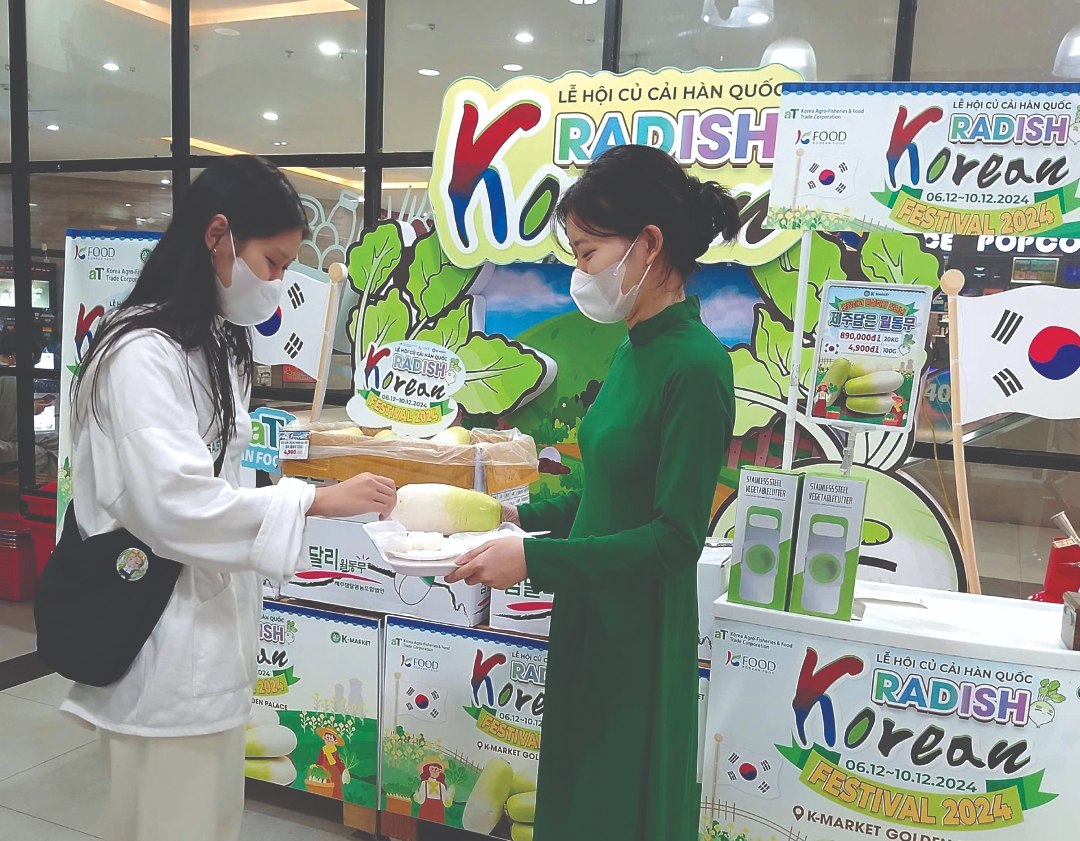
K-Market, the first mini-store chain in Vietnam specializing in Korean products, opened its first store in 2006. Despite its focus on Korean products, the chain is fully owned by a Vietnamese company. After 19 years of operation, K-Market now has 69 stores in major cities such as HCMC, Hanoi, and Haiphong, catering to the growing demand for Korean products among Vietnamese consumers and the Korean community in Vietnam.
Circle K, the first international convenience store chain to enter Vietnam in 2008, has seen remarkable growth. Between 2021 and 2022, it strengthened its market lead in terms of store count, sales, and profit. By the end of 2024, Circle K operated 476 stores, open 24/7, and offered home delivery through food delivery apps. This 24/7 service has made Circle K especially popular among urban youth, particularly single individuals.
Family Mart entered Vietnam in 2009, paving the way for other Japanese convenience store chains such as Ministop in 2015 and 7-Eleven in 2017. Currently, these Japanese chains have between 110 and 190 stores each.
GS25, a South Korean convenience store chain, was launched in Vietnam in 2018 and quickly expanded its presence. In August 2023, the International Finance Corporation (IFC) invested US$20 million to support GS25 expansion over the following two years. At the time, GS25 had more than 200 stores, according to Vietdata. This number has since grown to 355, reported Korea Times.
B’s Mart, a convenience store chain owned by Thai investors, has been active in Vietnam since 2013 but has had a difficult time competing with the newer Japanese and South Korean chains. While the company initially aimed to open 150 stores, it currently has only 84 outlets, mainly in HCMC.
Prolonged struggle with losses
Modern trade channels (MT), including hypermarkets, supermarkets, mini-stores, convenience stores, and e-commerce, account for 25-45% of Vietnam’s total retail value, varying by sector, according to Brands Vietnam. In contrast, general trade channels (GT), such as traditional markets and grocery stores, have seen their share steadily shrinking in urban areas. Kantar predicted a shift towards a 50-50 balance between MT and GT in the near future.
Market research firm B&Company estimated Vietnam’s retail sector, including convenience stores, reached a market value of US$276 billion in 2024. Meanwhile, the Ministry of Industry and Trade projects this figure could grow to US$350 billion by 2025.
In Vietnam’s fiercely competitive retail landscape, retailers often accept losses to secure market share. The intense rivalry in both the overall retail sector and the convenience store segment has made profitability a distant goal.
GS25 exemplifies this approach. Despite entering the market later than its Japanese and Thai competitors, GS25 initially planned to open 2,500 stores by 2027. Backed by Son Kim Retail and its parent company GS Retail in South Korea, the chain adopted a strategy of short-term losses to gain market share. Its reported loss in 2023 was US$4 million, an improvement from US$6.7 million in 2022.
Facing challenges, GS25 revised its targets, now aiming for 500 stores by 2025 and 700 by 2027—just 28% of its original goal—despite a US$20 million investment from the IFC, according to Korea Times.
Family Mart faces a similar uphill battle, reporting losses as it strives to establish its foothold. However, its 2023 loss dropped to US$400,000. Ministop and 7-Eleven reported respective revenue growth of 12% and 37.4% in 2023. Yet, profitability remained elusive, with Ministop’s losses doubling to US$2 million and 7-Eleven posting a US$4 million loss.
Bright spots amid the gloom
In an industry often marked by challenges, Circle K and K-Market stand out as rare success stories.
Circle K achieved its strongest revenue growth in 2022, reaching US$160 million and effectively recovering from two years of accumulated losses. A July 2024 report from Vietdata highlighted Circle K as the only foreign convenience store chain to post profit of over US$4 million in 2024.
K-Market, a Vietnamese-owned chain specializing in Korean food, also reported modest profit in 2022 and 2023, following 18 years of operation in Vietnam.
Vietdata’s report excluded WinMart and Bach Hoa Xanh, as they were not initially categorized as convenience store chains. However, these two leading retailers have also struggled with years of losses. Business reports from Q2 and Q3 of 2024, however, showed signs of recovery, pointing to a more optimistic outlook for both chains.