To harness GenAI’s power, early adopters should proceed with a mix of enthusiasm and caution and ensure that hope outweighs unforeseen harm.
Generative artificial intelligence, or GenAI, represents a technological leap with vast implications. Its ability to generate text, translate languages, create content, and provide insights holds the promise of transformative revolutions in both business and creativity.
However, like any powerful tool, GenAI demands cautious implementation and ethical considerations, given the risks of deepfakes, algorithmic bias and job displacement.
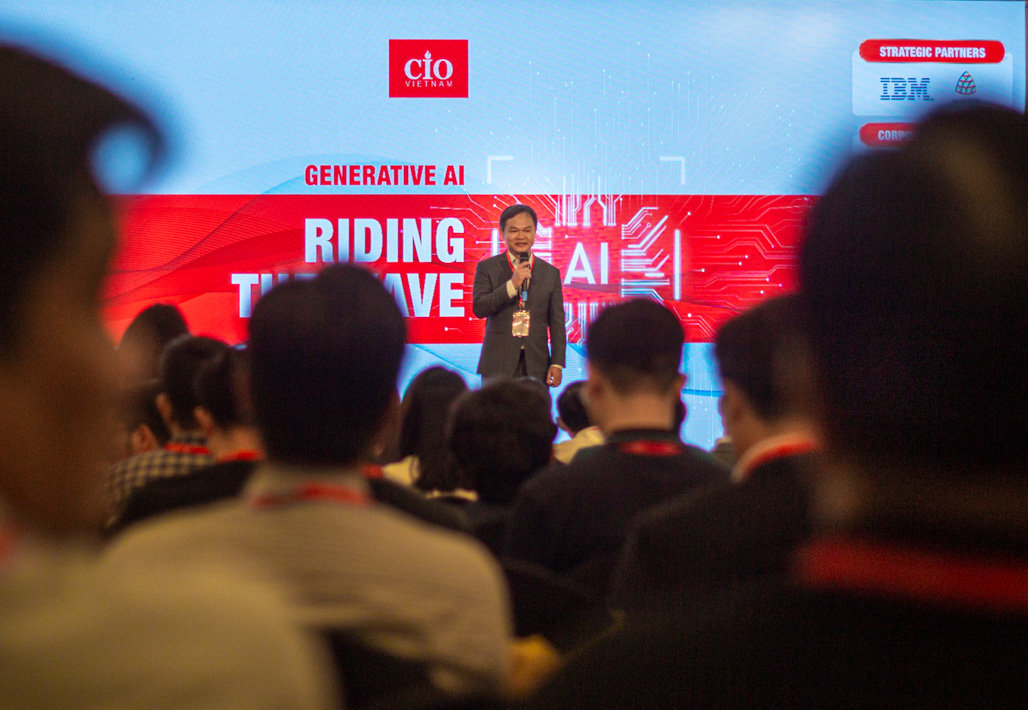
The GenAI conference, organized in HCMC last week by CIO Vietnam, underscored the imperative of balancing enthusiasm with wisdom. The key takeaway is clear. To ensure GenAI drives positive change, early adopters should establish proactive frameworks that guide ethical development and responsible governance of the technology.
Business transformation and innovation
The conference, themed “Generative AI – Riding the Wave,” was abuzz with excitement over the technology’s potential to revolutionize business operations. Hundreds of participants envisioned a wave of efficiency and innovation propelled by GenAI’s diverse capabilities.
Experts attributed the current boom in the AI industry directly to the expanding capabilities of GenAI applications, making them accessible to ordinary back-end users. GenAI leverages a unique combination of cutting-edge AI technologies, including powerful large language models (LLMs), diffusion models, and user-friendly interfaces.
LLMs such as ChatGPT by OpenAI, Copilot by Microsoft, and Gemini by Google drive GenAI’s proficiency in understanding and generating human-like text. Diffusion models enable it to produce lifelike images and sounds, while user-friendly interfaces make this power accessible to anyone with a smartphone. Given its ability to save time and reduce costs, GenAI is pushing the boundaries of AI across industries, driving economic and societal progress.
One significant area of impact is customer service. Currently, chatbots powered by GenAI can handle routine inquiries around the clock, freeing up human agents to address complex issues and personalize interactions. This not only enhances customer satisfaction but also allows businesses to optimize resource allocation.
GenAI holds the promise of revolutionizing data-driven decision-making by analyzing vast amounts of information to uncover hidden patterns and predict market trends. This enables businesses to leverage actionable insights for optimizing product development and gaining a strategic edge.
AI-powered tools offer tangible benefits to marketing teams, automating repetitive tasks such as composing social media posts or crafting personalized emails. This frees up valuable time for planning prioritized tasks, enhancing overall productivity.
According to Le Trong Hung, CEO of NamiQ AI, the surge in AI-powered content creation is driven by its affordability, user-friendliness, and ability to enhance business productivity. GenAI empowers even non-technical users to develop and customize their own AI tools for streamlining work processes.
However, GenAI’s impact extends beyond automation. Its capacity to generate fresh ideas, create design variations, and personalize content for different demographics has the potential to unlock entirely new levels of innovation. Shorter development cycles are conceivable, fueled by AI-powered brainstorming sessions and marketing campaigns tailored to specific customer segments.
In the realm of design, GenAI can swiftly generate product mockups and adjust designs based on real-time customer feedback.
According to Juan Mendoza, CEO of The Martech Weekly, the market is evolving towards increasingly personalized experiences. He envisioned a future where AI-powered tools enable businesses to reach the pinnacle of personalization, modifying products and experiences in real-time to cater to individual preferences.
Risks and ethical considerations
While the potential of GenAI is vast, its widespread adoption necessitates careful consideration and proactive solutions to mitigate potential harms. “In some cases, GenAI can provide incorrect answers in a way that appears both confident and convincing,” noted Tran Viet Huan, CTO of SonKim Group and president of CIO Vietnam.
The ease with which convincing yet harmful content can be generated using GenAI poses an insidious threat. Among these threats, deepfakes have the capability to erode trust and destabilize societies.
According to the U.S. Department of Homeland Security, “deepfakes” stem from the use of AI techniques that enable computers to learn complex patterns from data. This technology facilitates the creation of highly realistic fake content, including videos and images, for disseminating misinformation and perpetrating fraudulent activities.
The danger, the agency stated, “comes not from the technology used to create it, but from people’s natural inclination to believe what they see.”
In Vietnam, the National Cyber Security Monitoring Center (NCSC), under the Authority of Information Security, highlighted in a press conference last November that advancements in deepfake technology have enabled the creation of videos that are 70-80% realistic, making them challenging to discern with the naked eye. These sophisticated deepfakes are often used in online scams, primarily targeting financial fraud.
Meanwhile, GenAI systems trained on biased datasets run the risk of perpetuating and even amplifying existing societal inequalities. This challenge extends beyond technical fixes.
In the Harvard Business Review, experts argued that training data for AI systems may contain biased human decisions or reflect historical or social inequities. For instance, if a particular group is underrepresented in the training data, the algorithm may struggle to make accurate decisions regarding that group, leading to higher error rates in AI facial recognition systems.
At the CIO conference, Maurya Velpula, regional director at CNAV Business Value (Vietnam), underlined the importance of regulations governing the safe use of AI. These regulations should be based on core principles such as human rights, sustainability, transparency and risk management. Alongside regulation, it is crucial to develop ethical AI that prioritizes fairness and inclusivity.
Responsible adoption approach
To maximize the benefits of GenAI while minimizing harm, a proactive and responsible development approach is needed, instead of rejecting progress altogether.
Experts at the event recommended that businesses adopt a dual approach to derive maximum benefits from AI adoption. This approach, encompassing both “top-down” and “bottom-up” strategies, targets strategic and operational levels simultaneously.
At the executive level, leaders utilize AI insights to optimize resources, make informed decisions based on data and market trends, and enhance overall business strategy. Meanwhile, rank-and-file employees can leverage AI tools to complete tasks faster and better, and streamline everyday workflows. This integrated approach fosters both company-wide improvements and individual productivity gains.
Given that GenAI impacts customer experiences significantly, businesses must first define the kind of experience they aim to deliver. Implementing AI where it directly enhances the customer journey can yield favorable outcomes and foster user trust in the technology. Experts suggest starting with short-term projects, lasting from two to four weeks, and establishing clear metrics for tracking progress.
Data protection is another critical pillar in the responsible use of GenAI. Businesses must prioritize data security and privacy to prevent misuse and cultivate trust in these systems. By addressing these ethical and security concerns meticulously, all stakeholders can ensure that the benefits of GenAI outweigh its potential risks.
It is essential for businesses to invest in developing a robust, high-quality dataset – a “data farm” – to empower AI solutions. Employees at all levels should be equipped to effectively drive AI technology. They must not only prompt GenAI systems to complete daily tasks but also identify potential inaccuracies and critically evaluate AI-generated outputs.

Goldman Sachs has cautioned that AI-driven automation poses a risk to 300 million full-time jobs globally. This scenario underscores the urgent need for workers to adapt and upskill. While AI is potent, human judgment, risk assessment, and ethical oversight remain indispensable. To thrive in this evolving landscape, employees must become skilled drivers of AI technology, rather than passive components at risk of being left behind.
AI adoption should be viewed as an ongoing process, not a one-time solution. Companies should commit to sustainable integration, where AI becomes a natural part of the business workflow.
Collaboration is paramount to navigating the development of AI. Businesses, governments, and academic institutions must collaborate in investing in AI safety and transparency research, establishing robust ethical guidelines, and making AI sustainability a shared priority.
By adopting a proactive and responsible approach, users can unlock the full potential of GenAI while shaping a future where technology serves humanity more effectively.