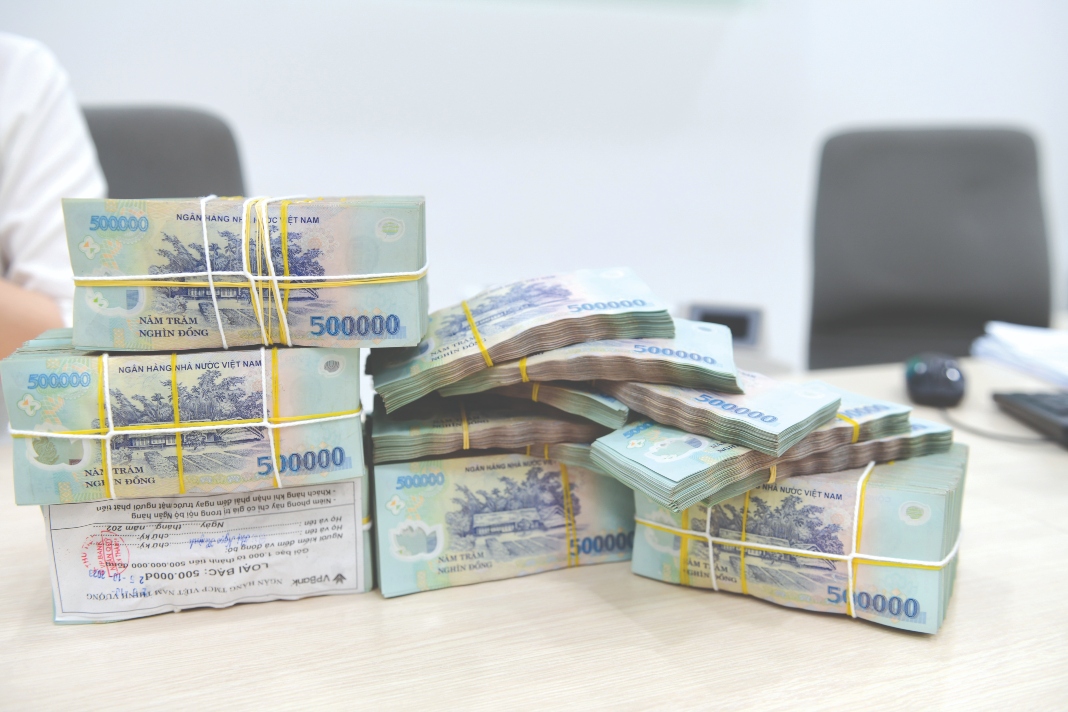
Around this time last year, the cash flow was obstructed, and a widespread liquidity crunch was reported across the board, driving up interest rates, with many banks hiking deposit rates to maintain liquidity. Now, the situation has all moved inversely.
Ample liquidity
The overnight rate on the interbank market on November 16, 2023 tumbled to 0.21% a year, while the rates for one-week and two-week lending also crashed to 0.33% and 0.52%, respectively. Compared to early this month, the overnight rate lost 84 basis points, while the one-week and two-week rates shed 116 basis points. One year ago, the overnight rate hovered around 4-5%, or even 6-7% at times.
The G-bond coupon in recent auctions ranged from 2.5% to 3.3% a year for 10-year debts compared to 4.8% one year earlier. Despite the low coupon, investors still snapped up some 90% of all bonds on offer. Even for the 30-year bonds, the winning coupon was also depressively low, at 3.05% a year, with VND750 billion worth of G-bonds issued.
Such comparisons indicate that the liquidity systemwide was excessively ample. Around this time last year, the cash flow was obstructed, and a widespread liquidity crunch was reported across the board, pushing up interest rates, with many banks spurring deposit rates to maintain the capital balance. Now, the situation has all moved inversely.
Let us put the falling deposit rates at banks into perspective. Since early November, many banks have further trimmed their deposit rates despite the favorable seasonality when deposits are often withdrawn for year-end spending needs. The rate cuts have been seen even among banks that have lowered interest rates to the floor such as Vietcombank, or among smaller banks that are usually at a disadvantage in competing for funds.
Statistics show that the average rate at 35 domestic banks as of the middle of November had fallen by 0.15 percentage point compared to two weeks earlier for deposits shorter than five months, at 3.8%. Interest rates have been trimmed by 0.18 point to 5% for deposits of six to 11 months, by 0.17 point to 5.3% for 12-month deposits, and by 0.15 point to 5.5% for deposits longer than 13 months. The averate deposit rate now is lower than that in September last year when banks started to drive up interest rates to attract cash from customers.
For deposits shorter than five months, most banks have lowered interest rates to levels far below the cap of 4.75%, facilitating a possible cut in the policy rate by the central bank. However, as the inflationary and forex movements still pose risks to some extent as well as a not-so-positive outlook for the banking industry, analysts are of the view that a policy rate cut is unlikely in near term.
Reasons
Given the bleak economic outlook and uncertainties in the business environment, idle cash is still funneled into banks as a safe haven despite falling interest rates. Data from the State Bank of Vietnam (SBV) showed that as of the end of August, 2023, deposits from the general public in the banking system had exceeded VND6.43 quadrillion, rising by VND567.6 trillion, or 8.93% against the end of 2022.
Meanwhile, lending has remained stagnant though the peak period of business started from the middle of the fourth quarter when the demand for capital often surges as seen in previous years. This year has seen a stark difference though. As of the end of October, the credit growth systemwide had reached only 7.39%, far lower than the target of 14% for this year capped by the SBV. If the credit growth cap is to be realized, banks need to pump at least VND800 trillion in credit into the market in the last two months of the year.
Many observers predict the credit growth this year should be 11-12%, meaning a sharp increase of four percentage points in the two months. Still, this is a huge challenge for banks to boost lending due to multiple difficulties facing businesses, a scant amount of new orders for exports, and a frozen real estate market. Meanwhile, many banks have adopted a cautious approach in lending due to concerns over the gloomy business outlook and rising bad debts.
Owing to such reasons, excessive liquidity in the banking industry has been reported in recent months. The cash flow in the economy has been obstructed and the capital circulation is no longer as flexible as in previous years.

Another factor contributing to the year-end excessive liquidity is that a huge amount of T-bills issued by the SBV is falling due. The SBV started to scale down the issuance of T-bills in early November before putting an end to new issues on November 9 as the forex pressure has eased. In a fortnight between ealy this month and November 17, the amount of 28-day T-bills issued by the SBV was worth VND46.25 trillion, while the amount of 28-day T-bills that came due was VND150.9 trillion, meaning the SBV pumped a net volume of VND104.65 trillion into the banking system.
The outstanding T-bills are worth VND103.75 trillion, and these papers will all fall due prior to December 6, including VND45.55 trillion worth of such papers to become due prior to November 24. Such a huge amount of capital being pumped into the banking system has dragged down the interbank interest rates in recent times.
As the U.S. Federal Reserve will likely refrain from any rate hike this year due to the inflation stateside cooling down to the target of 2%, the U.S. dollar on global markets is predicted to weaken. If this is the case, the forex pressure in Vietnam will ease further, enabling the SBV to step up buying the greenback given ample forex supplies stemming from increasing foreign direct investment and a huge trade surplus. That will also translate into greater liquidity in Vietnam dong in the banking system.