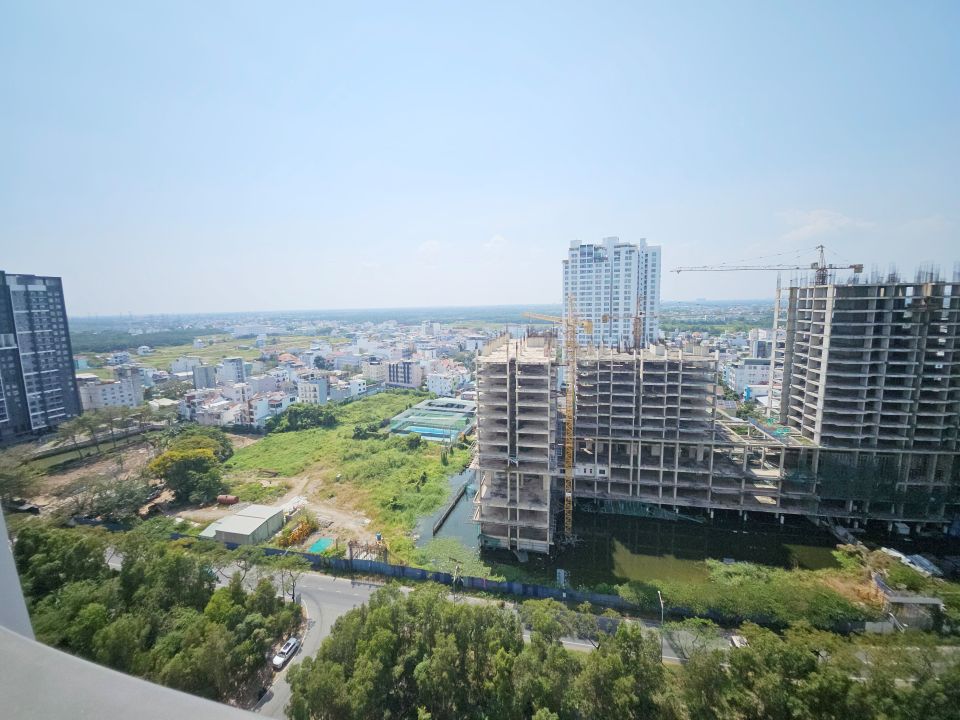
While policymakers have sought to lower interest rates to support manufacturing and economic growth, much of the additional credit has historically flowed into the real estate market rather than productive sectors
After years of property prices rising far faster than incomes, Vietnam’s real estate market is now grappling with weakening liquidity and subdued transaction activity, even as housing and land prices remain well beyond the reach of most households.
As a result, a significant amount of financial capital has become tied up in land holdings and property projects, reducing the circulation of funds across the broader economy. Meanwhile, many manufacturers continue to face difficulties accessing credit and contend with high capital costs.
Amid pressure to support economic growth, the State Bank of Vietnam has recently lowered interest rates and eased some lending conditions for the real estate sector. However, the move raises an important question: will looser credit conditions address the economy’s underlying capital shortages, or merely prolong the property bubble and potentially lay the groundwork for a new asset-price cycle?
High interest rates are merely a symptom
Recent debates over monetary policy in Vietnam have often revolved around a familiar question: whether interest rates should continue to be lowered to support businesses and promote economic growth. However, to address the problem at its root, we must answer why an economy that has experienced many years of high credit growth, continuously expanding outstanding loans and an ever-increasing money supply still frequently finds itself in a situation where businesses lack capital, production struggles and growth remains fragile.
If this question cannot be answered, any effort to lower interest rates may prove to be only a short-term solution to a structural problem.
In reality, today’s high interest rates are largely a symptom of a deeper problem: a distortion in resource allocation caused by capital being drawn disproportionately into the real estate market over an extended period.
When capital favors land over production
In a healthy economy, society’s savings should be transformed into productive investment, technological innovation, improvements in labor productivity and the expansion of productive capacity. However, over many years, a significant portion of the economy’s financial resources has instead been channeled into real estate.
The reasons are straightforward. Businesses investing in production face numerous risks, including intense competition, fluctuating input costs, technological disruption, management challenges and external pressures. Property investors, by contrast, have often been able to generate significant returns simply by buying land, holding it and benefiting from price appreciation that far outpaces growth in the real economy.
When returns from holding real estate exceed returns from productive investment, resources will inevitably flow into property. That is the logic of the market. The issue lies not in investors’ behavior, but in a policy framework that has created incentives that make asset speculation more attractive than productive investment.
Asset bubbles do not create real wealth
A common misconception is that rising real estate prices are a sign of growing economic wealth. In reality, sustainable wealth is created through higher productivity, technological advancement and increased production of goods and services, not through asset price inflation.
By contrast, a doubling or tripling of property prices does not create new factories, generate new technologies or increase national labor productivity. It largely represents an increase in paper wealth.
Moreover, if capital continues to be diverted from productive sectors into asset speculation, long-term economic growth may suffer. In other words, asset bubbles are not a sign of genuine prosperity but often a symptom of misallocated resources.
When housing prices far outpace incomes
According to Numbeo (2026), a crowdsourced database that provides information on living costs and housing markets worldwide, the house price-to-income ratio in major Vietnamese cities has reached exceptionally high levels. Hanoi ranks third globally, with a ratio of 38, while HCMC ranks 11th, with a ratio of 32, among the world’s most expensive housing markets.
As housing prices rise, the wealth of property owners increases. Banks expand lending based on the growing value of collateral. Real estate developers increase investment. The market becomes more active. However, once prices climb too high, asset values begin to detach from household incomes and consumer demand among households with genuine housing needs. Market liquidity starts to decline. Sellers are unwilling to lower prices. Buyers can no longer afford to purchase. Banks become trapped with collateral assets that have lost their liquidity. Transactions gradually disappear. Capital becomes locked in assets with enormous nominal values but that cannot be converted into actual cash flows.
As a result, a substantial share of a nation’s resources is frozen in real estate, unfinished projects, and underused assets.
This is one of the paradoxes of the Vietnamese economy. For many years, credit growth has consistently outpaced GDP growth, yet businesses have continued to report difficulties in accessing financing. The reason is that a significant portion of credit has been used to finance the purchase and holding of assets rather than the creation of new productive capacity. When these assets become trapped at irrational price levels, capital ceases to circulate efficiently. As a result, the economy faces a shortage of funding for productive investment despite an abundance of credit on paper.
And when capital becomes scarce, upward pressure on interest rates is virtually unavoidable.
 Mistake of using cheap money to fix consequences
In response to the difficulties faced by businesses, a commonly proposed solution is to lower interest rates further. However, if the root cause lies in a distorted capital allocation structure, injecting more liquidity may only worsen the problem.
Cheap money, or persistently low interest rates, was itself one of the factors that contributed to the formation of asset bubbles in the past. If policymakers continue to rely on cheap money to address the consequences of those bubbles, the economy risks repeating the same cycle: Monetary easing → Asset prices rise → Credit expands → Speculation intensifies → Asset prices rise further → A new bubble emerges. Meanwhile, productive investment becomes increasingly underfunded and less attractive compared with asset speculation. This is a vicious cycle that many economies have experienced repeatedly throughout history.
Policies to break vicious cycle
Policymakers often seek lower interest rates as a way to stimulate production and economic activity. Yet the economy lacks an effective set of policies to ensure that capital is actually directed toward productive sectors. In practice, the experience of the past several decades shows that monetary and credit expansion has tended to channel capital into real estate speculation rather than production.
The primary objective of monetary policy should be to maintain macroeconomic stability, keep inflation under control, and safeguard the financial system, rather than serving as a tool for driving economic growth.
Therefore, monetary policy should be designed to discourage speculation rather than rely on broad-based monetary easing. Instruments such as loan-to-value ratios and lending rates should be differentiated according to the purpose of the loan and the number of properties owned by the borrower. Individuals purchasing their first home for owner-occupation could be granted more favorable credit conditions, while loans used for investment purposes or for acquiring multiple properties should be subject to stricter requirements.
However, the challenges facing the economy today do not stem solely from high interest rates. Rather, they are the result of long-standing distortions in the allocation of resources. As such, it would be unrealistic to expect monetary policy alone to correct these structural imbalances. The missing piece of the puzzle must come from fiscal policy.
Vietnam needs a robust tax framework to reduce incentives for real estate speculation and property hoarding. Such a framework could include a time-based capital gains tax, with higher tax rates applied to properties sold after short holding periods; a progressive annual property tax based on the number of properties owned; and taxes on vacant land, unused housing, or development projects that remain idle or are not put into productive use within a reasonable timeframe.
The long-term objective should not be to keep real estate prices elevated, but to restore the flow of capital away from asset speculation and toward productive investment, innovation, and productivity-enhancing activities. Only then can the economy achieve sustainable growth without relying on recurring cycles of credit expansion and asset bubbles.