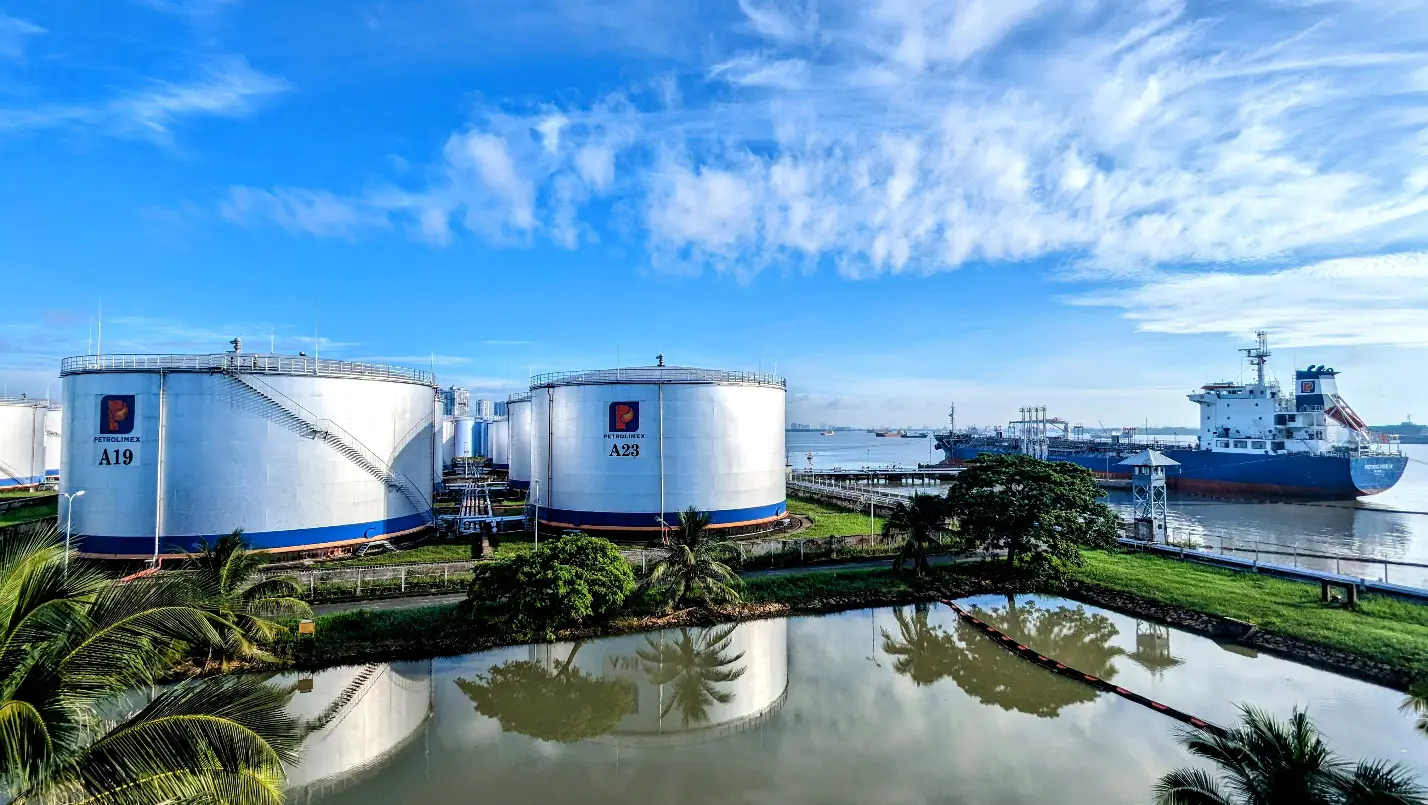
Rising fuel prices and escalating logistics costs are compelling businesses to conserve every liter of fuel. While practicing thrift is always essential, storage capacity ultimately determines the economy’s resilience against energy shocks.
Fuel for transport and electricity for cold storage account for a significant share of operating costs in the fruit and vegetable trade. Nguyen Dinh Tung, CEO of Vina T&T — a trading, service, and import-export company — explained that given soaring fuel prices, businesses must optimize domestic logistics to cut costs and sustain efficiency. Instead of relying on numerous individual trips, companies now consolidate shipments, gathering produce from the Mekong Delta and the Central Highlands before transporting it to HCMC for packaging.
Truong Thinh Trading Company has already adopted order consolidation and route optimization, but now “must consider more carefully each trip to minimize fuel costs,” noted director Pham Van Thang. In addition, common vehicles are used for business travel, and many partner meetings are conducted online.
Rising fuel prices, which drive up transport and service costs, have also hit the tourism industry. Tour contracts are often signed months in advance, making price adjustments difficult. Nguyen Son Thuy, director of Visit Indochina Company, explained that to maintain selling prices, many businesses are optimizing itineraries, shortening travel distances, and prioritizing fuel-efficient or electric vehicles for shorter routes.
The Politburo’s Conclusion 14-KL/TW on ensuring fuel supply and stabilizing prices underscores the necessity of saving. Yet, in today’s increasingly unpredictable global energy market shaped by geopolitical tensions, thrift alone is not enough. To strengthen resilience against energy shocks, long-term foundations must be consolidated — including diversifying crude oil sources, refining price management mechanisms and fiscal policy, and, most critically, expanding storage capacity.
International experience highlights that major economies treat fuel storage as a strategic “buffer.” The United States maintains reserves sufficient to cover more than a month of demand. In Asia, several countries proactively build large storage systems to absorb short-term market disruptions: Japan holds reserves equal to 254 days of net imports, South Korea about 200 days, and China between 70 and 90 days.
Vietnam’s economy now ranks 32nd globally, driving rising fuel demand — yet storage capacity remains inadequate. The most pressing limitation is the low level of national reserves. Under Decree 95/2021/ND-CP, wholesale distributors are required to maintain storage equivalent to at least 20 days of supply, while retail distributors must hold five days.
In terms of infrastructure, Vietnam lacks a true national fuel storage system; most reserves are kept by wholesale businesses. Moreover, the operational mechanism across different storage levels is unclear, with no central authority capable of effectively coordinating a unified national storage strategy.
In 2023, the prime minister approved a plan to develop national infrastructure for petroleum and gas storage and supply, aiming to ensure reserves equivalent to 75–80 days of net imports, with efforts to reach 90 days. This capacity is intended to guarantee sufficient and continuous fuel supply for socio-economic development, security, and national defense.
In Conclusion 14, the Politburo also emphasized the need to “build early a national strategy for the long-term supply and storage of materials and fuels,” underscoring storage as a cornerstone of energy security.
According to Ha Dang Son, director of the Center for Energy Research and Green Growth, Vietnam’s partial reliance on imports of crude oil and petroleum products means that enhancing storage capacity must be treated as a core element of the national energy security strategy. The objective is not only to safeguard supply but also to strengthen the autonomy and resilience of the energy system against unpredictable global market developments.
Crude oil reserves, in particular, hold special significance for the stable operation of domestic refineries. With sufficient storage, refineries can maintain production even during disruptions in international supply, ensuring continuity in both industrial output and national energy security.
Son argued that Vietnam should increase investment in strategic storage systems and reserve infrastructure, particularly at energy hubs and areas linked to oil refineries, in order to gradually expand petroleum and crude oil reserves to levels closer to international practice. At the same time, he emphasized the need to design a mechanism that coordinates national reserves with business reserves: the State would take the lead in directing and managing strategic reserves, while key energy enterprises would develop and operate the infrastructure. This model, already applied in many countries, helps ease budgetary pressure while enhancing flexibility and efficiency in reserve management.
To build a long-term “energy shield,” independent energy expert Phan Xuan Duong argued that the priority is not simply expanding the number of storage facilities, but establishing a modern national storage system that functions as a macroeconomic regulation tool. He outlined four essential roles for such a system: (1) Mitigating supply shocks — maintaining sufficient reserves to offset disruptions in imports; (2) Stabilizing prices — releasing stock when prices surge and absorbing stock when prices fall, rather than leaving reserves idle; (3) Integrating energy into macroeconomic regulation — coordinating reserve operations with fiscal and monetary policies; (4) Supporting energy transition — using reserves strategically to facilitate the shift toward cleaner energy sources.
Duong stressed the need to establish clear directions for developing large-scale national and regional storage centers, while advocating business participation in reserves through public–private partnerships (PPP), since the State alone cannot finance the entire system.
He proposed a phased roadmap: In the short term (1–2 years), it must complete the design of the national storage system with specific scenarios, raise minimum reserves to 30–45 days, and pilot concentrated storage facilities; In the medium term (3–5 years), it needs to develop two to three large-scale storage centers operating under a rotation mechanism; In the long term (5–10 years), it must reach international reserve levels of 60–90 days and gradually evolve into a regional “energy hub.”
Duong emphasized that if Vietnam succeeds in building an effective storage system, the country could shift from merely “consuming what is bought” to proactively regulating its energy market. Conversely, failure to act in time would leave Vietnam vulnerable to energy shocks, directly undermining growth targets — including aspirations for double-digit expansion — and eroding industrial competitiveness.