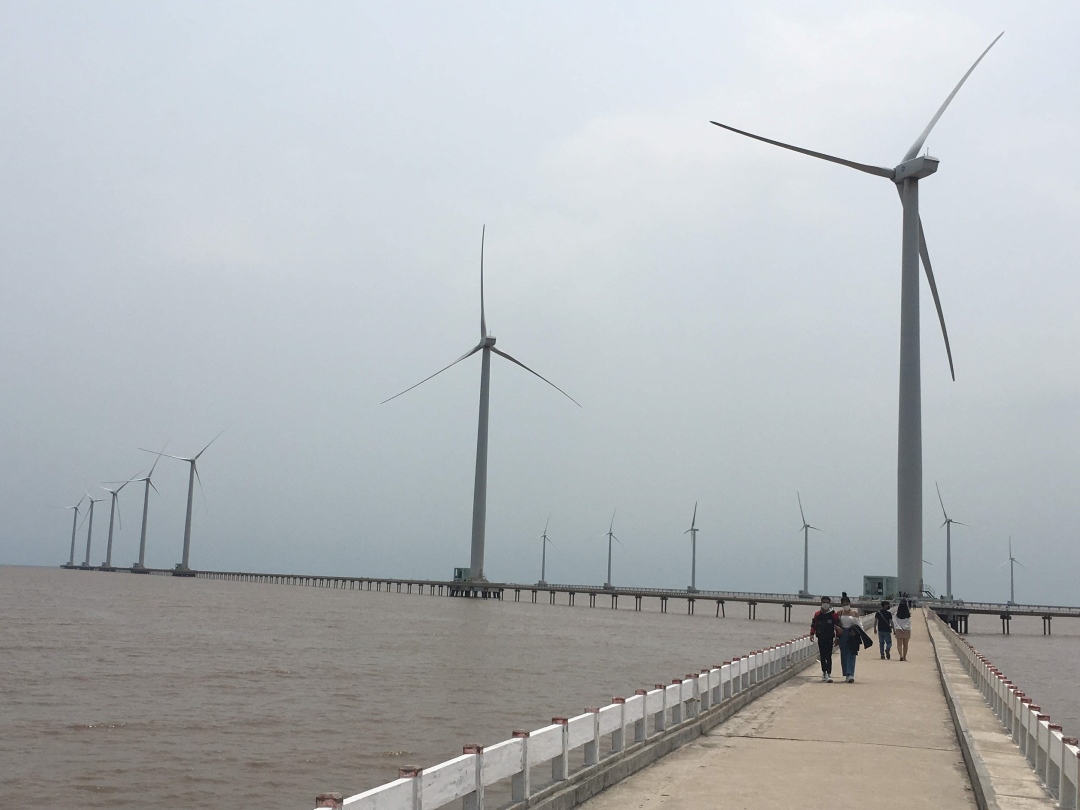
Norway’s Equinor, following Danish energy giant Ørsted, has abandoned plans to invest in offshore wind energy in Vietnam, citing the absence of a clear legal framework. These setbacks are slowing Vietnam’s push toward green energy.
Foreign investors’ withdrawals
Magnus Frantzen Eidsvold, a spokesperson for Equinor, said that the energy giant had discontinued its business development in Vietnam and closed its Hanoi office.
This marks the first time Equinor has shut down an international office focused on offshore wind farm development. In recent years, the company has exited over a dozen countries where it had oil and gas operations, shifting its focus to renewable energy and low-carbon projects.
Eidsvold did not provide detailed reasons for the company’s decision to exit Vietnam but stated that the move followed a routine review of Equinor’s renewable assets portfolio. “The offshore wind sector has been facing significant challenges, and we need to be disciplined in our approach,” he told Reuters.
On its website, Equinor emphasizes that Vietnam holds some of the best wind resources in Asia and is committed to developing an offshore wind energy market, thanks to its long coastline and favorable wind conditions. The World Bank has put Vietnam’s offshore wind power potential at an impressive 599,000MW, with capacity to supply 12% of the country’s electricity by 2035.

In 2022, Danish company Ørsted, another major player in offshore wind energy, also shelved its investment plans in Vietnam. The company cited delays and unclear policies surrounding project implementation and power purchase agreements as the main reasons for its withdrawal.
Other investors have raised similar concerns about challenges in developing offshore wind farm projects in Vietnam. These include the lack of a clear legal framework, with regulations failing to specify which authority is responsible for making investment decisions. Furthermore, there are no established processes for surveying, monitoring, or assessing marine and wind resources, adding to the difficulties in moving forward with such projects.
Challenges in meeting offshore wind power objectives
Under Vietnam’s National Power Development Plan VIII, the country aims to develop 6,000MW of offshore wind power by 2030, with an ambitious target of reaching between 70,000MW and 91,500MW by 2050. However, no offshore wind power projects have been allocated to investors so far. Experts argue that without immediate action to secure foreign investment and initiate projects, it would be difficult to achieve these objectives.
To attract foreign investment, the Vietnamese Government must provide not only comprehensive technical data but also offer investment policy incentives. Offshore wind power projects require colossal costs—ranging from US$2.5 billion to US$3 billion for every 1,000MW of capacity—and take 6-8 years to complete, from survey to final implementation.
One industry expert pointed out that the lack of detailed, reliable data on wind speeds, regional and national wind potential, and seabed conditions is deterring investors. Furthermore, the legal framework governing offshore wind power development is still incomplete, adding to the challenges investors face when getting involved in projects in this sector.
According to leaders of a company under the Vietnam National Oil and Gas Group (PVN), even with strict and comprehensive policies in place, it could still take up to eight years for investors to fully execute an offshore wind energy project. Currently, however, there are almost no specific regulations guiding the implementation and development of such projects, which require compliance with multiple related laws.
The Ministry of Industry and Trade has pointed out that it is unclear whether the authority to approve investment proposals for offshore wind farms rests with the National Assembly, the Prime Minister, or local authorities. Moreover, no specific regulations define market access conditions for foreign investors. Several legal provisions remain vague, hindering the successful development of offshore wind farms.
Experts argue that to reduce future risks and establish a well-defined legal framework, Vietnam needs a tailored legal and policy system for renewable energy, particularly offshore wind power. Authorities should consider piloting initial projects during this phase to help develop a cohesive and fully functioning market in the future.
The Ministry of Industry and Trade has recently proposed a pilot research plan for offshore wind power development, suggesting that state-owned enterprises should take the lead in initial investments rather than foreign or private investors. The proposal outlines three potential options for selecting an investor. The first option is to assign the project to the Vietnam Oil and Gas Group (PVN) due to its extensive data resources and expertise in the oil and gas sector. The second option is to hand the project over to the Vietnam Electricity Group (EVN), and the third option is to entrust the project to a unit within the Ministry of National Defense.
PVN has already started positioning itself to capitalize on the opportunities in this potential sector. PTSC, a subsidiary of PVN, has secured contracts for offshore wind power export projects, covering various services such as surveying, design, procurement, construction, fabrication, transportation, installation, and operation.
Despite some initial progress, it may take a lot of time to meet the ambitious goals outlined in Power Development Plan VIII. For this reason, the Government should quickly draw up a clear roadmap and introduce specific policies to attract foreign investment and make businesses confident to invest long-term in Vietnam.