Revisions to Resolution 98 are expected to give HCMC a sharper competitive edge and attract more strategic investors as the city pursues its ambitions to become a true megacity.
New landscape, new demands In the December 3 session, the National Assembly reviewed the proposal and appraisal report and held group discussions on draft amendments to Resolution 98, the 2023 framework piloting special mechanisms and policies for HCMC’s development. After more than two years in force, Resolution 98 has delivered positive results. But the merger of Binh Duong and Ba Ria-Vung Tau into HCMC has reshaped the landscape, rendering the 2023 resolution too limited for today’s circumstances. A new plan calls for fresh momentum. City leaders have often said that updating Resolution 98 is about crafting a “new, well-fitted coat” – one broad, strong, and refined enough to support the city’s next stage of development. At the Autumn Economic Forum 2025, co-hosted by HCMC and its partners in late November, city and central government leaders outlined a broader vision for the city’s future to domestic and international investors. “After the merger, HCMC is entering a new phase of development, with a wider horizon and a bold ambition to become a modern, dynamic, and livable international metropolis with global competitiveness,” said Tran Luu Quang, secretary of the HCMC Party Committee. Truong Minh Huy Vu, director of the HCMC Institute for Development Studies, said the city continues to rank as Vietnam’s leading economic center by almost every indicator, from income and budget revenue to total social investment and the strength of its business and tech start-up ecosystem. Major cities across Asia, including Shanghai, Tokyo, Seoul and Bangkok, all span smaller areas than HCMC. The city’s population is second only to Shanghai’s and broadly comparable to Tokyo’s. Even so, those urban economies are already valued at around US$1 trillion. As HCMC expands its scale, it is setting its ambitions on reaching that level of economic output. “When we look ahead to 2045-2050, HCMC has everything it needs, from industry, agriculture, and services to high-tech sectors, along with a robust urban ecosystem that has grown from its own internal strengths,” Vu said. Under the new plan, the city will redesign its development layout and follow a more connected, multi-centered approach. The strategy sets out three zones, three development corridors, five key pillars, and one special district. Even as the overall landscape has changed, experts note that the city continues to grapple with institutional and policy bottlenecks that constrain development and investment. Figures indicate that after more than two years of rolling out Resolution 98, HCMC has effectively implemented 36 of the 44 mechanisms, is continuing work on six others, and has ended two due to changes in national regulations. The policy landscape has also changed significantly, with the Politburo issuing a series of key resolutions on private-sector development, science and technology, international integration, and reforms in lawmaking and enforcement. Against this backdrop, updating Resolution 98 has become essential, particularly after the recent administrative merger, to ensure the city’s framework aligns with broader national policies. A revised resolution would provide HCMC with the legal tools to push deeper decentralization, clear existing bottlenecks and leverage new opportunities created by the merger, advancing its ambition to evolve into a megacity. Attracting strategic investment with policy reforms One notable change in the draft revision of Resolution 98 is the sweeping expansion of mechanisms to attract strategic investors. The draft introduces 11 additional priority project groups not included in the current resolution, spanning transport and urban infrastructure, advanced healthcare, tourism, culture, sports, clean energy, logistics, and environmental development. A standout addition in this draft, alongside the international financial center, is the plan to establish a free trade zone. The zone would test a suite of breakthrough preferential policies and mechanisms aimed at attracting high-quality investment, finance, trade, and services, while supporting export growth, industrial expansion, research and development, and the recruitment of high-skilled talent. The draft would also allow HCMC authorities to independently appraise and approve investment proposals and issue investment registration certificates, provided that the proposals align with approved planning documents. This shift is intended to streamline procedures and cut policy delays. Moreover, central and city leaders at the Autumn Economic Forum repeatedly underscored the importance of tapping resources from the business community and from domestic and international investors.
Prime Minister Pham Minh Chinh further instructed HCMC to soon issue a detailed action plan to implement the forum’s commitments and to take the lead in testing sandbox models for the green economy, green finance, and smart urban development, while moving ahead with the launch of the international financial center.
A positive signal at this year’s forum was that many international businesses expressed support for HCMC’s vision, saying it aligns well with the new context and offers substantial room for collaboration. A wide range of sectors was mentioned, including technologies such as AI and semiconductor manufacturing, industrial parks, digital infrastructure, green transport, telecommunications, and education and workforce training.
Many foreign investors are looking not only for broader collaboration but also for faster project approvals, clearer legal frameworks, and stronger financing prospects. Strategic land planning was likewise raised as a key concern.
HCMC is now calling for investment in 116 projects, including 29 priority initiatives. These range from the international financial center and high-tech and innovation projects to infrastructure, logistics and port development, energy-related industrial facilities, and a central urban rail network of 27 lines totaling 1,024 kilometers.
Strengthening HCMC’s competitiveness
With more than 40 new provisions that fall outside the current legal framework, the proposed changes center on decentralization, investor attraction, infrastructure upgrades and organizational reform, laying the groundwork for breakthrough mechanisms to develop HCMC as a megacity.
In the economic sphere, the plan targets US$8-12 billion in annual non-state investment, underpins double-digit growth from 2026 to 2030, aims for average GRDP expansion of 10% to 11% a year, and raises per capita GRDP to US$14,000 to 15,000 by 2030. The proposed free trade zone is expected to elevate HCMC into an international commercial hub, strengthen its competitiveness, attract higher-quality foreign investment, and support the development of fully integrated supply chains.
On infrastructure, the plan calls for completing Beltways
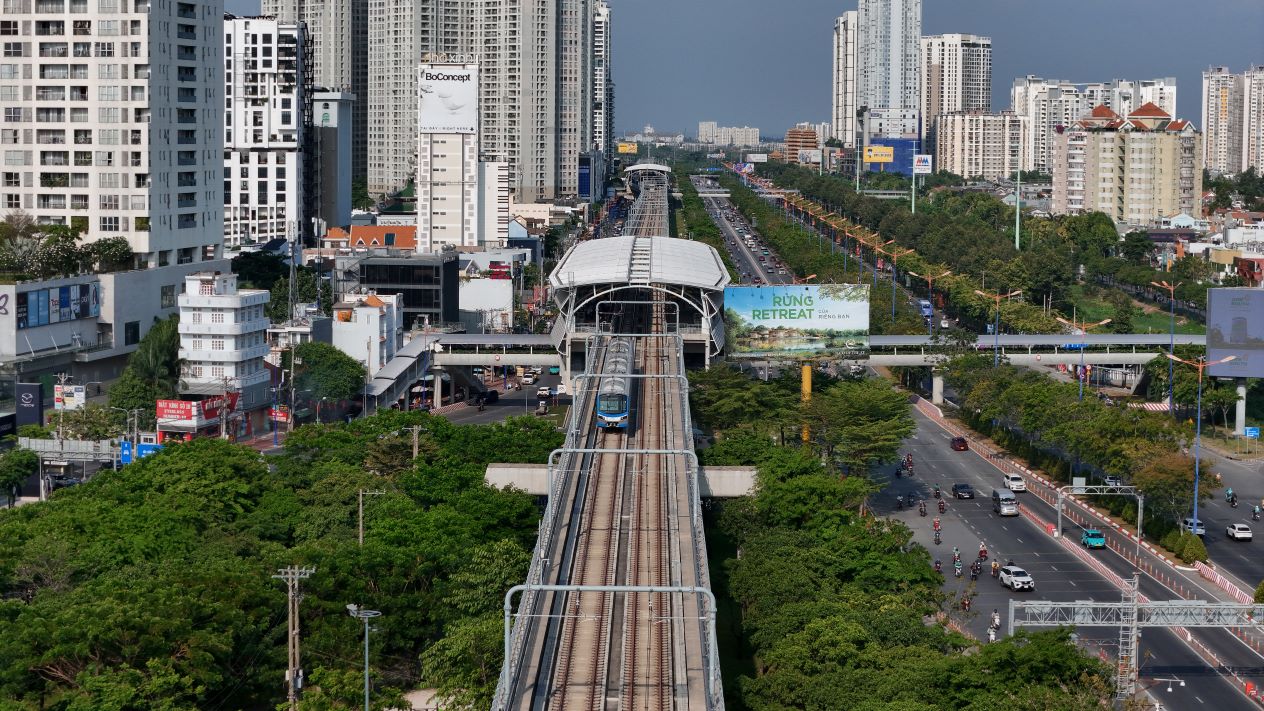
No. 2, 3 and 4 within five years, expanding the metro system, easing congestion and flooding, and cutting logistics costs. Transit-oriented development will optimize land use, promote green mobility, and improve climate resilience. Regional connectivity will also be strengthened, linking the Southeast region with the Mekong Delta and leveraging Long Thanh International Airport and the Cai Mep-Thi Vai port complex.
On policy and society, deeper decentralization will improve administrative efficiency, streamline the apparatus, and help attract talent for innovation. The city aims to become a sustainable, human-centered metropolis, ranking among the world’s top 100 most livable cities, with a high quality of life and strong appeal to global corporations.
Moreover, central and city leaders at the Autumn Economic Forum repeatedly underscored the importance of tapping resources from the business community and from domestic and international investors.
Prime Minister Pham Minh Chinh further instructed HCMC to soon issue a detailed action plan to implement the forum’s commitments and to take the lead in testing sandbox models for the green economy, green finance, and smart urban development, while moving ahead with the launch of the international financial center.
A positive signal at this year’s forum was that many international businesses expressed support for HCMC’s vision, saying it aligns well with the new context and offers substantial room for collaboration. A wide range of sectors was mentioned, including technologies such as AI and semiconductor manufacturing, industrial parks, digital infrastructure, green transport, telecommunications, and education and workforce training.
Many foreign investors are looking not only for broader collaboration but also for faster project approvals, clearer legal frameworks, and stronger financing prospects. Strategic land planning was likewise raised as a key concern.
HCMC is now calling for investment in 116 projects, including 29 priority initiatives. These range from the international financial center and high-tech and innovation projects to infrastructure, logistics and port development, energy-related industrial facilities, and a central urban rail network of 27 lines totaling 1,024 kilometers.
Strengthening HCMC’s competitiveness
With more than 40 new provisions that fall outside the current legal framework, the proposed changes center on decentralization, investor attraction, infrastructure upgrades and organizational reform, laying the groundwork for breakthrough mechanisms to develop HCMC as a megacity.
In the economic sphere, the plan targets US$8-12 billion in annual non-state investment, underpins double-digit growth from 2026 to 2030, aims for average GRDP expansion of 10% to 11% a year, and raises per capita GRDP to US$14,000 to 15,000 by 2030. The proposed free trade zone is expected to elevate HCMC into an international commercial hub, strengthen its competitiveness, attract higher-quality foreign investment, and support the development of fully integrated supply chains.
On infrastructure, the plan calls for completing Beltways
No. 2, 3 and 4 within five years, expanding the metro system, easing congestion and flooding, and cutting logistics costs. Transit-oriented development will optimize land use, promote green mobility, and improve climate resilience. Regional connectivity will also be strengthened, linking the Southeast region with the Mekong Delta and leveraging Long Thanh International Airport and the Cai Mep-Thi Vai port complex.
On policy and society, deeper decentralization will improve administrative efficiency, streamline the apparatus, and help attract talent for innovation. The city aims to become a sustainable, human-centered metropolis, ranking among the world’s top 100 most livable cities, with a high quality of life and strong appeal to global corporations.