The construction industry is a major consumer of natural resources and energy. Adopting Environmental, Social, and Corporate Governance (ESG) is essential for companies in this sector to protect the environment and meet sustainability standards.
The push for sustainable construction
Experts emphasize that short-term investments will not yield instant results. ESG requires a systematic, long-term investment over three to five years to achieve significant benefits.
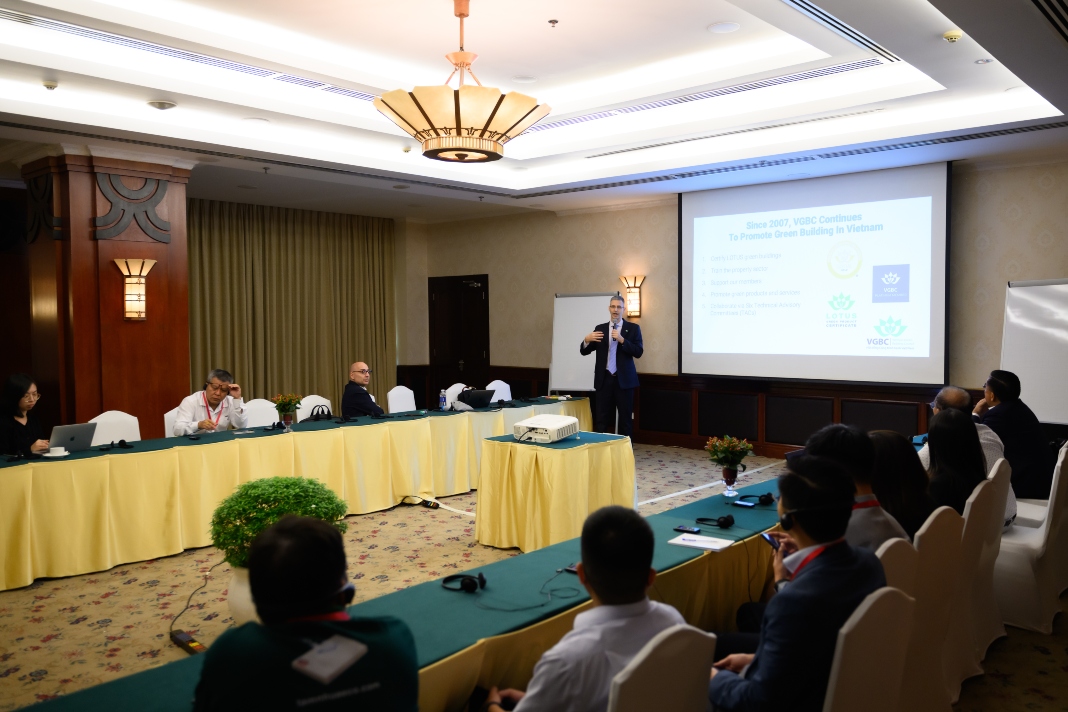
At the ESG Series Masterclass workshop on “How to Incorporate ESG in the Construction Sector?” on June 13, Douglas Lee Snyder, executive director of the Vietnam Green Building Council, highlighted the substantial environmental impact of construction projects compared to manufacturing and transportation. The workshop was part of the ESG Forum 2024, titled “From Ideas to Action,” organized by The Saigon Times, in collaboration with the EuroCham Green Growth Sector Committee (GGSC) and the ESG & Sustainable Business Transition Alliance.
Globally, construction accounts for over 40% of greenhouse gas emissions, while in Vietnam, this figure is 33%. The production of building materials like steel, metals and glass is responsible for around 30% of the environmental impact.
Steel production, in particular, is highly polluting, emitting 1.8 tons of carbon to turn out each ton of crude steel. “With steel consumption expected to reach 1.8 billion tons by 2025, carbon emissions could hit three billion tons,” said Truong Anh Hai, vice president in charge of Occupational Health, Safety, Environmental, and Community at NS Bluescope Vietnam.
Snyder stressed that construction companies must quickly adopt ESG practices to stay relevant in today’s sustainability-focused world. These commitments are no longer optional but mandatory, especially with the implementation of the Carbon Border Adjustment Mechanism (CBAM) in the European Union. CBAM is a carbon tariff on carbon-intensive products imported into the EU. It initially applies to the highest-emitting industries with the highest risk of leakage, such as steel, cement, aluminum and fertilizer, and will then be expanded to other industries according to the roadmap.
In response to global green initiatives following the 26th United Nations Climate Change Conference of the Parties (COP26), many Vietnamese companies and investors in the construction sector are developing plans to reduce emissions and aim for carbon neutrality by 2050, in line with the Vietnamese Government’s net zero commitment, Snyder added.
Long-term commitment needed for ESG success
Vietnamese businesses are having a hard time implementing ESG. At the event, a representative of NS BlueScope Vietnam said cost is a primary concern under the current tough economic conditions. Companies also raised concerns about the benefits and timeline of ESG investments. However, it is important to note that ESG is a long-term journey and it takes three to five years to see first results.
ESG implementation is a gradual process which can take years to evaluate. Long-term progress in ESG shows a company’s commitment to sustainable business practices. Sustained efforts in ESG demonstrate a company’s dedication to sustainability, Hai said, emphasizing that setting realistic, long-term goals for ESG initiatives is essential.

Another challenge is the lack of sufficient resources. ESG is a relatively new field, and many employees lack a full understanding of its definition. This can lead to heavy reliance on external resources, which may not always be a perfect fit for a company’s specific needs.
A mindset shift is also necessary. Companies often have independent management systems like ISO 9001 for quality management, ISO 14001 for environmental management systems, and ISO 45001 for health and safety at work. However, ESG requires cohesive efforts from all employees. The interconnected nature of ESG activities means that poor performance in one area can impact overall goals. For instance, a wastewater treatment operator that does not ensure the discharged water meets environmental quality standards will harm the environment. If departments work in isolation, sustainable ESG implementation cannot be achieved, according to Hai.
To address these challenges, ESG experts and businesses propose establishing official channels to provide information on ESG practices for investors, facilitating easier access and implementation. The Government should introduce specific ESG criteria for various industries, including construction and textiles. Initially, the Government could support businesses with consulting and financial resources. In the long run, ESG practices should be made mandatory, with collective action across communities and supply chains necessary for significant impact.