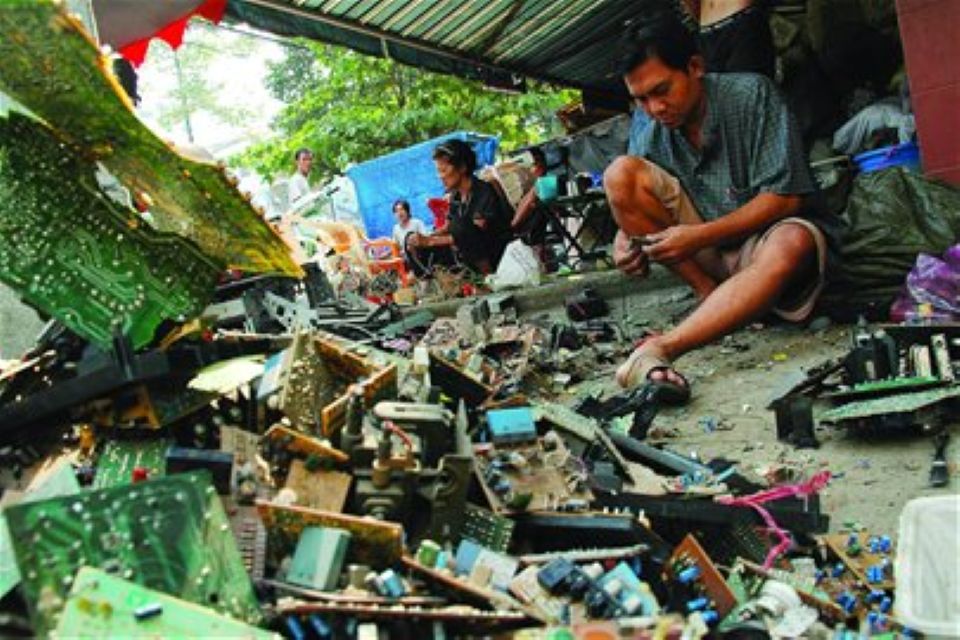
Electronic waste, or e-waste, is mounting as demand for consumer technology continues to grow. In Vietnam, where much of the discarded equipment is processed by informal recyclers using rudimentary methods, concerns are rising over the environmental consequences.
For environmentally conscious consumers, finding a place to dispose of unwanted electronic items such as batteries, remote controls, electronic toys, or broken laptop and computer parts can be surprisingly difficult. While collection programs, battery-for-gifts campaigns, and producer take-back initiatives have been widely promoted, accessing these disposal channels in practice is often far less straightforward than advertised.
Simple, but not always convenient
When L.A., a secretary at a business association, changed jobs after the 2026 Lunar New Year holiday, her former office lost more than just an employee. It also lost its unofficial e-waste collection point. Known among colleagues as the keeper of the office’s “Doraemon bag,” L.A. maintained a box where used batteries could be dropped off before being taken to designated recycling sites. She also helped dispose of larger electronic items, from old phone chargers and cables to worn-out laptop accessories, either delivering them herself or directing coworkers to appropriate collection points. Her message was always the same: electronic waste should not be thrown out with household garbage.
Just last week, her colleague brought a bag of used batteries, damaged charging cables, and other discarded electronic items while shopping at a store belonging to one of Vietnam’s largest electronics retail chains in HCMC. The salesperson on duty accepted the items but reportedly said they would simply be thrown away, adding that the store did not have any designated collection bin for electronic waste. Alarmed by the response, the customer asked for the items back and took them home.
In fact, the retailer had previously partnered with a South Korean consumer electronics company to launch a used-battery collection campaign in August 2023. The initiative, however, lasted only two months. After announcing that it had successfully collected more than 600 kilograms of used batteries, the campaign quietly came to an end.
Even earlier, Vietnam Recycles (VNTC) officially announced that it would stop accepting all types of batteries for collection, including AA, AAA, and lead-acid batteries, from the end of October 2021. Following VNTC’s decision, the Green Life project also discontinued its scheduled household battery collection program at the end of the same year.
There are two main reasons behind the decisions by VNTC and Green Life. First, Extended Producer Responsibility (EPR), a mechanism introduced under Vietnam’s 2020 Law on Environmental Protection and formally implemented in 2022, requires manufacturers and importers of batteries to either collect and recycle their products or make financial contributions to the country’s environmental protection fund. Second, storing large quantities of used AA and AAA batteries can pose safety risks, including leakage of chemicals, corrosion, and the potential for short circuits or fire hazards.
Many collection points can still be found through a simple Google search. However, most of them accept only used batteries and not other forms of e-waste, such as charging cables, adapters, electric toothbrushes, or small electronic devices. Determining whether these collection points are still operating, what items they actually accept, and under what conditions often requires additional effort. For many consumers, the prospect of researching such details simply to avoid making a wasted trip can be discouraging. Not everyone, after all, is as committed and diligent as L.A., who routinely guides colleagues on how and where to dispose of electronic waste responsibly.
A growing mountain of e-waste
Back in 2016 and 2017, researchers led by Associate Professor. Ph.D. Nguyen Duc Quang and others at the Institute of Environmental Science and Technology at Hanoi University of Science and Technology estimated that Vietnam generated about 100,000 tons of electronic waste each year.
Their assessment covered only the most common household and office appliances, such as televisions, refrigerators, washing machines, computers, and printers. It excluded industrial-scale equipment, small electronic components, and unregulated imported electronics, thereby likely underestimating the actual volume of e-waste. Even based on those conservative estimates, the researchers projected that Vietnam’s annual e-waste generation would climb to 250,000 tons by 2025, reflecting the country’s rapidly growing consumption of electronic products.
However, the picture appears even more alarming in The Global E-waste Monitor 2024, published in March 2024 by the United Nations Institute for Training and Research (UNITAR) and the International Telecommunication Union (ITU). The report adopts a broader definition of e-waste, encompassing “any discarded product with a battery or a plug.” Under this definition, Vietnam generated an estimated 516,000 tons of e-waste in 2022, more than double the volume recorded just two years earlier.
According to the report, the surge has been driven by the global proliferation of low-cost electronic products. Smartphones, charging cables, wireless earbuds, e-cigarettes, battery-powered toys, and even solar panels have become increasingly affordable, accelerating consumption and, ultimately, disposal.
 Are businesses taking responsibility?
Public awareness and responsibility toward consumer electronics in Vietnam remain highly uneven. In some households and workplaces, discarded electronic items are simply thrown out with regular household waste. In others, used batteries are carefully stored in collection boxes awaiting recycling. For larger electronic items, however, proper disposal often depends on consumers’ goodwill and initiative, especially when manufacturers and distributors are not subject to stronger collection requirements.
For conventional electronic products such as mobile phones, laptops, computer monitors, keyboards, mice, mini fans, electrical cables, and printers, recycling facilities partnered with VNTC are required to follow a closed-loop, four-stage dismantling process. The goal is to recover as much value as possible from recyclable materials, including plastics, copper, and precious metals, while preventing hazardous substances from entering the environment.
Single-use batteries are classified as hazardous waste because they contain significant amounts of toxic chemicals. Due to technological limitations, treatment in Vietnam is largely focused on safe incineration and preparation for landfill disposal, rather than recovering materials such as steel, zinc casings, and plastic components as is commonly done in more advanced recycling systems. Rechargeable batteries, particularly lithium-based batteries, present a different challenge. Speaking to local media at events attended by VNTC, Mai Thi Thu Hang, a representative of the organization, said that partner companies currently lack suitable recycling technologies for these batteries. As a result, collected lithium batteries are transferred to licensed waste treatment operators and managed as hazardous waste rather than being recycled for material recovery.
Drift of giant iceberg
Some observers describe Vietnam’s e-waste problem as merely the “tip of the iceberg.” But like an iceberg, what is visible above the surface reveals only a fraction of the whole. A closer look beneath reveals not only the true scale of the challenge but also the direction it is heading.
The concern is compounded by a striking paradox. Vietnam was the world’s second-largest importer of electronic waste in 2025, trailing only Japan. Yet while Japan has developed one of the most advanced e-waste recycling industries in the world, the fate of electronic waste containers arriving in Vietnam remains a growing concern. Where these materials ultimately end up, and how they are processed, is far less certain.
The concern stems from the fact that an estimated the informal recycling sector handles 80-90% of electronic waste in Vietnam. Much of it flows through networks of scrap collectors and recycling hubs such as Bui village in Hung Yen Province, the craft villages of Van Mon and Quan Do in Bac Ninh Province, Trang Minh in Haiphong City, Soc Son on the outskirts of Hanoi, and Tan Thanh Dong in HCMC. Beyond these well-known locations, countless unlicensed workshops and illegal dumping sites operate across the country.
In a series of reports published in the first half of 2024, the Associated Press described Vietnam as one of the leading destinations in Southeast Asia and the Middle East for U.S. electronic scrap exports. The news agency reported that exports of electronic waste and scrap from the United States to Vietnam reached about US$1 billion between January 2023 and January 2025.
Meanwhile, Vietnamese media reports and television documentaries have repeatedly documented unsafe recycling practices in informal e-waste hubs. Workers are often seen dismantling electronic devices by hand without protective equipment, burning electrical wires and circuit boards in open spaces to recover copper, using acid baths to extract gold and other valuable metals from electronic components, and disposing of residual waste directly into nearby fields and waterways. The environmental consequences are evident. Many of these areas are marked by acrid smoke from open burning, contamination of water sources by acids and heavy metals, and persistent concerns about the long-term impacts on both ecosystems and public health.
The story is far from over
The tightening of Vietnam’s EPR regulations in 2026 may signal progress, but the country’s e-waste challenge remains far from resolved. The volume of discarded electronics continues to grow alongside consumer demand for inexpensive gadgets with increasingly short lifespans. A single heatwave, for instance, can trigger a surge in sales of handheld electronic fans, many of which may ultimately join the country’s expanding stream of electronic waste. At the same time, recycling and trading hubs such as Van Mon, Quan Do, Trang Minh, and Nhat Tao continue to bustle with activity.
Ultimately, the untold story behind Vietnam’s growing mountains of e-waste is not merely about the lack of dedicated collection bins or consumers’ habit of discarding unwanted devices with household garbage. The deeper issue lies in the widening gap between the explosive pace of technology consumption and the country’s still-limited capacity to collect, process, and recycle electronic waste. It is also a story of unresolved bottlenecks, from the shortage of recycling technologies that domestic companies can develop and operate at scale to the regulatory and policy frameworks needed to support a more circular electronics economy. Above all, the challenge ultimately comes down to the awareness and patience of consumers like L.A., and the many people whose habits she has helped shape, as noted at the beginning of this story.