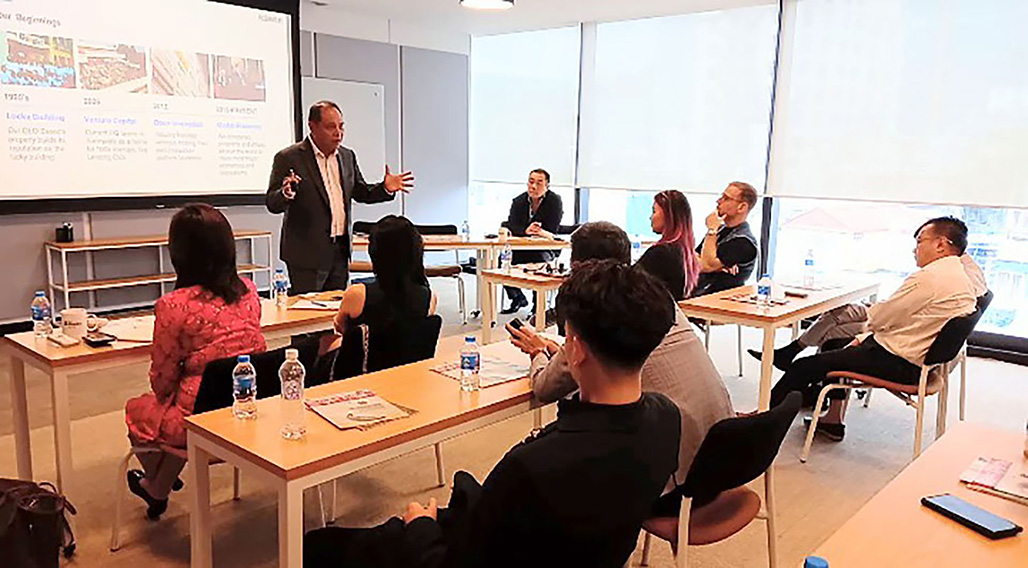
Jojo Flores, co-founder of the world’s top business incubator Plug and Play in Silicon Valley, participated in three seminars in HCMC in the past week to encourage the establishment of an innovative ecosystem, inspire the startup spirit among young talent, and sound out opportunities to connect Vietnamese startups with global corporations. He speaks with The Saigon Times on entrepreneurship and innovation after the seminars.
The Saigon Times: My first question is about your expectation when participating in Plug and Play seminars here. Do you see Vietnam as a new frontier for startups and innovation with opportunities opening up given the current economic conditions and the institutional environment of the country?
Jojo Flores: I have very high expectations of the Vietnam market due to several factors I’m observing. Your economy has been thriving at 6-7% per year, which leads to a rising middle class, increased purchasing power, and higher demand for innovative products. Vietnam is a large and young market, which I believe is tech-savvy. You also have a reasonably high internet and mobile penetration, if I’m not mistaken about 70%, which is acceptable in growing e-commerce and digital platforms. Lastly, I think that your Government recognizes that technology and entrepreneurship play vital roles in advancing the country. Thus, I am keen to learn more about how we can engage and collaborate to accelerate this process.
We have learned that you, born and bred in the Philippines, have sought to inspire the spirit of business startup and entrepreneurship in your home country. Do you see similarities between the Philippines and Vietnam in terms of entrepreneurship and the regulatory environment for business development?
Yes, I was born and educated in the Philippines. However, I spent most of my professional and entrepreneurial career in Silicon Valley and Europe. The Philippines and Vietnam are very similar markets, but I must recognize that Vietnam has grown leaps and bounds over the last 10 years. Kudos to you guys for leveraging on your talent and technology in making this happen. Our market conditions are also very similar, if not identical. The Philippines has a little advantage with the English language though. One thing for sure is that our big tech companies are not international companies. They’re local, and this is an opportunity which I think both our countries should strive to change.
In Southeast Asia, Singapore has the most startups reaching the unicorn status, at 25, while there are only four in Vietnam. Please give comparison between the two countries in this respect. And in your opinion, what are the key impediments to the incubation of startups, are they the legal corridor, the people’s mindset, or the level of economic development?
I believe that the key activities of Singapore in its success in building its startup ecosystem are accountable to its government initiatives and programs, focus on technology and entrepreneurship in its higher education, and private sector collaboration with startups. The rest of Southeast Asia should learn and copy what Singapore has done in the last 15 years. Very early on and it continues to this day, the Singapore Government has numerous programs to support its startup community. For instance, Plug and Play works actively with Enterprise Singapore to help startups gain global market access. On the education front, National University of Singapore and Nanyang for example heavily promote and support entrepreneurship through international programs in Silicon Valley. And for the private sector, big corporations have innovation teams that search and actively engage with startups, giving them proof of concept and investment opportunities. Today, Plug and Play APAC works with close to 50 multinationals in this respect.
Foreign direct investment in Vietnam is pretty high, at roughly US$27.7 billion in 2022, but most was channeled into manufacturing or real estate, while little was spent on technology-driven sectors. Do you think such a fact indicates anything about the slow pace of business startups in Vietnam?
I had dinner with one of your startups here in HCMC last year. I don’t have any other data to validate his claim, but he told me that at least 1,000 web 3.0 companies in Vietnam had raised at least US$1 million each over the last 2-3 years. I suspect that this US$1 billion came through FDI. This figure is truly admirable in world standards. So, I really don’t think that it could be considered as slow pace. However, the next step is to build on that figure and increase value by making these startups succeed and globalize.
Also relevant is the amount of portfolio investment in Vietnam, which totaled US$5.7 billion in January-October last year, a sharp fall of 35% year on year. Does the downtrend signal anything worrisome about the business startup environment?
The global startup scene is indeed experiencing some hiccups. We had the collapse of FTX and the current crypto winter. We recently had problems with SV Bank, too. These contribute to everyone tightening their belts, obviously. However, it’s not the first time for these incidents. It will happen again. The important thing is to know how to adjust your mindset and behave under such conditions. For startups, you need to conserve cash as best as you can. You’ll need to focus on being cashflow positive and have a clear path to profitability. Finally, this is the time when the founders need to lead and inspire the team and keep their minds and hearts strong.
It is generally perceived that the development of business startups requires a willingness to take risks and an innovative mindset, but such characteristics are hard to nurture. As an experienced leader at the world’s largest business incubator Plug and Play, do you think there are ways to help young talent, especially students, to overcome the fear of failures and to do away with the risk-averse culture?
I agree, what you’re saying is difficult indeed. Many startup founders especially here in Southeast Asia are first time founders. They’re young and really don’t have much real-world experience yet. It’s a little easier in Silicon Valley, since the culture there isn’t afraid of failures. It’s just part of the game. The young founders there grow up thinking this way. Young minds and hearts are impressionable. So, you need to inspire them with actual stories close to home. You need poster children of success. Celebrate these individuals and companies, and have them tell their stories in schools and universities. Interestingly enough, President Widodo of Indonesia appointed Nadiem Makarim, co-founder of Gojek, as their Minister of Education and Culture. What do you think will happen to the startup ecosystem of Indonesia with this move?
Plug and Play has helped connect tens of thousands of startups with hundreds of global corporations and venture funds, especially those in Silicon Valley. How do you see the interest of global investors in Vietnam’s startups?
Vietnam and the rest of Southeast Asia is far to Silicon Valley. Silicon Valley isn’t the only resource available to help our Southeast Asia startup ecosystem. I feel that we have ample supply of resources here in the form of talent, customers, funding, even corporate partners. What we need to copy from Silicon Valley is their best practices, or the software that they use. I don’t think we lack the hardware to make ourselves successful. That’s our mission at Plug and Play. Create the same platform here in Vietnam and Southeast Asia that enables open collaboration from among all the stakeholders—the startup community, universities, government, investors, mentors and experts, and corporations. And when we’re able to create this platform, the international community (is) to join us and partner with us.
 An innovative ecosystem is decisive for business startups, which is also aligned to Plug and Play’s goal of promoting innovation for acceleration. What are your recommendations for Vietnam to develop such an ecosystem?
Like a successful startup, it has to have product-market fit. The product is a result of market demand. My trip now to HCMC is partly to discover that as well. That’s why I’m meeting with your government officials and large corporations. I want to know your national roadmap to build business here and create value. Is it in agriculture, aquaculture, tourism and hospitality, manufacturing? And in future-proofing these industries, what technology pain points and gaps are you facing that needs to be enabled and built. Once we identify these opportunities, then Plug and Play can do its magic. We can bring the knowhow of programs and create the network to accelerate the process of building new technologies that address those industries.
Does Plug and Play have any specific plan to set up a presence in Vietnam to incubate startups and help connect domestic startups with global corporations? And does Plug and Play have plans to build up an investment portfolio in Vietnam?
Yes to all. Our Southeast Asia play cannot be complete without Vietnam included. Of course, the full value of Plug and Play can only be realized if we have the local collaboration of the stakeholders. My trip here is to evaluate the level of commitment from the entire community and am hopeful that we can garner such.
Thank you ever so much for your time.
Reported by Van Thang