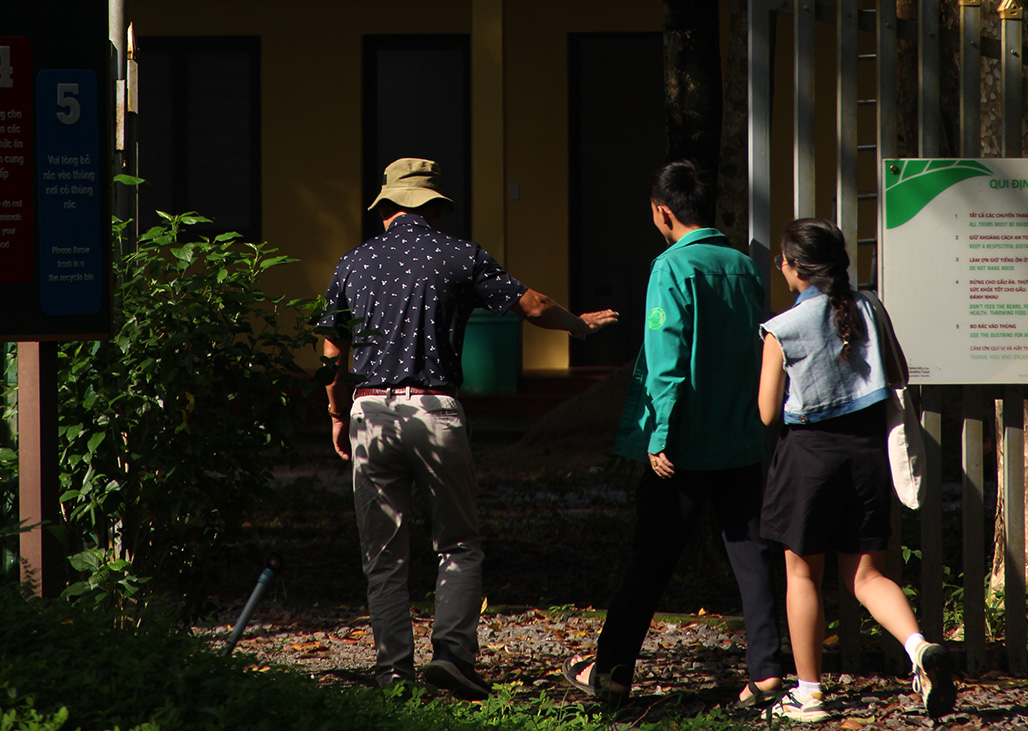
Efforts to safeguard the environment and promote harmonious coexistence between humans and nature are central to environmental projects led by international organizations like the U.S. Agency for International Development (USAID) and the World Wide Fund for Nature in Vietnam (WWF-Vietnam).
Collaboration is key
Cat Tien National Park is gaining popularity as an immersive ecotourism destination, offering a peaceful escape from urban life. Located in Nam Cat Tien Commune, Tan Phu District, Dong Nai Province, this park holds international acclaim for its ecological significance. It was designated a world biosphere reserve by UNESCO in 2001 and recognized as a site of international importance under the Ramsar Convention in 2005 for its wetland, known as Crocodile Lake.
The park’s exceptional biodiversity attracts visitors. It comprises five distinct natural forest types: evergreen broadleaved forest, semi-deciduous evergreen forest, mixed wood-bamboo forest, bamboo, and wetland and semi-wetland. It also houses a rich ecosystem, including 1,730 animal species and 1,655 plant species.
However, managing and preserving Cat Tien National Park’s vast 71,000-hectare expanse spanning three provinces—Dong Nai, Lam Dong, and Binh Phuoc— with 90 kilometers along the Dong Nai River presents a significant challenge. Authorities must safeguard the park’s critical role in Vietnam’s biodiversity.
The park also faces issues like local poachers and illicit activities that threaten wildlife. Conservation initiatives and support from foreign organizations, such as WWF-Vietnam and USAID, have played a pivotal role. These organizations engage in various projects, including wildlife protection, afforestation, knowledge-sharing seminars, and collaboration with government agencies to conserve the environment.
As Vietnam tackles pressing challenges like poverty reduction, improved education, and infrastructure development, its resources remain limited. Therefore, foreign organizations are essential partners in preserving natural resources and advancing long-term socioeconomic progress, especially amid growing threats to wildlife.
Facing future challenges in Vietnam’s ecosystems
Vietnam’s remarkable biodiversity is attributed to its diverse ecosystems, including vast forested areas. In 2022, the country had 14.8 million hectares of forest land, encompassing 10.1 million hectares of natural forests and 4.7 million hectares of planted forests, according to the Ministry of Agriculture and Rural Development (MARD). With a forest coverage of 42.02%, Vietnam continues to discover new species in its forests each year, as noted by WWF-Vietnam.
Despite this biodiversity, Vietnam’s forests are facing threats. The nation’s economic growth necessitates infrastructure development, including roads that often traverse forested regions. Such construction can disrupt the delicate ecological balance and impact local species due to changes in the landscape and increased human activity.
In May of this year, Prime Minister Pham Minh Chinh approved a proposal to construct a 71-kilometer road connecting two southern provinces, Binh Phuoc and Dong Nai. While local governments initially proposed a route through Ma Da Bridge, linking Dong Nai and Binh Phuoc, the Ministry of Transport expressed concerns about the project’s environmental impact.
The approved plan, which has the lowest cost among feasible options, includes a 31-kilometer section running through the Dong Nai Biosphere Reserve (formerly Cat Tien Biosphere Reserve). This decision aims to minimize potential harm to the biosphere reserve.
The Vietnamese Government recognizes the importance of conserving natural resources, but challenges persist, particularly in raising community awareness. These challenges are compounded by the country’s expanding timber exports, which reached US$16.5 billion in 2022, a 4% increase over the previous year due to surging wood product prices.
Global Forest Watch reports that Vietnam lost approximately 2.6 million hectares of tree cover between 2001 and 2018, representing a 16% decline since 2000. Additionally, from 2011 to 2015, there were around 27,260 cases of deforestation recorded annually, resulting in the destruction of 2,640 hectares of forest each year, according to MARD.
As Vietnam’s forests diminish, its wildlife faces increasing threats. The demand for wildlife meat further exacerbates the challenges of wildlife conservation in the country. A representative from the Sustainable Forest Management and Biodiversity Conservation (VFBC) project, Nguyen Thuy Hang, highlighted the focus on hunting meat animals, primarily by consumers aged 30-39 in both urban and rural areas.
A committed journey
WWF-Vietnam is on a mission to help Vietnam strike a harmonious balance between safeguarding and restoring forest ecosystems and biodiversity while ensuring the sustainable growth of the country’s economy.
WWF has established its presence in different parts of Vietnam, including Hanoi, the north-central region, the Central Highlands, the southern region, and the Mekong Delta, through a range of initiatives. Its strategic goals encompass reducing the environmental impact of Vietnam’s forest sector and enhancing the protection or management of forests in protected areas within the Central Annamites Landscape.
In Vietnam, WWF collaborates with local governments and other entities to pursue mutually beneficial objectives. One such partnership involves the USAID Biodiversity Conservation initiative, which seeks to improve forest quality and protect animal populations. This initiative places a special emphasis on empowering local communities to become stewards of biodiversity, benefiting both forests and wildlife, as well as the well-being of the communities themselves.

In September, WWF-Vietnam, in conjunction with USAID and relevant authorities, organized a workshop to promote wild species conservation and environmental protection through responsible tourism at Cat Tien National Park. The event aimed to raise awareness about wildlife conservation by bringing together government officials and the local business community. Notably, around 40 hospitality businesses committed to enhancing their responsible tourism efforts as part of this initiative.
The USAID Biodiversity Conservation project achieved significant milestones in 2022. It managed to protect over 270,000 hectares out of 700,000 hectares of biologically significant land through improved biodiversity and natural resources management. And more than 1,150 individuals received training in sustainable natural resources management and biodiversity conservation.
Nicholas Cox, chief of party at USAID Biodiversity Conservation Vietnam, said, “Success in the management of forest biodiversity will only be achieved through collaboration between those with management responsibility and those who stand to directly benefit from biodiversity conservation.”
It is crucial to recognize that achieving sustainable development in Vietnam requires not only the dedicated efforts of local authorities but also the vital involvement and support of relevant stakeholders.
At Cat Tien National Park, visitors are encouraged to adhere to an environmentally responsible approach when exploring the area, summarized by the phrase, “Taking only pictures and leaving only footprints is a civilized way of dealing with forests.”