When the European Union-Vietnam Free Trade Agreement (EVFTA) was signed four years ago, expectations were high for a transformative economic partnership. Those expectations are now being realized.
A new report by EuroCham highlights a significant surge in businesses experiencing substantial benefits. After four years of implementation, Vietnam has become the largest ASEAN exporter to the EU.
“The EVFTA has shown that expectations for trade growth between Vietnam and the EU have become a reality,” said Ngo Chung Khanh, deputy director of the Multilateral Trade Policy Department at the Ministry of Industry and Trade, according to local media.
Unprecedented access
The EVFTA, which came into force on August 1, 2020, marked a pivotal moment in the economic relationship between Vietnam and the EU. Designed to foster deeper economic integration, the free trade deal primarily aims to bring down trade barriers, reduce customs duties, and enhance market access for Vietnamese and EU firms.
At its core, the EVFTA is a comprehensive trade deal that seeks to eliminate almost all tariffs on goods traded between the EU and Vietnam. Upon its implementation, 65% of EU exports to Vietnam immediately became duty-free, with the remaining tariffs to be phased out over a decade.
Conversely, 71% of Vietnamese exports to the EU enjoy immediate tariff elimination, a figure set to climb to nearly 100% within seven years, according to data from the EuroCham EVFTA report in 2019.
Beyond tariff reductions, the agreement also streamlines customs procedures, facilitating the movement of goods and reducing business costs. The EVFTA offers European service providers unprecedented access to the Vietnamese market, surpassing the commitments made under the World Trade Organization (WTO). This expansion of market opportunities is expected to stimulate trade in services and create new business avenues.
Delivering on its promise
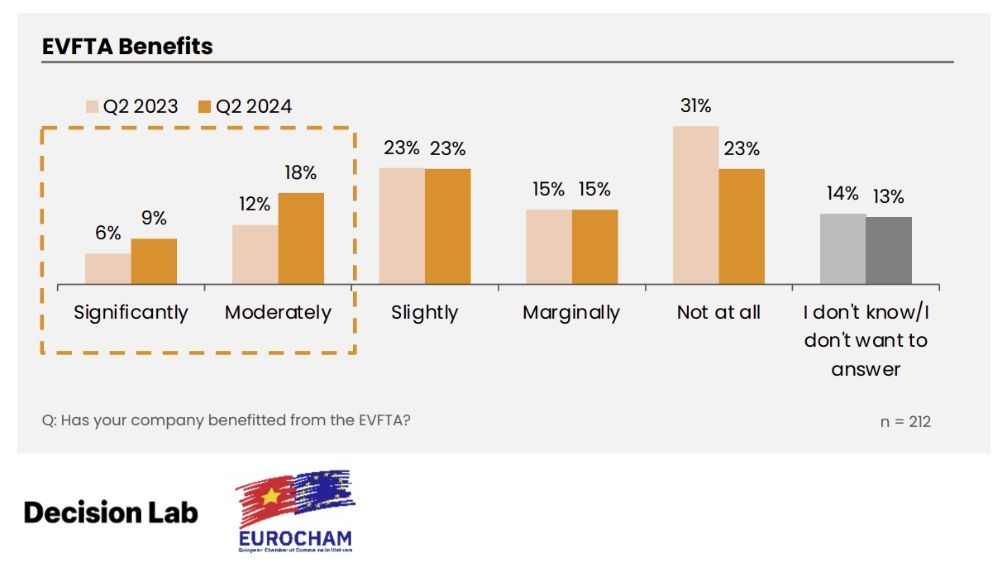
The EuroCham survey shows the positive impact of the EVFTA on Vietnamese businesses, with over 59% of respondents reporting some level of benefit. This figure includes those who noted “Significant”, “Moderate” or “Slight” benefits.
Despite EU imports in the first two months of 2024 declining by 14.2% year-on-year to 381.4 billion euros, according to Eurostat, Vietnam’s exports to the continent have rebounded. Bilateral trade between Vietnam and the EU reached US$15.9 billion (equivalent to 14.5 billion euros) in the first quarter of 2024, a 15.9% year-on-year increase, according to the General Statistics Office.
Exports of key Vietnamese items to the EU, including seafood, fruit and vegetables, footwear, textile, and wooden products, have grown substantially.
This indicates that the EVFTA is effectively facilitating market access and enabling Vietnamese businesses to expand their reach, as noted in a report by the Ministry of Industry and Trade.
The benefits of the EVFTA are distributed unevenly across sectors. The services sector leads, with nearly 38.6% of businesses reporting “Significantly” or “Moderately” improved trade conditions. Manufacturing, another key pillar of the Vietnamese economy, has also experienced positive changes, with around 38% of manufacturers reporting “Moderate” or “Slight” benefits.
Tariff reduction or elimination has emerged as the most significant benefit, cited by 29% of respondents. This suggests that the EVFTA’s core objective of reducing trade barriers has been effectively achieved.
The combined impact of improved competitiveness (18%) and broader market access (16%) underscores the agreement’s role in enhancing Vietnam’s position in the global market. These factors are crucial for businesses seeking to expand their customer base and increase market share.
Additional benefits such as enhanced supply chain efficiency (15%), greater transparency and predictability (11%), and a strengthened legal framework (11%) collectively indicate the EVFTA’s positive influence on the overall business environment. These factors are essential for attracting foreign investment and fostering domestic growth.
Main barriers
The figures reveal several key obstacles that hinder Vietnamese businesses from fully capitalizing on the EVFTA’s benefits. Regulatory compliance stands out as the most significant challenge, with nearly one-fifth of respondents identifying complex regulations as a primary barrier.
The lack of recognition and acceptance of international standards presents a substantial hurdle, indicating a need for better alignment between domestic regulations and global best practices to facilitate smoother trade operations. A considerable portion of businesses also reported a limited understanding of the EVFTA’s provisions, underscoring the need for improved awareness and capacity building.
In 2022, a survey by the Vietnam Chamber of Commerce and Industry found that awareness of specific EVFTA commitments among Vietnamese businesses was relatively low. Only 30% of surveyed firms reported a fairly good understanding, and just 10% had a very good grasp of these commitments.
On the European side, the EuroCham report points out secondary challenges, including customs-related issues such as valuation problems and lengthy clearance procedures, which contribute to operational inefficiency.
Communication and legal challenges, such as difficulties in interacting with local authorities and accessing fair legal recourse, also hinder businesses’ ability to thrive under the EVFTA.
Lessons learned
These challenges underscore the necessity for ongoing adaptation and strategic adjustment. The EVFTA serves as a vital bridge, but its effectiveness depends on the ability of businesses and governments to navigate complexities and capitalize on opportunities.
In an era marked by global economic uncertainties, fully leveraging the potential of both the Vietnamese and EU markets is crucial for a mutually beneficial partnership.
Addressing regulatory hurdles, enhancing customs efficiency, and fostering a deeper understanding of the agreement can create a more conducive environment for businesses to thrive. Simultaneously, the EU can support these efforts through capacity building, market access facilitation, and promoting sustainable development.
Exploring opportunities in digital trade, green technologies, and value chain integration can unlock new growth frontiers. While a noticeable portion (41.0%) of businesses in the “Others” category, neither services nor manufacturing, reported some level of benefit, a significant number (25.0%) have not observed any positive impacts from the deal. This suggests that businesses in a broad range of sectors may require more targeted support or guidance to fully capitalize on the opportunities presented by the EVFTA.
Therefore, the EVFTA should act as a catalyst for broader economic cooperation. Strengthening institutional collaboration and knowledge exchange between Vietnam and the EU will be essential in maximizing the agreement’s impact.