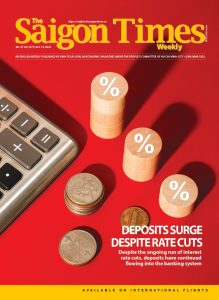
Despite the ongoing run of interest rate cuts, deposits have continued flowing into the banking system. This is an omen of economic conditions getting tougher.
A big surprise?
Data from the General Statistics Office (GSO) showed that capital mobilization by credit institutions, as of September 20, had increased by 5.8% compared to the beginning of the year. In contrast, credit growth stood at 5.73%. The trend of capital mobilization outpacing credit growth persisted into the third quarter.
The GSO data also indicated that by June 20, deposits had increased by 3.26%, while outstanding loans grew by 3.13%. That deposits are growing faster than loans has been observed throughout the year, highlighting certain challenges in the economy, especially given the significant slowdown in lending in the banking system.
The first nine months of 2020 saw a higher growth rate in capital mobilization than in lending, except for 2020 when the Covid-19 pandemic significantly disrupted economic activities. During this period in 2020, capital mobilization increased by 4.04%, compared to credit growth of 10.54%. In 2021, the rates were 4.28% and 7.17% respectively, demonstrating a clear shift in these two indicators.
In absolute terms, deposits at credit institutions have increased by VND685.53 trillion compared to the beginning of 2023, totaling more than VND12,500 trillion as of September 20. Meanwhile, outstanding loans increased by VND683.27 trillion, amounting to more than VND12,600 trillion. Despite the higher growth rate in deposits, the difference is not significant, with deposits at banks still VND100 trillion below outstanding loans.
However, it is worth noting that a representative from the State Bank of Vietnam (SBV) reported that the total capital mobilized by banks as of September 30 had amounted to VND12,900 trillion, surpassing the total outstanding loans in the economy, which stood at VND12,630 trillion.
Despite deposit rates steadily declining since the beginning of the second quarter, capital mobilization by banks continues to rise at a rate higher than lending. Deposit interest rates averaged 5.9% in late September, significantly lower than the 7.68% level in the same period last year.
Nonetheless, credit growth has been persistently low though interest rates have dropped sharply. Credit growth in the third quarter of 2023 was only 2.6%, the lowest in recent years, possibly exceeding only the 1.7% increase observed in the third quarter of 2020 when the country was placed on lockdown due to the Covid-19 pandemic.
The persistent inflow of funds into banks amid declining interest rates, along with sluggish credit growth, suggests that there may be unwelcome obstacles in the current economy. The issue of modest credit growth has been a topic of discussion, and the fact that deposits continue to grow at a higher rate than outstanding loans points to the woes faced by banks in finding borrowers.
Hindrances
GDP exhibited a promising surge, estimated at 5.33% year-on-year in the third quarter, taking the GDP growth rate in the first nine months of the year to 4.24% against the year-ago period. However, this growth remains subdued when compared to the meager rates of 2.19% and 1.57% observed in the first nine months of 2020 and 2021, respectively, within the 2011-2023 timeline. These figures collectively paint a less optimistic economic picture. Amidst these challenges, the persisting shortage of orders has forced numerous enterprises to curtail their production and operate with reduced vigor. The overall business community is displaying limited demand for loans, with idle capital, if available, increasingly accumulating in banks.
The hardships are succinctly reflected in Vietnam’s Manufacturing Purchasing Managers’ Index (PMI) for September, which stands at a mere 49.7 points. This marks a return below the crucial 50-point threshold, following a slight uptick to 50.5 in August. This downturn indicates deteriorating business conditions for domestic manufacturers.
According to an S&P Global report, manufacturers remain hesitant to expand their workforce in such challenging circumstances, leading to a seventh consecutive month of declining employment. Although the rate of employment reduction is modest, it represents the most significant decline since June.
Despite capital outflow challenges, foreign investment has significantly bolstered the economy. Foreign direct investment (FDI) in Vietnam for the first nine months of 2023 is estimated at US$15.91 billion, up 2.2% over the same period last year. This figure is the highest FDI influx recorded during January to September in the past five years. It has contributed to the expansion of money supply in the economy, aided by the State Bank of Vietnam’s active role as a net buyer of foreign currency since the beginning of the year, aimed at building up foreign exchange reserves.
The banking system is currently grappling with excess liquidity due to deposits outweighing loans. Furthermore, banks issued substantial corporate bonds in the first eight months of 2023, accounting for 40.7% of the total corporate bond value offered. The bond sales were partly for refinancing maturing bonds or restructuring their terms to capitalize on prevailing low market interest rates.
However, this excess liquidity has led to undesirable consequences, including a surge in foreign currency speculation and swing trading at select banks in the interbank market, which is exerting pressure on the exchange rate. To address this issue, the central bank has issued tens of trillions of dong worth of Treasury bills (T-bills). A recent report by BIDV Securities Company (BSC) said that demand deposits left at the State Bank of Vietnam (SBV) have reached nearly VND400 trillion, surpassing the required reserve of some VND280 trillion.
Banks’ capital efficiency has undeniably worsened, as the vast amount of money infused into the system cannot be readily lent out. Instead, it is channeled into investment avenues with significantly lower rates of return, such as government bonds, interbank lending, or the purchase of T-bills, whose interest rates are even lower than those prevailing in the interbank market. If this trend persists, it could adversely impact the net interest margin (NIM) of banks, especially given the rising bad debt levels witnessed since the beginning of the year.
Nevertheless, with an uptick in loan demand expected in the final months of the year, credit has a chance to outpace capital mobilization in the remainder of 2023. Given the industry-wide credit growth target of 14% for this year, banks are unlikely to squander the remaining growth potential as they aim to lay a solid foundation for next year’s growth targets.