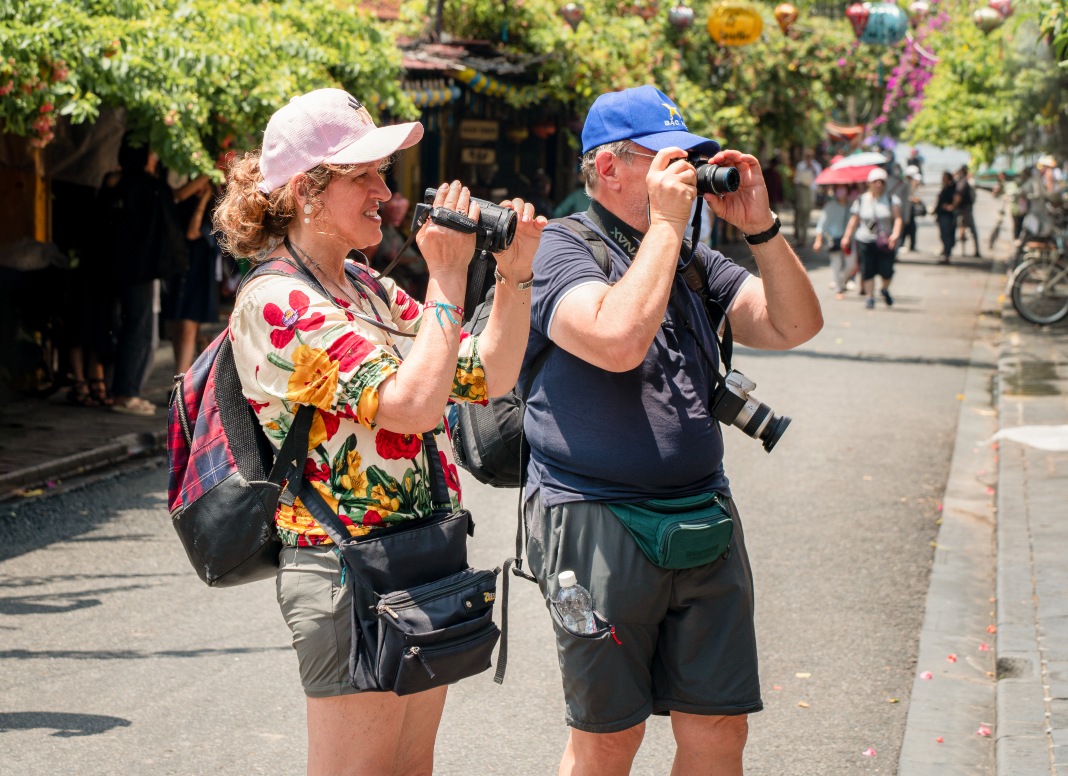
Relying heavily on the Chinese and South Korean markets is akin to putting all eggs in one basket, a strategy that could potentially jeopardize Vietnam's tourism growth.
China was once a pivotal tourism market for numerous Asian countries, contributing to over 30% of total international tourist arrivals in these nations prior to the Covid-19 pandemic. However, the prolonged absence of Chinese solo travelers and tourist groups has prompted these countries to pivot towards exploring opportunities in niche markets.
Tourism transformation in Thailand
China has expanded the list of countries that group tourists can visit, including Thailand, after lifting Covid-19 travel restrictions. While popular destinations anticipated an influx of vacationers, the question remains: When will it materialize?
Thailand initially expected a surge in Chinese tourist arrivals this year. Nevertheless, this hope dwindled as China's economic woes and low consumer spending impacted the forecast. Data from booking platform SiteMinder, shopping app Meituan, and the Tourism Authority of Thailand (TAT) revealed that Thailand received only 1.6 million Chinese tourists in the first half of 2023. With lackluster performance from January to June, the government's goal of welcoming seven million Chinese visitors and 30 million international travelers for the year seems increasingly difficult to achieve.
RHB Bank Malaysia's senior economist, Barnabas Gan, notes that Thailand's tourism growth has recently decelerated. Political instability and fierce competition from neighboring countries have hindered the industry's anticipated recovery. Interestingly, many Chinese tourists have shifted their plans, opting to visit Malaysia instead of Thailand due to the ease of obtaining visas for Malaysia within 1-3 days at a cost of only ¥200.
Sisadiwat Cheewarattanaporn, chairman of the Association of Thai Travel Agents (ATTA) and representative of the Federation of Thai Tourism Associations (FETTA), said that Thailand's tourism industry is urgently proposing waiving visa fees for Chinese tourists within three months to stimulate inbound tourism.
With strategic adjustments, Thailand anticipates an improvement in Chinese tourist arrivals next year, according to Sisadiwat. TAT aims to diversify its tourism markets to reach the target of 7-8 million Chinese visitors and 25 million tourists from other markets. For instance, TAT hopes to attract around three million visitors from Japan and South Korea, one million from Hong Kong, 600,000-700,000 from Taiwan, and 10.5 million from the ASEAN in 2023.
To compensate for the decline in Chinese visitors, TAT is focusing on ASEAN countries, including Vietnam. Among Thailand's top 10 tourism markets, Vietnam previously held the 10th to 11th position. However, since 2020, Vietnam has risen to the fourth spot with a surge in travelers to Thailand, trailing only behind Malaysia, India, and Singapore.
Thailand is actively pursuing Vietnamese group tourists, encouraging them to explore conference and MICE opportunities in Phuket and Chiang Mai, rather than concentrating solely on Bangkok and Pattaya. In the first quarter of 2023, the number of MICE tourists from Vietnam surged to 6,553 visitors, ranking fourth after Malaysia, Singapore, and China.
Exploring niche markets
In April 2023, the Chinese Government sanctioned Vietnam for outbound group tours. Consequently, over 557,000 Chinese tourists journeyed to Vietnam during the initial half of 2023, securing second place in the country's top 10 tourism markets. It followed South Korea with 1.6 million visitors but surpassed the U.S. with 375,000 visitors. Notably, this figure pales in comparison to the 2.5 million Chinese visitors during the first half of 2019 and the 5.8 million for the entire year.
Nonetheless, leaning heavily on the Chinese and South Korean markets raises concerns of an "all eggs in one basket" scenario. This approach poses a potential threat to the sustainable growth of Vietnam's tourism industry.
Kim Jae Chon, a former South Korean diplomat associated with Dong Bo Air Services, noted, "South Korean tourists tend to lose interest in new destinations quickly. After becoming acquainted with Danang and Hoi An, their curiosity turns to Nha Trang, then Dalat and Phu Quoc. Once these places lose their allure, they seek fresh locales to explore."
Concurrently, insights from the Statistical Yearbook of 2022 unveil Vietnam's intriguing niche tourism markets. The top 10 international markets with the highest spending in Vietnam include the Philippines with a per-person expenditure of US$2,257.8, followed by Belgium at US$1,995.3, and the U.S. at US$1,709.7. Also noteworthy are Australia, Denmark, Norway, the Netherlands, Canada, the UK, and Germany.
Markets with comparatively lower expenditures hold substantial potential as well. Malaysian and Indonesian visitors gravitate towards Halal food and products, while Cambodian tourists lean towards medical tourism and healthcare treatments in HCMC. "Visitors from Bangkok embrace Dalat's refreshing climate," said Jack Ronnachat, host of the News 1 program in Bangkok.