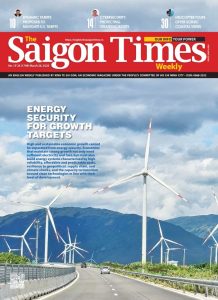
High and sustainable economic growth cannot be separated from energy security. Economies that maintain strong growth not only need sufficient electricity and fuel, but must also build energy systems characterized by high reliability, affordable and predictable costs, resilience to geopolitical, supply chain, and climate shocks, and the capacity to transition toward clean technologies in line with their level of development.
In the context of Vietnam gradually more dependent on external energy sources, the issue is no longer simply about adding supply. Rather, it is about designing an energy structure that supports rapid growth, reduces disruptions, minimizes dependency, and improves energy efficiency.
This article analyzes international empirical evidence and proposes policy implications to help implement Politburo Resolution 70-NQ/TW (on ensuring national energy security through 2030, with a vision to 2045), in support of achieving double-digit growth in the coming years.
 Empirical evidence: how does energy security relate to growth?
Research by Pinar (2026) shows that in low-income and lower-middle-income countries, economic growth depends more strongly on: (i) domestic energy availability, (ii) energy production per capita, and (iii) energy consumption per capita.
As a country progresses toward upper-middle-income and high-income status, three points should be noted:
First, regarding the share of renewable energy and economic efficiency: increasing the share of renewables may initially reduce economic efficiency due to high upfront infrastructure costs. However, at higher income levels, renewables can become a driver of growth thanks to modern infrastructure and environmental benefits. The policy implication is that green transition must be system-wide and coordinated, avoiding mechanical targets based solely on proportions.
Second, reducing energy intensity (i.e., improving efficiency) promotes growth across all income groups. However, the impact of efficiency gains may be lower in middle-income countries compared to low- or high-income ones. This suggests the need to promote technological innovation and green innovation to overcome efficiency thresholds and optimize productivity.
Third, the role of per capita energy consumption declines as income rises: future growth relies less on consuming more energy and more on using energy intelligently and efficiently.
Diversifying supply to reduce strategic dependence
Studies by LaBelle (2023) and Alam et al. (2025) show that overdependence on a single source, market, or supply route can become a strategic vulnerability. The implication is that economies aiming for high growth must avoid single-source dependence, diversify suppliers and energy types, and maintain contingency plans for non-economic shocks such as conflicts, logistics disruptions, trade sanctions, and supply chain volatility.
From energy security to energy resilience
Schmitz et al. (2025) introduces the concept of energy resilience, under which modern energy systems must be designed to withstand: (1) sudden shocks, including conflicts, import disruptions, infrastructure failures, and natural disasters; and (2) slow erosion, such as climate change, aging infrastructure, depletion of domestic resources, rising capital costs, and delays in infrastructure investment.
A key insight is that a system that appears “secure” on paper may still be vulnerable if it lacks redundancy, flexibility, robust infrastructure, or adaptive governance mechanisms.
Digitalization can improve allocation—but must be matched by supply capacity
Research by Sen et al. (2025) and Xu et al. (2026) highlights the growing importance of the digital economy, digital infrastructure, smart cities, and energy management technologies for energy security and efficient allocation.
However, these studies also caution that rapid digitalization and urbanization can significantly increase electricity demand. If supply infrastructure does not keep pace, energy security may deteriorate. Therefore, digital transformation must be accompanied by digitalized operational and metering data, investment in power grids, backup capacity, and demand-side management tools.
The private sector as a key driver of energy investment
According to Xiong et al. (2026), energy security risks can stimulate renewable energy investment, but stronger and more sustained impacts come from private sector development. The private sector plays a critical role in expanding clean energy investment and enhancing system capacity. The policy implication is clear: rapid growth cannot rely solely on public investment; it requires a transparent institutional framework, reduced policy uncertainty, and the mobilization of private capital into generation, grids, storage, and demand management.
Policy implications for Vietnam: implementing Resolution 70 for double-digit growth
Recognizing the importance of energy security, the Politburo has issued Resolution 70-NQ/TW, and the Government has followed with Resolution 328/NQ-CP for implementation. Based on the international empirical evidence discussed above, this article proposes the following policy priorities:
First, develop a set of energy security indicators directly linked to growth targets.
Energy security is a foundational condition for achieving double-digit growth. Therefore, it is necessary to integrate energy objectives into growth strategies, industrialization plans, infrastructure investment, and foreign direct investment (FDI) attraction. It is also important to assess the growth impacts of risks such as power shortages, fuel supply disruptions, and energy price volatility, and to establish measurable, regularly monitored national energy security indicators with clear warning thresholds tied to growth performance.
Second, prioritize energy efficiency as a “source of energy”.
If high energy intensity constrains growth, then improving energy efficiency is the most cost-effective and sustainable growth strategy. Policies should focus on tightening energy efficiency standards in industry and buildings, encouraging the adoption of energy-saving technologies, promoting demand-side management and time-of-use electricity pricing where appropriate, and linking investment incentives to energy performance.
Third, develop renewable energy through a scientific and system-wide approach.
The green transition is necessary, but the growth benefits of renewable energy depend on financial capacity, technological absorption, infrastructure readiness, and the level of development. Therefore, rapidly increasing the share of renewables should not automatically be equated with greater energy security in all circumstances. Priority should be given to synchronized investment in renewable generation, transmission grids, storage, smart dispatch systems, and flexible backup capacity, along with careful assessment of impacts on electricity costs and business competitiveness.
Fourth, accelerate digital transformation in the energy sector to enhance system management.
Digital transformation is a key tool for improving operational capacity and system optimization. Investments are needed in smart metering systems, enhanced load forecasting capabilities, advanced dispatch and demand response mechanisms, and integrated models combining energy, data, and digital payments.
Fifth, mobilize private sector investment in energy.
High growth cannot depend solely on public budgets. A stable legal framework for energy investment is essential, along with reduced uncertainty in power purchasing mechanisms and infrastructure investment policies. The role of the private sector should be expanded in areas such as renewable energy, energy storage, digital infrastructure in the power sector, energy efficiency solutions, and distributed energy systems for industrial zones.
Ensuring energy security does not mean closing off the economy or pursuing complete self-sufficiency. Rather, it means reducing system vulnerability while maintaining growth momentum. To achieve double-digit growth, Vietnam needs to shift its focus from simply adding supply to optimizing the entire system—prioritizing energy efficiency as a resource, developing renewables in a coordinated manner, accelerating digitalization in system operations, and enabling greater private sector participation. This approach aligns with the spirit of Resolution 70 and is critical for minimizing disruption risks, controlling costs, and enhancing economic competitiveness.
(*) University of Economics and Law, Vietnam National University – HCMC