After a sharp increase in April, the exchange rate between the U.S. dollar and the Vietnamese dong has been declining since early May across both formal and informal markets. What factors are driving these recent exchange rate trends?
The exchange rate swings back around
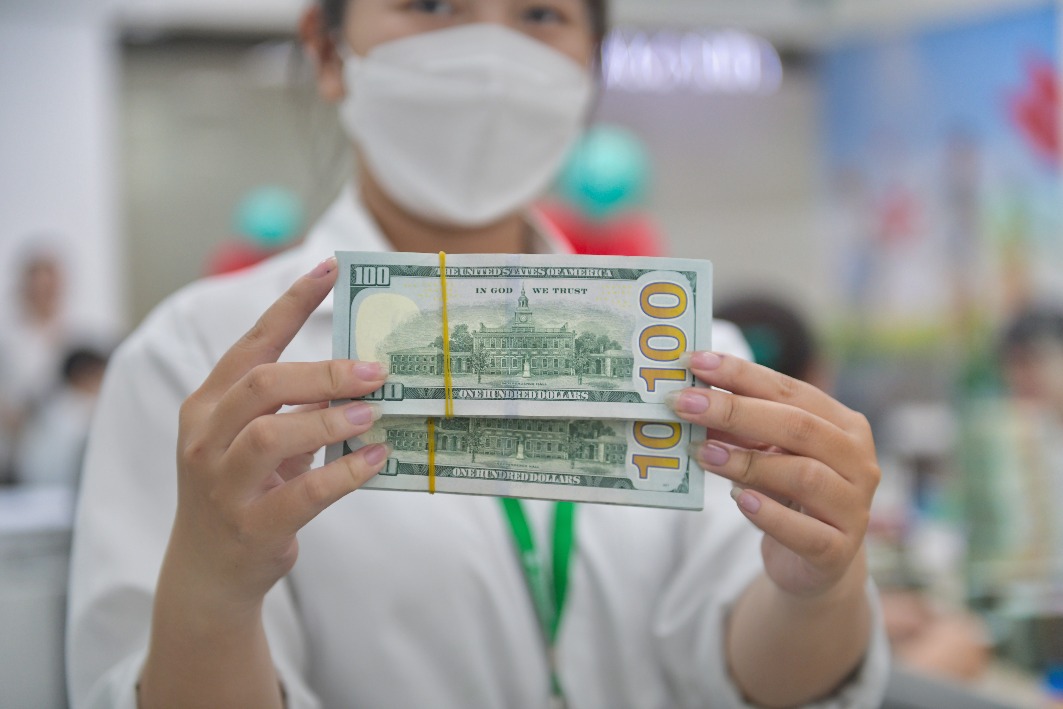
The value of the U.S. dollar in the informal market dropped by VND130 on May 15 and 16, bringing its buying and selling prices down to VND26,320 and VND26,420 per dollar, respectively. Similarly, bank transaction prices saw a slight decline of VND30-40 over the same week, settling at VND25,750 for buying and VND26,110 for selling. The central exchange rate between the dollar and the dong also experienced a modest VND13 reduction.
The decline in the U.S. dollar followed a series of unexpected tariff announcements by President Donald Trump in early April. In response, the U.S. Dollar Index plunged from above 104 points to 98 points, before recovering slightly to 100 points at present.
Conversely, the price of the U.S. dollar in Vietnam’s domestic market surged during the same period. In April, the central exchange rate increased by VND119, while transaction prices at banks jumped by VND440, and in the informal market, they skyrocketed by approximately VND600.
This sharp rise was most noticeable in early April, immediately following President Trump’s tariff announcements. The news triggered investor concerns that Vietnam’s exports to the U.S. would be heavily impacted and that investment capital flows into Vietnam might decline, exerting pressure on the country's foreign currency supply in the coming period.
The surge in the exchange rate at that time was largely driven by investor concerns rather than fundamental shifts in foreign currency supply and demand, which have remained relatively stable. Despite this, Vietnam’s trade balance recorded a US$0.58 billion surplus in April, bringing the cumulative trade surplus for the first four months of 2025 to US$3.79 billion, according to the General Statistics Office. However, this figure is notably modest compared to the US$9.06 billion surplus achieved during the same period last year.
Regarding foreign investment, Vietnam had attracted US$13.82 billion in total registered foreign investment capital in the year to April 30—including newly pledged and adjusted capital, as well as foreign capital contributions and share purchases—marking a nearly 40% year-on-year increase. Meanwhile, foreign direct investment (FDI) disbursed in Vietnam during the first four months of 2025 reached US$6.74 billion, up by 7.3% compared to the same period last year.
Tourism remains a significant source of foreign currency. In April, Vietnam welcomed 1.65 million international visitors, a 6.3% year-on-year increase. Over the first four months of 2025, total arrivals reached 7.67 million, a 23.8% rise.
Meanwhile, incoming remittances to Ho Chi Minh City in the first quarter amounted to more than US$2.41 billion, representing 25.3% of the total remittances received in 2024 and showing a 19.6% increase compared to the previous quarter.
The declining exchange rate in mid-May signals market sentiment has stabilized, suggesting that initial concerns over tariffs may have been exaggerated. Optimism among investors is further supported by expectations of an imminent trade agreement between the U.S. and Vietnam, particularly given ongoing progress in negotiations between the U.S. and China.
Expectations of a trade agreement
The United States and China held high-level negotiations in Geneva, Switzerland, on May 11, aiming to resolve trade and tariff disputes. Following the talks, both nations agreed to temporarily suspend certain reciprocal tariffs for 90 days, alongside a significant reduction in total import tariffs.
Specifically, the basic tariff rate of 10% remains unchanged, while the 20% duty imposed on China due to allegations of fentanyl trafficking will also be retained. However, newly introduced tariffs will be deferred, temporarily lowering the total import tax on Chinese goods from 145% to 30%. In response, China will remove some of its retaliatory tariffs, reducing duties on American goods from 125% to 10% for the time being.
Observers forecast that U.S. tariffs on Chinese imports will likely remain at 30% until the end of the year. Although this marks a significant reduction from the previous 145% rate before the truce, Bloomberg Economics reports that the current tariff level is still high enough to eliminate 70% of Chinese shipments to the U.S. in the medium term.
Meanwhile, the exchange rate between the U.S. dollar and the Chinese yuan is expected to hover around 7.2 yuan per dollar through the year. Speculation about a potential yuan devaluation has subsided, with
Beijing likely to prevent excessive capital inflows and outflows, ensuring greater currency stability.
A more stable yuan helps ease depreciation pressure on the Vietnamese dong, given that China is Vietnam’s largest trading partner. Historically, whenever China devalues its currency, the dong also weakens in response.
The temporary suspension of reciprocal tariffs between the U.S. and China has raised hopes that Vietnam could achieve similarly favorable outcomes in its upcoming trade negotiations. Less than a week after the U.S.-China talks, Minister of Industry and Trade Nguyen Hong Dien, leading the Vietnamese delegation, held direct ministerial-level talks with U.S. Trade Representative Jamieson Greer on May 16, focusing on a reciprocal trade agreement between the two nations.
This marked the first in-person ministerial-level meeting between Vietnam and the U.S. since their online exchange on April 12, conducted under the guidance of senior leaders from both countries. During the talks, Jamieson Greer praised Vietnam’s goodwill and proactive approach in preparing for the negotiations and expressed broad agreement with Vietnam’s proposed approach and key recommendations.
Greer expressed optimism that, with dedicated efforts from both the U.S. and Vietnam, the upcoming technical-level negotiations would yield positive outcomes, delivering practical benefits to the people and business communities of both nations while strengthening bilateral trade relations and their comprehensive strategic partnership.
Vietnam has already taken proactive steps to facilitate greater U.S. imports, as demonstrated by US$1.57 billion worth of goods shipped from the U.S. in April—a 40% surge compared to the same period in 2024. Over the first four months of 2025, total import turnover from the U.S. reached US$5.66 billion, a 25.8% year-on-year increase.
In response to concerns over trade fraud, Vietnam has tightened controls on Chinese goods rerouted through the country to evade high U.S. tariffs. Additionally, the General Department of Vietnam Customs is actively implementing measures to combat counterfeit imports and strictly enforcing regulations against origin fraud.
On May 17, Prime Minister Pham Minh Chinh signed Directive 13/CT-TTg, aimed at strengthening efforts against smuggling, trade fraud, and counterfeiting in the current economic landscape. Beyond safeguarding domestic consumers and businesses, this directive also aligns with U.S. requirements for Vietnam in the global fight against trade fraud.