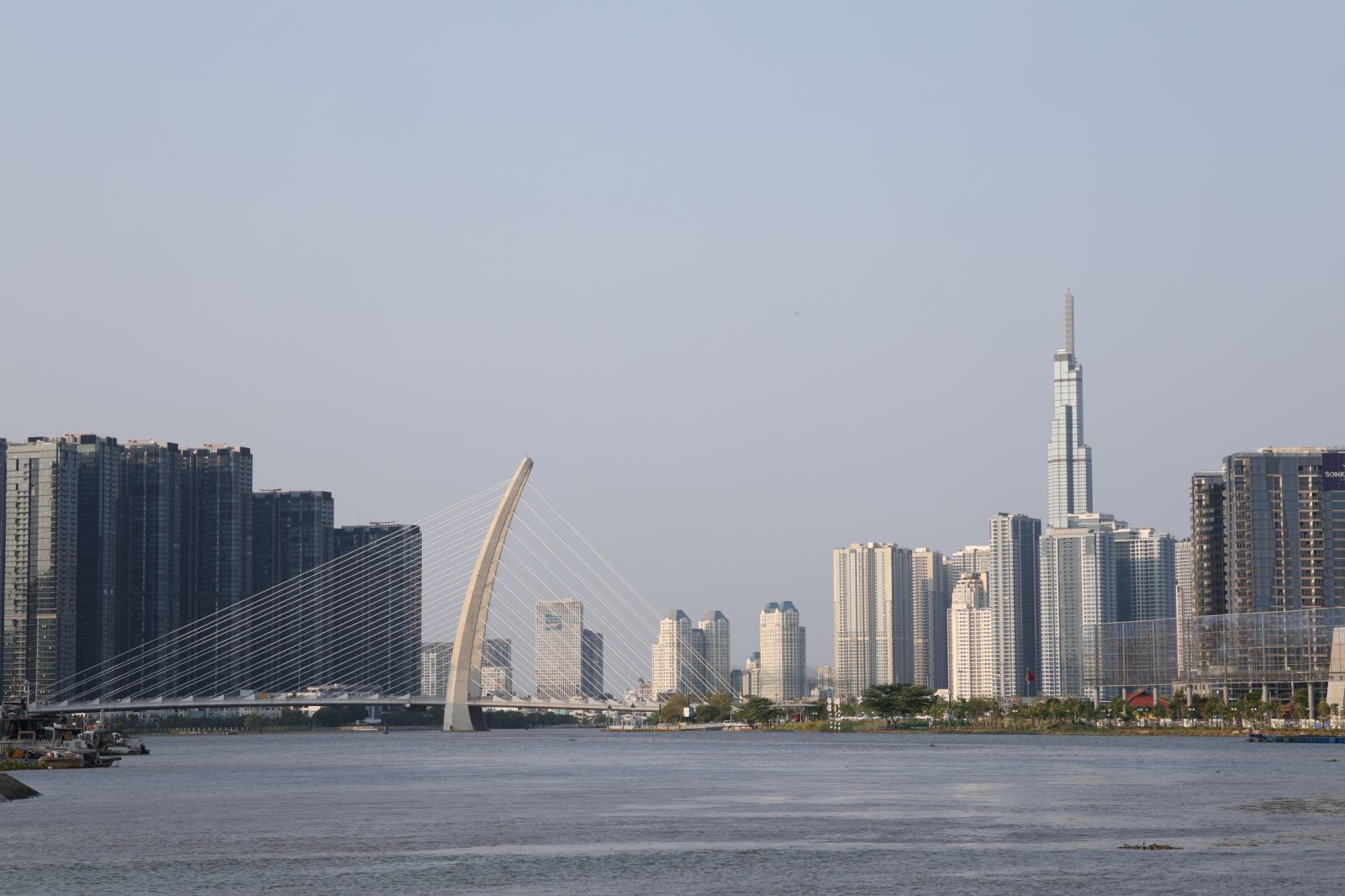
Hanoi and HCMC are seeing the growing demand for condominiums and sustainable office spaces. The industrial sector is expanding rapidly, driven by strong foreign investment activity and a focus on high-tech manufacturing.
Strong sales, rising prices, and divergent supply
The residential real estate markets in Vietnam’s two largest cities – HCMC and Hanoi – showed contrasting trends in new condominium supply in the first half of this year, according to recent reports.
Data from CBRE indicated a significant surge in Hanoi’s market, with over 10,840 units, mostly in the city’s western areas, marking the highest level since 2020. This rise sparked a buying frenzy, with second-quarter sales surpassing the figure in all of 2023. Smaller, affordable units, particularly those suited for leasing, proved highly popular.
Conversely, new condominium supply in HCMC remained limited, reaching only 40% of the levels recorded in the first half of last year. Despite the limited supply, strong demand persisted, with sales in the first half of 2023 achieving 80% of the previous year’s figure. Projects in locations close to the central business district (CBD) have been introduced to the city’s market under high-end and luxury segments.
Hanoi’s average primary selling price for condominiums reached VND60 million per square meter, excluding VAT and maintenance fees. The increasing involvement of developers from southern Vietnam, particularly in the high-end condominium market, has led to a rise in average prices in the capital city, narrowing the price gap between Hanoi and HCMC.
In HCMC, primary selling prices also increased to over VND63 million per square meter. The secondary market followed suit, with prices rising due to positive project developments and infrastructure improvements.
The landed property markets in both cities remained relatively subdued, with limited new supply. Hanoi saw a decline in new launches and sales, while HCMC’s new launches exceeded the total for 2023. Prices continued to rise in both cities.
In the second half of 2024, Hanoi expects a stronger landed property market, while HCMC anticipates further price increases due to continued limited supply. The residential market is poised for growth in 2025, fueled by positive economic news and upcoming legal reforms, with improved supply, product quality, and selling prices expected.
Green rush in office sector
In the first half of this year, Hanoi’s Grade A office rents remained stable at US$29.2 per square meter per month, while Grade B rents slightly increased to US$14.6 per square meter per month.
HCMC experienced a dip in Grade A rents to US$45.9 per square meter per month due to a new building offering lower rates, which prompted older buildings to provide more attractive incentives. Grade B rents in the city rose to US$26.3 per square meter per month.
Office occupancy rates in Hanoi showed marginal improvements, with Grade A at 19.2% and Grade B at 17.8%. Despite pressure from increased supply, Hanoi’s office market demonstrated resilience with a 50% year-on-year increase in total net absorption in the first half of the year.
In HCMC, the influx of new supply in 2023 pushed Grade A vacancy rates to a 10-year high of 21%, while Grade B vacancy remained at 10.1%. This situation has led some developers to reconsider new launches in the city’s outlying areas. The market is expected to see major Grade A supply in the CBD over the next two years.
Relocation was the primary driver of major office transactions in Hanoi, accounting for 86% of deals. In HCMC, expansion demand led with 44%, primarily due to two large transactions outside the CBD. Both cities saw the information technology, finance, banking, and insurance sectors as key drivers of office demand.
In Hanoi, the planned relocation of 36 government ministry and agency headquarters to the west of West Lake and Me Tri is expected to boost office demand and shift the workforce towards these locations. According to Savills, this move will increase convenience for employees accessing public service facilities.
However, the extensive development pipeline in Tay Ho Tay New Urban Area, particularly for Grade A offices, could intensify competition in the office market. The launch of Metro Line No. 3.1 between Nhon and Hanoi Station in the third quarter of this year is expected to further support office supply and performance along the metro line and in the western areas.
The office market in HCMC is witnessing a “green rush,” with strong demand for sustainable, high-quality office spaces driving the development of new, eco-conscious projects, according to a report by Avison Young. The recent addition of e.town 6 in Tan Binh District, expected to be the city’s second LEED Platinum-certified office building, and upcoming projects like Marina Central Tower in District 1, targeting LEED Gold by Q2 2025, exemplify this trend.
Nhung Vu, director of Office Services at Avison Young Vietnam, said that green-certified and transit-oriented developments are crucial for attracting top-tier tenants in HCMC’s competitive market. These projects are expected to enhance the city’s attractiveness as a prime business hub, catering to both local and international companies.
A spark in industrial real estate
The industrial real estate market is experiencing robust growth, fueled by a resurgence in production investments.
According to CBRE, industrial land prices saw a slight uptick in Tier 1 northern markets, reaching an average of US$134 per square meter for the remaining lease term, a 0.3% quarter-on-quarter increase and a 4.5% year-on-year rise. In southern Vietnam, Tier 1 markets held steady at US$173 per square meter.
In the ready-built warehouse (RBW) and factory (RBF) sectors, over 225,000 square meters of space were completed in northern Tier 1 markets, with factories comprising 95% of the new supply. RBF occupancy reached 89%, while RBW occupancy remained at 79%. Rental rates saw a slight divergence, with RBF rents rising 1.9% year-on-year to US$4.9 per square meter per month and RBW rents declining 1.0% to US$4.6 per square meter per month.
The southern RBW market had no new supply but saw a 9% occupancy surge due to major transactions in HCMC and neighboring Long An. The RBF market welcomed over 371,000 square meters of new space, primarily in the southern provinces of Binh Duong and Dong Nai, resulting in an occupancy dip to 81%. Both RBW and RBF rents remained stable at US$4.5 and US$4.9 per square meter per month, respectively.
Major industrial hubs like Hanoi and HCMC experienced stable rental prices and occupancy rates. In the second quarter, Hanoi’s average rent for industrial land was US$134 per square meter for the remaining lease term, with an occupancy rate of 83%. In HCMC, industrial land reached its highest average rent at US$230 per square meter per lease term, maintaining a 90% occupancy rate.
Hanoi’s neighboring provinces benefited from this stability, with rents growing 5-7% due to spillover demand and improved infrastructure. For instance, Bac Ninh Province attracted huge investments, including Foxconn’s US$383 million circuit board plant and Amkor’s US$1.07 billion expansion.
Despite currently facing land constraints, HCMC is focused on attracting high-tech investments to maximize the value of existing industrial land. Projects like Hyosung’s large-scale data center exemplify this strategy. The city is also actively working to resolve legal barriers hindering new projects.
Vietnam’s secondary industrial markets are also gaining traction due to ample land availability, lower occupancy rates, and competitive rents. This, coupled with the growing focus on sustainable industrial parks, is attracting significant foreign direct investment in high-tech sectors.