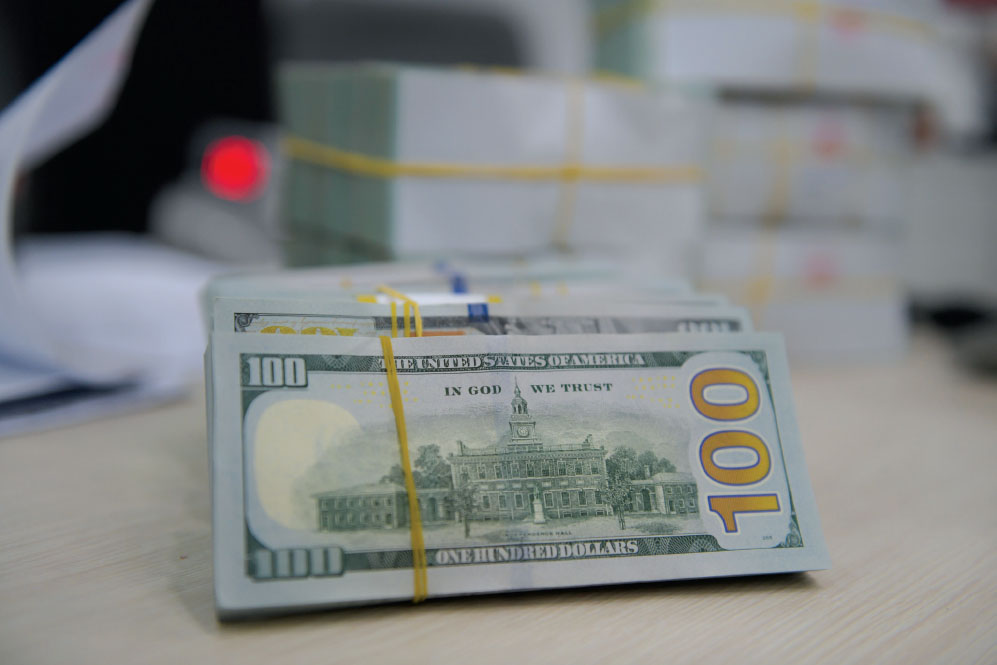
Unusual exchange rate movements in recent times reflect the shifting expectations on the monetary policy by the U.S. Federal Reserve (Fed) and declining foreign exchange reserves, following a period of significant foreign capital outflows in 2024
Exchange rate rises as Fed signals slower rate cuts
The exchange rate between the U.S. dollar and the Vietnam dong has surged, reaching a peak last seen in June 2024, immediately after the U.S. Federal Reserve announced an interest rate cut of 25 basis points in December 2024. Simultaneously, the Fed signaled a slower-than-expected pace of rate reductions. Consequently, the U.S. Dollar Index (DXY) climbed above 108 points, marking its highest level since 2023, putting significant pressure on the Vietnam dong.
In response, the State Bank of Vietnam (SBV) intervened by selling about US$1.8 billion from foreign exchange reserves over a few days. Additionally, the SBV deployed liquidity-regulating tools, such as SBV bills and open market operations (OMO), at an annual interest rate of 4% to maintain the swap rate difference between the dong and the dollar near zero.
While selling foreign currency helps stabilize the exchange rate, these developments underscore the domestic financial market’s sensitivity to the Fed’s policies, especially given its cautious stance on interest rates.
Foreign reserves at a critical level
According to balance of payments data, US$7.5 billion in foreign currency flowed out of Vietnam in the first nine months of 2024, with peak outflows of US$6.07 billion in Q2. Although the pace of outflows slowed to US$59 million in Q3, the cumulative figure remains significant, second only to the record US$21.5 billion outflows during the same period in 2022.
Specifically, the current account surplus in the first nine months of 2024 was US$17.5 billion, a 19.7% year-on-year decline. Meanwhile, the financial and capital account recorded a cumulative deficit of US$7.55 billion, reflecting significant drops in foreign indirect investment (FII) and deposit and loan flows. Additionally, the “errors and omissions” category stood at US$17.83 billion, up from US$15 billion in the same period last year, signaling heightened risks amidst a volatile macroeconomic environment.
Data from the International Monetary Fund (IMF) showed that by the end of September 2024, Vietnam’s foreign exchange reserves (excluding gold and special drawing rights - SDRs) stood at US$82.3 billion. Factoring in foreign currency sold in December, reserves dropped to US$80.5 billion—equivalent to 2.4-2.5 months of import cover, significantly lower than IMF recommendations and levels in regional countries (Indonesia about 5.7 months; Malaysia 4.6 months; Thailand 7.4 months; India 8.5 months; and China 13 months).
Thin reserves cushion makes maintaining exchange rate stability increasingly challenging, posing significant hurdles for balancing inflation, exchange rate, and interest rate objectives.
Challenges in management of foreign exchange and interest rates in 2025

With his unconventional economic policies—particularly on tariffs and trade—the incoming Donald Trump administration has strengthened the dollar internationally. Concurrently, the Fed’s cautious stance on rate cuts continues to push the dollar higher.
In Vietnam, credit growth reached 11.9% by the end of November 2024, while deposit growth was just 10.6% (including interbank market growth of some 2% from bank bond issues), creating a significant gap. Against this backdrop, the SBV has maintained a cautious approach to interbank liquidity management, with interest rates expected to remain elevated. Over time, this is likely to impact market interest rates (for businesses and consumers). A slight increase in market interest rates is anticipated in the first half of 2025, despite regulatory efforts to lower borrowing costs.
Furthermore, with thin foreign exchange reserves, the SBV faces tough trade-offs between stabilizing exchange rates and managing interest rates. As the SBV governor emphasized to the National Assembly in October 2024, maintaining exchange rate stability is crucial for investor confidence. Thus, early 2025 could see adjustments to the exchange rate band, along with possible hikes in policy rates or tighter credit growth caps.
Unpredictable exchange rates highlight the need for risk management
Exchange rates are projected to remain volatile in 2025, mirroring the complexities of 2024, due to the unconventional policies of President Trump and Vietnam’s limited foreign exchange buffer. The SBV may have to undertake significant adjustments to exchange rates and interest rates to preserve macroeconomic balance.
Such fluctuations not only pile pressure on the economy but also heavily impact businesses, especially those engaged in international trade or with foreign currency-denominated debt. Therefore, businesses must prioritize effective exchange rate risk management strategies to mitigate negative impacts.
A robust risk management strategy should account for various exchange rate scenarios and implement preventive measures to ensure stable operations. Companies should understand how exchange rate risks affect their activities and consider appropriate tools to shield their core business operations. For foreign currency loans, minimizing outstanding balances and using hedging contracts such as forwards or swaps can help mitigate adverse effects from exchange rate fluctuations.