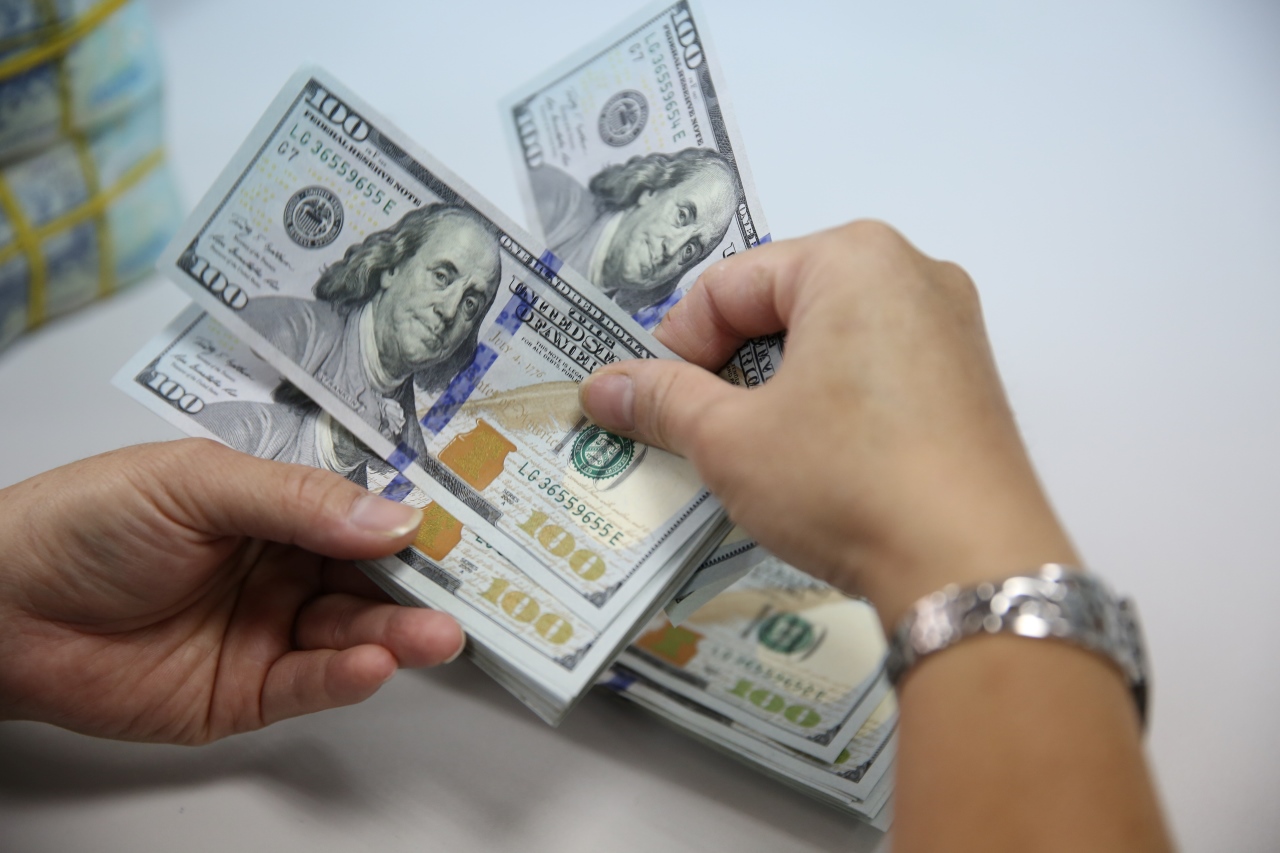
Interest rates for Vietnam dong currency have steadily inched down recently but dollar interest rates on the interbank market have remained high, fueling concern over forex speculation
A widening interest rate differential
This month, numerous banks have continued cutting deposit interest rates. Bac A Bank, for example, has trimmed deposit rates for tenors longer than six months by 0.15 to 0.2 percentage point. Deposits of one to five months and those longer than 13 months at VPBank have got their interest rates cut by 0.2 point while the rates for tenors of six to 13 months are down by 0.4 to 0.5 point. LPBank has taken off 0.2 point from deposit rates for tenors of one to five months, and 0.1 to 0.4 point for tenors longer than 13 months. OCB has lowered rates by 0.3 point for all tenors longer than six months.
On the interbank market, interest rates have taken a deeper dive. On July 6, the overnight rate plunged to 0.61% per annum while the rate for one-week loans also tumbled to 0.85% and 1.31% for two-week loans. Longer-term loans carry higher rates, at 3.04%, 4.51% and 5.82% for one-, three- and six-month loans, respectively. Compared to early June, when these rates hovered between 4% and 7%, the current interest rates have fallen steeply since the State Bank of Vietnam (SBV) cut policy rates on June 19, the fourth rate reduction this year.
The central bank’s interest rate cuts are commendable as they have paved the way for commercial banks to reduce deposit and lending rates. However, Vietnam dong interest rates have spiraled down while dollar interest rates on the interbank market have stayed high, prompting concerns that forex rate speculation may return.
The central bank in its latest update on the forex and interbank markets during the week from June 19 to June 23 said that while the overnight rate for Vietnam dong loans plunged to 0.75% a year, that for the dollar stayed at 4.84%, hence an interest rate differential (IRD) of 3.09 percentage points in favor of the dollar. For longer tenors, the IRD between Vietnam dong and the greenback is even wider, at 3.85 points for one-week loans and 3.38 points for the two-week term. The IRD was a bit softer for one-month and three-month loans. For tenors of six and nine months, Vietnam dong interest rates remain high because deposits of such terms are not subject to the ceiling rate. As such, the IRDs are 1.12 and 2.33 points in favor of the local currency for deposits of such terms, respectively.
Prior to the middle of May, the Vietnam dong interbank interest rate had always been higher than the dollar interest rate, but their positions have converted in recent weeks. The IRD between the two currencies has been widening, which may incentivize banks to seek short-term loans in Vietnam dong and convert them to the U.S. dollar for lending. In so doing, they can make gains from money dealing on one hand, and benefit from a strengthening of the greenback on the other, as the U.S. Federal Reserve is expected to continue raising its federal funds rates to underpin the dollar on global markets.
In the minutes of the Federal Open Market Committee June meeting just released by the Fed, it was reported that though Fed governors objected to a rate hike in June due to concerns over economic growth, most still thought that the interest rate should be further hiked this year. Up to 16 out of 18 members of the Board of Governors anticipated at least one more rate hike this year, while 12 members projected two or more rate hikes in the rest of the year. Fed Chair Jerome Powell has also hinted at possible rate hikes in July and September.
A different background?

Recent warnings by some international institutions of the risk of capital flight give weight to concerns. Specifically, after the SBV cut its policy rates for the fourth time this year, the World Bank has advised Vietnam’s monetary regulator to attend to the stark contrast in monetary management between Vietnam and other countries, saying such a move can pile pressure on capital flows and the foreign exchange rate. Meanwhile, Paulo Medas, division chief at the Fiscal Affairs Department of International Monetary Fund, has observed that interest rates have tumbled to new lows, exerting strong pressure on the forex market and the forex rate.
However, the background this year has changed for the better, so the forex market is expected not to be so volatile as it was in last year’s second half.
First, by the end of the third quarter last year, the market was stressful due to various consequential occurrences, from irregularities in the corporate bond market and abnormal operations at a bank to worries over high inflation that prompted forex speculation. The situation now has changed. There is now no haunting over uncertainties in the banking industry, while the inflation rate has ebbed beyond expectations, with the consumer price index in the first half this year rising only 3.29% against the year-ago period, way below many other countries. The local currency’s value therefore has been maintained.
In addition, the ample forex supply is one of the important factors behind the stable forex market, as it hinders the appetite for forex speculation and enables the SBV to control and intervene in the forex market when necessary owing to the ever-increasing foreign reserves.
Data from the General Statistics Office showed that having declined for five months on end, the cumulative disbursement of foreign direct investment in the year to June had made a mild turnaround, rising 0.5% against the year-ago period. In addition, portfolio investments by foreign investors surged 76.8% year-on-year to over US$4 billion. The amount of fresh FDI pledged in the first half of this year also rose 31% from the year-ago period to US$6.49 billion, although the additional FDI injected into operational projects decreased slightly due to monetary tightening in many countries.
Regarding foreign trade, although trade fell 15.2% year-on-year to US$316.65 billion, exports shrank at a narrower margin of 12.1% in the first half given the import contraction of 18.2%. Consequently, the country enjoyed a trade surplus of US$12.25 billion, thus driving up foreign currency supply in the country. Against the context of shrinking global trade induced by uncertainties, Vietnam sees an export push as a key task in the rest of the year.
It is noteworthy that among major trade partners of the U.S., Vietnam is not listed as a money manipulator. The SBV stated that in bilateral talks, the U.S. Department of the Treasury has appreciated Vietnam’s monetary and forex management, which has brought about financial, monetary and macroeconomic stability despite numerous challenges.
Such achievements explain why the forex market has been stable since early this year, and would likely continue this trend in the coming time. As of July 10, 2023, the reference rate of the U.S. dollar announced by the SBV has increased by only 0.84% against the beginning of the year. Spot rates at banks have barely increased, inching up by only 0.3%-0.4%, while on the free market, the greenback has even weakened against Vietnam’s dong.