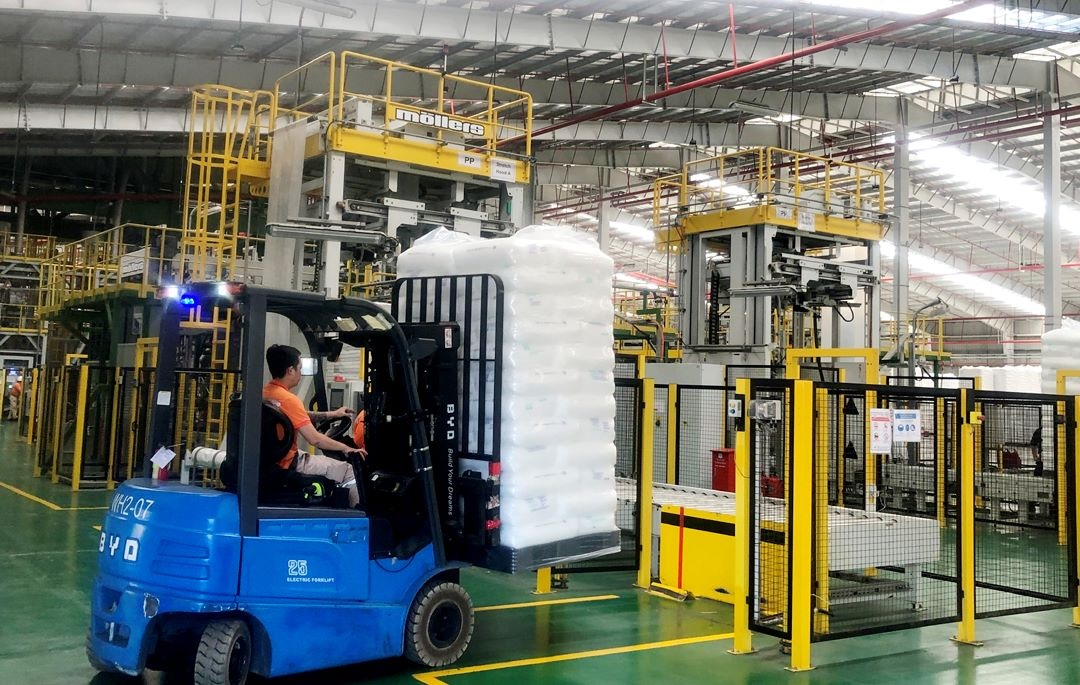
The ongoing conflict in the Middle East has driven up oil prices, freight rates and costs of multiple key inputs, putting new pressure on manufacturers in Vietnam as they are scrambling to keep orders and production stable.
Cost pressures spread across manufacturing
Military tensions involving the United States, Israel, Iran and the wider Middle East are driving up costs across global commodity and logistics markets. In Vietnam, many manufacturers say they have recently received repeated price hike notices from suppliers, prompting them to review inventories and prepare contingency plans.
Le Mai Huu Lam, general manager of Cat Van Loi Company, a producer of industrial support products in the mechanical engineering sector, said the firm relies mainly on steel and PVC as input materials. Their prices have risen sharply since the U.S.-Israel war on Iran began.
PVC prices have climbed about 30%, while steel prices have inched up roughly 5%, significantly increasing production costs. “However, with market demand remaining weak, we cannot raise selling prices in line with higher input costs. That means our profit margins are being squeezed,” Lam said.
He added that manufacturers are facing a difficult balancing act between rising global input costs and what customers are willing to pay.
Similar pressures are emerging in other industries. Nguyen Dang Hien, vice chairman of the HCMC Food and Foodstuff Association, said plastic resin used for packaging production has surged in recent days.
“Resin prices are rising almost daily and could soon reach VND28,000–30,000 per kilogram, more than 10% higher than before,” Hien said.
In the veterinary pharmaceutical and feed additive sector, Lam Thuy Ai, vice chairwoman of the Saigon Entrepreneurs Association and general manager of Mebifarm JSC, said many imported inputs have also begun rising sharply.
The price of the antibiotic amoxicillin has increased to around US$25 per kilogram from roughly US$20 previously. Prices of various vitamins and additives have also fluctuated quickly since early March.
“Feed manufacturers have been issuing frequent price increase notices. This shows cost pressure is spreading across the production chain,” Ai said.
In agriculture, Vu Duy Hai, chairman and general manager of Vinacam Group, said several large plants in the Middle East have shut down and fertilizer exports from Iran have stalled. As a result, urea prices jumped more than US$100 per ton in just one week, threatening to raise farming costs.
In the packaging sector, Hoang Trung Son, general manager of Dong Tien Packaging and Paper Company and chairman of the Vietnam Paper Packaging Association, said the impact of Middle East tensions is clearly visible in logistics costs and raw material supply.
According to member companies, international freight rates are fluctuating by the day. Many shipping lines have introduced war-risk surcharges of US$1,500–US$2,000 per 20-foot container, while air freight rates have jumped about 60–70% since the conflict began.
Some shipping routes have also been disrupted. Container vessels are being rerouted around the Cape of Good Hope instead of passing through the Red Sea, adding three to four weeks to transit times and significantly increasing costs.
Cargo insurance premiums have also risen sharply because of war risks. Data from international marine insurance markets show war-risk premiums in the Gulf region have increased severalfold.
Dao Trong Khoa, chairman of the Vietnam Logistics Business Association, said the global logistics market is shifting from a phase of “disruption” to one of “emergency control.”
“Many shipping lines have adjusted routes or suspended certain services. These factors will continue to push logistics costs higher in the near term,” Khoa said.
According to the HCMC Export Processing and Industrial Zones Authority, several manufacturing sectors in Vietnam are being affected, including electronics, textiles, chemicals and seafood.
Electronics producers face the risk of shortages of chips and semiconductors imported from Europe and may have to switch to air freight at much higher cost, pushing up product prices. Textile and footwear manufacturers also face the risk of summer orders from the EU being cancelled if delivery schedules cannot be met.
Chemical producers report rising prices for inputs such as plastic resin, solvents and additives, following global oil price movements.
Food and seafood exporters, especially those shipping fresh and frozen products, face additional risks as airspace restrictions force cargo flights to be cancelled or rerouted, raising transport costs and increasing the risk of spoilage.
The authority also noted that refrigerated containers are becoming scarce and expensive, causing shipments of shrimp and Tra fish (pangasius) bound for the EU and Middle Eastern markets such as Jordan and UAE to pile up at transshipment ports.
Firms scramble to adapt to supply chain disruptions
Lam Thuy Ai of the Saigon Entrepreneurs Association said that if global oil prices rise to US$100–US$120 per barrel, energy costs in manufacturing could increase by 20–40%, pushing up both transport and raw material costs. If oil climbs above US$130 per barrel, many industries would face severe cost pressure.
In response, many companies say they have begun introducing risk management measures to reduce the impact of market volatility.
Procurement teams are reviewing all raw materials and categorizing them by their importance to production and price volatility.
Strategic inputs that directly affect production lines are being prioritized to secure supply, while companies build safety stock levels based on import lead times.
“We are also looking for additional suppliers to avoid relying on a single source,” Ai said. Firms are also negotiating with long-term partners to stabilize prices and supply during the current volatility.
In some sectors, companies are adjusting production plans to prioritize products with stronger margins or those less dependent on imported materials.
“Given these developments, we will focus on risk management, maintain domestic markets and existing customers to stabilize orders,” said Le Mai Huu Lam of Cat Van Loi Company.
His company is also cutting costs, postponing non-essential investments and expanding digitalization to improve productivity. At the same time, it is stepping up marketing efforts to find markets less affected by the conflict in order to diversify demand.
In logistics, diversifying shipping routes and carriers is also being seen as a key strategy. Dao Trong Khoa of the Vietnam Logistics Business Association said companies should work with multiple transport partners and prepare alternative shipping options when major maritime routes are disrupted.
Besides, firms are also expanding the use of digital technologies in supply chain management to optimize operating costs.
Early warning mechanisms and cost stabilization needed
Beyond company-level efforts, industry associations say Government support is needed to ease cost pressures and stabilize supply chains.
Hoang Trung Son of Dong Tien Packaging and Paper Company said authorities should closely monitor developments in the energy and international transport markets to ensure an adequate fuel supply for domestic production.
The Vietnam Paper Packaging Association has also called for measures to help businesses stabilize freight and cargo insurance costs.
Meanwhile, the Vietnam Logistics Business Association has proposed establishing an early-warning system for global logistics disruptions, with a central hub providing regular updates on shipping routes, surcharges, and fuel prices.
Such a system would allow businesses to adjust production and shipping plans proactively rather than react after costs surge.
The Agency of Foreign Trade under the Ministry of Industry and Trade has also asked industry associations to assess the impact of the Middle East conflict on trade and raw material supply, while advising businesses to increase inventories and diversify sourcing.
According to Assoc. Prof. Dr. Nguyen Huu Huan at University of Economics Ho Chi Minh City, the key objective for companies in the current environment is maintaining reliable delivery capacity while keeping costs under control.
He said authorities should manage energy prices and exchange rates flexibly to limit the pass-through of costs into the broader economy, while supporting businesses in diversifying markets and shipping routes.
However, many economists said the impact of the Middle East conflict could be temporary if tensions ease soon.
In that case, oil prices and freight rates may spike for several weeks before easing once geopolitical tensions subside.
Still, the latest developments highlight how dependent many manufacturing sectors remain on global supply chains. In the longer term, developing domestic raw material sources, diversifying markets and strengthening production self-reliance remain strategic challenges for Vietnam’s economy.