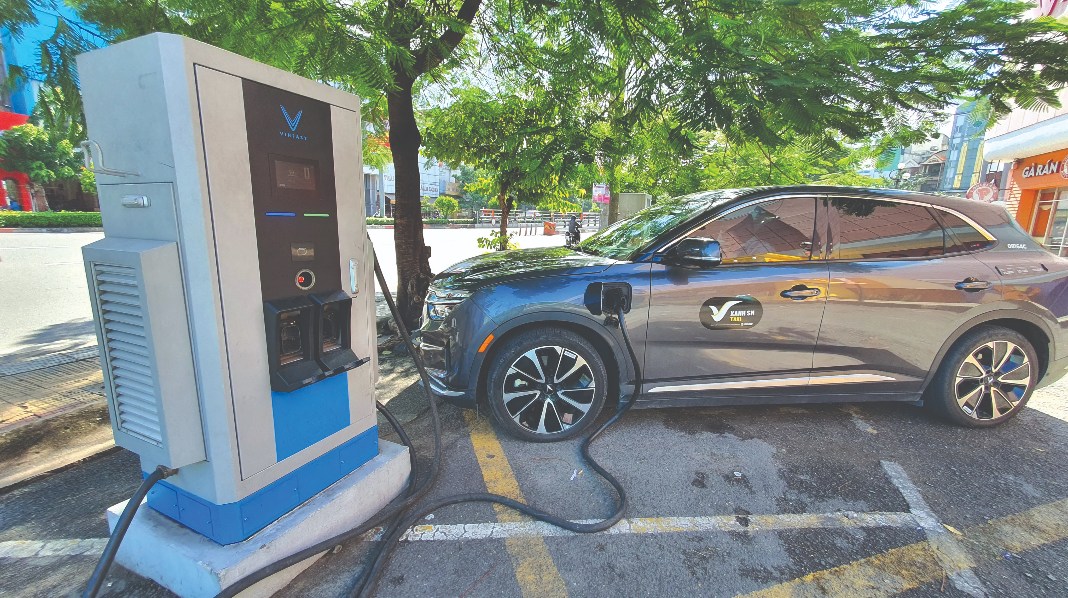
Switching from gasoline-fueled motorbikes and cars to electric vehicles is an inevitable trend. However, the development of charging infrastructure must be integrated into the transition plan from the outset, as it plays a critical role in the successful implementation of the plan.
Data presented at a workshop on green mobility in HCMC late last week indicated that VND970 billion is needed to support residents in Can Gio District in fully transitioning to electric vehicles, especially bikes. According to a roadmap proposed by the HCMC Institute for Development Studies, this transition will occur in three stages from 2024 to 2030, including financial support for vehicle purchases and incentives for lending interest rates and registration fees.
The plan estimates that transitioning from fossil fuel vehicles to clean energy-powered vehicles in Can Gio District will require more than VND970 billion. Approximately VND384 billion is expected to come from the State budget, and around VND590 billion from businesses and the public.
Transitioning to green transport will help reduce emissions and contribute to Vietnam’s goal of achieving net-zero emissions by 2050. However, this transition also requires consideration of power supply for charging stations, the development of a comprehensive charging station network, and the establishment of a fire safety system for electric vehicles.
A robust charging station network is essential for encouraging people to adopt electric vehicles. Currently, the lack of fast charging stations remains a significant barrier for both electric motorbikes and cars. Charging options range from slow to fast (levels 1, 2, and 3). While electric cars can be charged at home using a level-1 charger, the process is very slow. To improve the convenience of electric vehicles, a network of level-3 fast charging stations, with capacity ranging from 30-60kW, is necessary. However, this represents a substantial investment.
To achieve true green transport, the power supply for charging stations must also meet green standards. If electricity comes from coal or oil-fueled thermal power plants, the overall environmental impact will only partially meet green criteria. Given that electric vehicles require a substantial amount of electricity for charging, it is crucial to consider additional power supply needs and invest in the power transmission system in Can Gio to prevent system overload. Moreover, increased investment in renewable energy sources such as wind and solar power is essential to provide sustainable electricity for charging stations.
Another critical factor is ensuring fire and explosion safety for electric vehicle battery packs, which are primarily lithium-based. Unlike conventional fires, lithium battery fires cannot be extinguished using powder or CO2 fire extinguishers, and water is also ineffective. The high temperatures of burning lithium batteries, reaching 600-700°C, can cause water to convert to hydrogen, potentially leading to explosions. Since lithium battery fires are chemical reactions that do not require oxygen, they are difficult to extinguish and need a costly specialized solution.
There is no absolute safety, as even electric vehicles from globally renowned brands like Mercedes and Tesla have experienced fires. This highlights the need for substantial investment in fire safety systems if green mobility is to be developed. Electric vehicle fires can cause significant damage due to their difficulty in being extinguished. For instance, a Mercedes electric car battery explosion in South Korea on August 1 led to a fire spreading to 70 other vehicles in a basement car park. On August 16, a Tesla caught fire in an airport car park in Portugal, resulting in 200 nearby cars being burned.

According to South Korea’s National Fire Fighting Agency, there were 114 electric vehicle battery fires, resulting in two deaths and 28 injuries—significantly higher than the 46 cases reported in 2019. Over 57% of these fires occurred during charging, likely due to excessive heat or high voltage.
Despite South Korea's relatively advanced electric vehicle infrastructure and modern firefighting equipment, the incidence of electric car fires is considerable. These statistics suggest that proactively investing in fire safety systems for electric vehicles is essential for large-scale green transport plans in Vietnam. This is not just a prudent measure but a necessary one to ensure the safety and sustainability of green mobility initiatives.