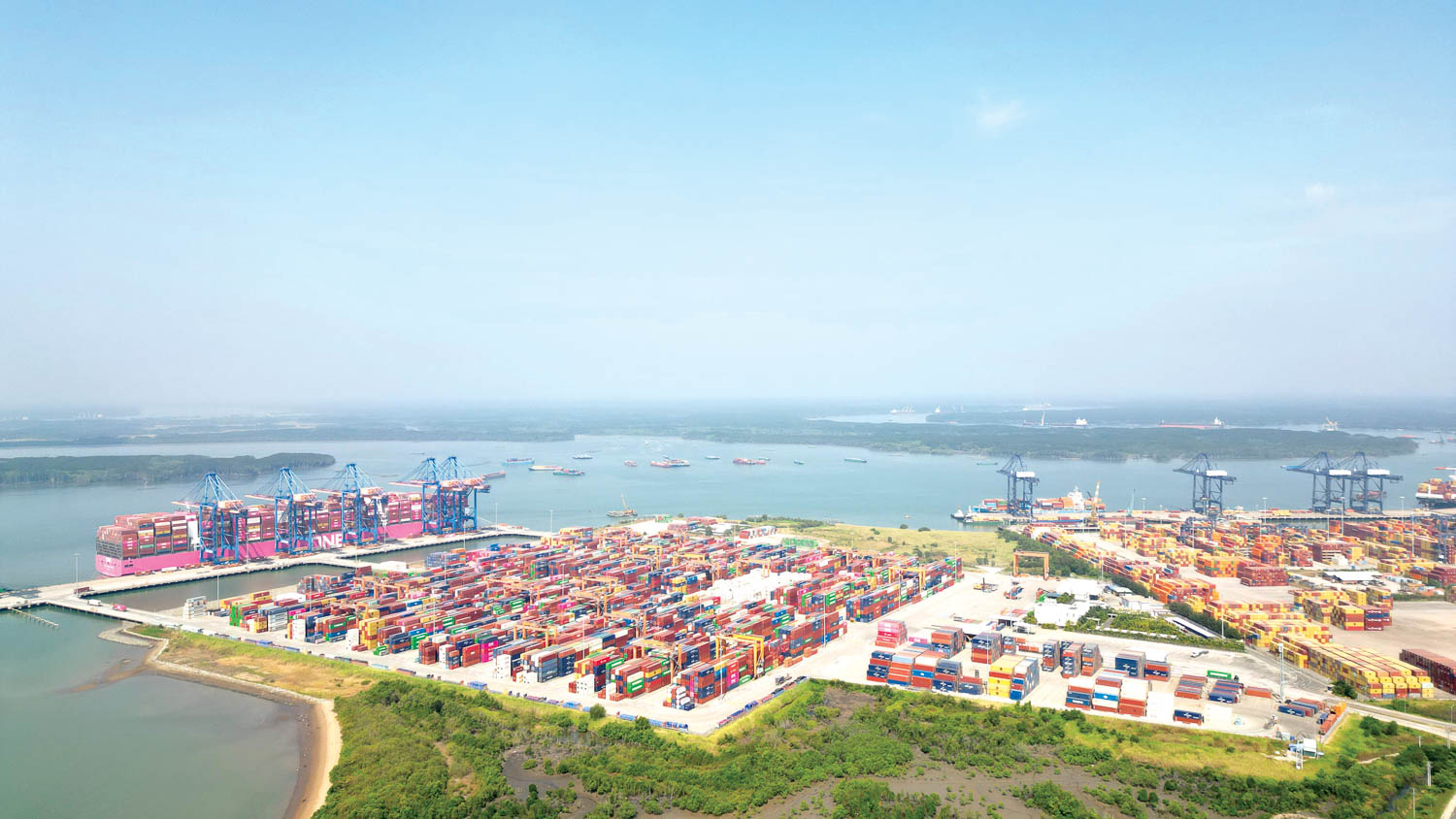
Amid rising competition among port hubs in Southeast Asia and Asia as a whole, the key question is no longer simply one of “capacity expansion,” but a strategic one: can HCMC transform itself from “a major transshipment point” into an international maritime center (IMC)? This is not merely an infrastructure challenge, but one of institutions, governance models, service integration capacity, and the city’s long-term development vision.
Logistics and seaports play a pivotal role in the economic development structure of HCMC and the entire Southern Key Economic Region. As the country’s largest economic hub, HCMC is not only a center of production and trade, but also a gateway linking Vietnam to regional and global supply chains. The port system—including Cat Lai–Phu Huu, Hiep Phuoc, Nha Be, and the deep-water Cai Mep–Thi Vai port cluster—has created a large-scale logistics space for the region. It currently handles around 15–16 million TEUs annually and is forecast to reach 26–32 million TEUs by 2030, once new infrastructure components such as Cai Mep Ha and the Logistics Center come into operation.
Location advantages, scale, and the “strategic window” for HCMC to envision an IMC
First, it is important to recognize that if an IMC is understood merely as a “slogan” or a cluster of services around ports, HCMC would find it difficult to catch up with the accumulated advantages of mature hubs such as Singapore. By contrast, if an IMC is designed as a functional layer within an ecosystem comprising a Free Trade Zone (FTZ), a Seaport City, and Vietnam’s International Financial Center (IFC), then an IMC can truly create high value added and retain global corporations. In short: the FTZ generates cargo flows, the Seaport City provides urban space, services, and human resources, and the IFC supplies capital, insurance, arbitration, and payments. The IMC acts as the coordinating mechanism that enables these flows to operate in sync.
Within this architecture, the IMC goes beyond cargo handling or transport to become an institutional infrastructure for advanced logistics and high-end services: bonded warehousing, consolidation and deconsolidation, digital supply chain management, brokerage, shipping agency services, marine insurance, trade finance, ship finance, risk derivatives, and legal and arbitration services. Objectively speaking, around 80% of global merchandise trade is carried by sea, and Vietnam’s total import–export turnover in 2025 reached US$930 billion. Even assuming that only 10% of transactions are intermediated through the IFC and IMC, this would already amount to nearly US$100 billion flowing through the IFC and IMC each year.
HCMC therefore possesses sufficiently strong fundamentals to seriously consider an IMC—not as a slogan, but as a strategic orientation to restructure the city’s and the region’s competitive capabilities within global supply chains.
First, HCMC’s locational advantage is not merely that it is “close to the sea,” but that it sits precisely at the intersection of three critical logistics spaces: the East–West Economic Corridor of the Mekong subregion; the Saigon–Dong Nai inland waterway network linking the country’s largest industrial and consumer region; and the gateway to the East Sea, directly connecting to international shipping lanes.
In other words, HCMC is not simply a “port node,” but a natural convergence point for cargo flows: exports from industrial zones, imports serving a regional market of over 40 million people, and potential transit and transshipment cargo from the subregion (Cambodia and parts of Laos and northeastern Thailand). This advantage provides the basis for forming a modern “seaport triangle”: (1) urban port clusters and distribution gateways (Cat Lai/Phu Huu/Hiep Phuoc) linked with ICDs and warehousing; (2) the deep-water port cluster (Cai Mep–Thi Vai) handling mother vessels, long-haul routes, and high-efficiency port services; and (3) future transshipment and sea-connecting infrastructure to expand international transshipment capacity. Within this structure, HCMC must play the role of a “coordinating brain”—organizing cargo flows, enabling multimodal connectivity, sharing data, standardizing services, and designing a unified operating rhythm for the entire ecosystem, rather than allowing ports to operate in silos.
Second, the existing scale and growth potential of HCMC and its surrounding region are creating a “critical mass” that enables a shift from the traditional port–logistics model to an IMC model. Once container and cargo volumes reach a sufficiently large level, competitive advantage no longer lies primarily in handling capacity, but in value-added services such as consolidation and deconsolidation, contract logistics, bonded warehousing and distribution, supply chain management, marine technical services, maritime insurance and finance, brokerage and legal services, and digital ecosystems. This is precisely what distinguishes a “large port” from a “maritime center.”
A true IMC functions like an “operating system” for cargo and service flows—it does not merely handle containers, but handles values. In hubs such as Singapore or Rotterdam, port success stems from the development of industry clusters around ports: global logistics firms, banks and insurers, port technology providers, human resource training, research and development (R&D), and enabling legal, tax, and administrative frameworks. As a result, every TEU passing through generates not only handling fees, but also a chain of service revenues and greater depth in national capabilities.
Third, HCMC is facing a rare “strategic window,” created by the convergence of external dynamics and internal needs. Externally, global supply chains are being restructured toward a multi-centered model, with greater risk diversification and rising demand for logistics gateways that offer high reliability, strong connectivity, and transparent digital services. Southeast Asia has thus become a new competitive arena among transshipment ports, where only those able to provide predictability and speed can retain cargo flows. Internally, HCMC faces dual pressure: on the one hand, urban infrastructure overload; on the other, the imperative to maintain its role as the “growth engine” of an open economy. If properly understood, an IMC would enable HCMC to “upgrade the quality” of its growth model—from expanding physical space to expanding the region’s coordination capacity, services, and technology.
However, it must be acknowledged frankly that existing advantages have yet to be fully exploited. The port system remains fragmented by administrative boundaries and governance mechanisms; supply-chain data lack interoperability; multimodal connectivity (inland waterways–roads–rail-based logistics) has yet to form a high-productivity network; and, most critically, the ecosystem of high–value-added logistics services remains thin, insufficient to “anchor” international enterprises within the ecosystem for the long term.
Therefore, moving toward an IMC should not be understood as “building an IMC headquarters,” “adding more ports,” or simply “creating a new label.” Instead, it must be designed as a comprehensive program to upgrade urban–regional competitiveness, encompassing the establishment of coordination mechanisms, the upgrading of service standards, the development of maritime industry clusters, the digitalization of operations, and a transition toward green logistics. Only then can HCMC shift from being merely a “cargo transshipment point” to a “value-creation node” within regional and international maritime networks.
Institutional bottlenecks: a legal foundation without an “IMC framework”
From an institutional perspective, Vietnam does not start from scratch in maritime and port governance. The existing legal system—including the Maritime Code, the Law on Investment, the Law on Planning, and relevant guiding decrees—provides a relatively comprehensive framework for port management, maritime safety, and infrastructure investment regulation. However, these frameworks are largely designed according to the traditional logic of state management of physical infrastructure, rather than with the mindset of developing an IMC as a complex economic–service ecosystem.
In other words, Vietnam currently has “laws for ports,” but not yet a “policy framework for the maritime ecosystem.”
First, the current legal structure still focuses primarily on tangible elements such as berth construction, channel management, maritime safety, and investment licensing and operations. While these are necessary foundations, they are insufficient to form a modern maritime center. A true IMC does not merely handle cargo flows; it must also function as a specialized maritime services economy, hosting high–value-added activities such as green fuel and energy supply, maritime insurance and finance, ship registration and legal services, shipping brokerage, ship repair and shipbuilding, maritime workforce training, and digital platforms for global supply-chain governance.
At present, these activities are fragmented across Vietnam’s legal system. Some fall under sector-specific laws, others under the jurisdiction of different ministries, while some are not clearly defined at all. This fragmentation creates significant institutional barriers to forming a “high-end maritime services cluster,” which is the very essence of global IMCs, despite the considerable market potential.
Second, the prevailing governance mechanism remains highly centralized, particularly for large-scale port projects. While multi-level approval processes help ensure oversight, they significantly reduce flexibility and decision-making speed—two factors that are critical in international maritime competition. In a context where centers such as Singapore, Rotterdam, or Dubai can adjust policies, port charges, and investment incentives within a very short time, delays in approval mechanisms risk causing HCMC to miss opportunities to attract shipping lines, investors, or strategic services.
Notably, the current governance model has yet to create a sufficiently strong “central coordinating body” to oversee the maritime ecosystem as a whole. Responsibilities are dispersed across multiple central and local agencies, constraining long-term strategic planning, integrated spatial development, and the coordination of stakeholder interests. By contrast, international experience shows that successful maritime centers all have a powerful coordinating institution—such as the Maritime and Port Authority of Singapore (MPA) or the Port of Rotterdam Authority—that acts both as regulator and as an “ecosystem architect.”
Third, the existing institutional framework does not adequately incentivize innovation or investment in high–value maritime services. Current incentives focus mainly on physical infrastructure investment, while areas such as maritime finance, logistics technology, supply-chain data centers, and advanced human resource training lack commensurate priority mechanisms. This limits Vietnam’s ability to compete with established centers that have already built comprehensive service ecosystems, where value added lies not in cargo handling, but in knowledge, technology, and global networks.
More importantly, the absence of an “IMC framework” means that existing policies tend to be fragmented, short-term, and weak in regional integration. HCMC may improve its port infrastructure, but if this is not aligned with the logistics development strategies of Dong Nai or the Mekong Delta, the overall advantage would be diluted. An international maritime center, by its very nature, is an inter-regional structure that requires institutions flexible enough to transcend traditional administrative boundaries.
From this perspective, it can be said that Vietnam already has a “legal foundation,” but still lacks a “guiding institutional framework” for IMC development. This gap is not merely a technical legal issue; it is fundamentally a matter of development mindset. It requires a shift from infrastructure management to ecosystem governance, from a control-oriented approach to an enabling one, and from a sector-based perspective to an inter-regional and cross-sectoral approach.
For HCMC to become a true IMC, the core task is not simply to build more berths or expand shipping channels, but to construct a new institutional architecture for the maritime economy. That architecture must be flexible enough to adapt to global volatility, open enough to attract international resources, and strong enough to coordinate interests among the state, businesses, and society. Only then can the city’s existing geographical and infrastructural advantages be fully “activated” to become sustainable competitive strength on the regional and global maritime map.
Policy proposals for HCMC on the IMC development roadmap
First of all, HCMC needs to reach a common understanding that an IMC is an integrated program comprising four layers, designed according to flow logic. FTZs, seaports, and inland container depots (ICDs) form the cargo flow; an international financial center represents the capital flow; the IMC itself embodies the services flow; and the seaport city concept reflects the urban and human capital flow.
To prevent these components from developing in isolation, the city should consider establishing a specialized authority responsible for ports and maritime services, similar to the Port Authority models in Singapore or Rotterdam. This body should operate at the city or inter-regional level and be vested with substantive authority over planning, project approval, investment coordination, and port operations oversight. The state should retain a leading role, particularly in long-term strategic orientation and the management of strategic space, while the private sector participates in operations and exploitation under market mechanisms. Such a model would ensure unified governance while preserving flexibility and economic efficiency.
At the same time, HCMC should institutionalize a regular public–private consultation and coordination mechanism through a maritime development advisory council comprising representatives from logistics firms, financial institutions, port operators, and independent experts. Experience from Singapore and Hong Kong shows that such councils play a crucial role in reflecting market demand, enabling timely policy adjustments, and maintaining consensus between the public and private sectors. For HCMC, a permanent dialogue mechanism among the municipal government, the Ministry of Construction, and investors would help resolve bottlenecks during implementation, especially for large inter-regional projects such as the Can Gio international transshipment port or supporting logistics systems.
In terms of infrastructure, expanding the inter-regional logistics network should be treated as a strategic priority. The city should develop a system of ICDs and large-scale distribution centers along ring roads and expressway corridors, directly connected to seaports. This model has proven effective in the Los Angeles–Long Beach area, where a network of ICDs and inland railways handles more than 20 million TEUs annually. The formation of logistics clusters in Dong Nai or along Ring Road 3 would not only ease inner-city traffic pressure but also facilitate efficient supply chains, reduce costs, and enhance competitiveness across the Southern Key Economic Region.
Alongside physical infrastructure development is the imperative of digital transformation and high-technology application. HCMC should move toward a “smart port” model, applying automation, artificial intelligence, and big data in vessel coordination, container yard management, and cargo flow forecasting. Establishing a smart logistics operations center that monitors the entire chain from port arrival to inland distribution would enhance transparency, reduce risks, and improve efficiency. Technologies such as blockchain for container traceability and real-time safety monitoring systems are likely to become core competitive advantages of the future IMC.
In parallel, green logistics must be placed at the center of the development strategy. With advantages in renewable energy potential and its coastal location, HCMC could take the lead in supplying clean fuels such as LNG, hydrogen, or biofuels for shipping. Developing electric freight vehicle fleets, using clean fuels for short-haul transport, and gradually electrifying logistics rail systems would help reduce emissions in line with global environmental, social and governance (ESG) trends. This would not only enhance the city’s image but also serve as a prerequisite for attracting international shipping lines that are increasingly sensitive to environmental standards.
Finally, to turn the IMC vision into reality, HCMC needs a set of tailored incentive mechanisms competitive at the international level. Policies such as tax incentives for logistics services, port fee reductions, infrastructure investment support, and the establishment of “free logistics zones” merit serious consideration. Mobilizing resources through public–private partnership models would help ease fiscal pressure while increasing implementation flexibility. Alongside this, an international communications strategy is needed to promote HCMC’s port system as a reliable node within global logistics networks.
Overall, HCMC stands at a rare opportunity to shift from being a “major transshipment point” to a “maritime center” with regional coordinating capacity. The conditions for an IMC to take shape do not lie in an IMC building in Thu Thiem, the number of berths, or TEU throughput, but in the ability to design an integrated ecosystem featuring flexible institutions, unified governance, effective regional connectivity, high-value services, digital technology, and a green orientation. If this challenge is solved, the IMC would not merely be a sectoral maritime objective, but a strategic driver for upgrading HCMC’s competitiveness and enabling Vietnam to move deeper into global value chains.